“Ayurveda” is an ancient healing system and its roots originated in India more than 5,000 years ago. It is taken as the Upaveda of Atharvaveda (One among the four important Indian Vedas).
The word Ayurveda is a combination of two words: “Ayur” means Life, “Veda” means Knowledge, Science, Wisdom. It called a “Science of Life”. More than a system of treating disease, this is a science of life & basic principles of Ayurveda.
History of Ayurveda
Indra, in turn, taught Ayurveda to a group of assembled sages, who then passed down different aspects of this knowledge to their students. According to history, Ayurveda was first described in text form by Agnivesha, Book named “Agnivesh tantra” later on this book redacted by Charaka, and became known as the Charaka Samhita. Second early text of Ayurveda is the “Sushruta Samhita” which was compiled by Sushrut, the primary pupil of lord Dhanvantri, sometime around 1000 BC. “Maharishi Sushruta” is known as the Father of Kshar Sutra (Surgery).
The Eight Branches of Ayurveda
Kayacikitsa (Internal Medicine)- General medicine, medicine for the wellness and treatment
Kaumara-bhṛtya (Pediatrics)- The treatment of children, Pediatrics
Shalyatantra (Surgery)- Surgical techniques and the extraction of foreign objects.
Shalakyatantra (Ophthalmology & ENT)- Treatment of ailments affecting ears, eyes, nose, mouth, etc. (“ENT”)
Bhutavidya- Psychiatry- Main deals with the Psychiatry problem.
Agadatantra- toxicology –
Rasayanatantra (Geriatrics) -Rejuvenation and tonics for increasing lifespan, intellect and strength
Vajikaraṇatantra (Aphrodisiac)- Aphrodisiacs and treatments for sexual diseases, enhancement of sexual pleasure, infertility, etc.
Pancha Mahabhuta
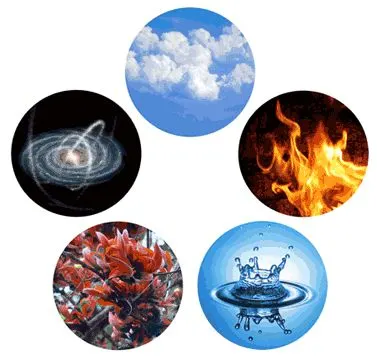
Theory of Pancha Mahabhuta or “five great elements” of Ayurveda are:
Prithvi (Earth)
Jala (Water)
Tejas (Fire)
Pavan (Air )
Akasha (Ether)
Hence, Ayurveda advocates Yat Pinde, Tat Bramhande.
Tridosha Theory
“Tri-doshaTheory”- The central concept of Ayurvedic medicine is the theory that health exists when there is a balance between three fundamental bodily senses of humor or tridoshas called Vata, Pitta and Kapha.
Every person contains all three doshas. However, the proportion varies according to the person, and usually, one or two Doshas are predominant. Within each person, the Doshas are regularly interacting with each other and with the Doshas in all of nature. This explains why a human can have much in similar but also have an endless variety of individual characters in the way they behave and respond to their environment.
In Ayurvedic ideology, the five elements associate in pairs to form three dynamic strength or synergy called “doshas”. Dosha means “that which changes.” word taken from the root dus, which is correlative to the English prefix ‘dys’, such as in dystrophy, dysfunction, etc. In this sense, dosha can be the witness as a fault, error, mistake or an infringement against the cosmic rhythm.
Agni- Digestive Fire
Agni in Sanskrit means fire and is used to describe all metabolic functions in our body.
“A defective fire leads to improper functioning of the tissues which in turn, creates Ama in the gastrointestinal tract and leading to the poor synthesis of tissues.”
Types Of Agni (principles of Ayurveda): According To The function and site of action AGNI HAS BEEN DIVIDED INTO 13 TYPES ACCORDING TO THE FUNCTION AND SITE OF ACTION:
Jatharagni – One Agni present in the stomach and duodenum.
Bhutagni – Five Agni from five basic elements.
Dhatwagni – Seven Agni present, one in each of the seven dhatus-tissues
What is PRAKRUTI
According to Ayurveda, Prakriti or the distinctive personality of an individual is driven by a combination of the Tridoshas – Vata, Pitta, and Kapha.
These three doshas rule a person’s health, diseases, a cure for any illness, etc. It is the blend of these three doshas that makes a person different and unique from others.
As per the Ayurveda text following are the factors, which determine the Prakriti of the fetus:
Time and season during the conception.
Doshic dominance in the uterus.
The condition of the sperm and ovum.
Maternal food and lifestyle.
Tryo Stambh (Three Pillers) of Ayurveda
Food (Diet)
Sleep (Mental Wellness), Nidra
Proper Management of Sexual Energy
Apart from above three main Piller, LifeStyle also play an important role for a healthy life ( Seasonal regimen (Ritu Charya) and daily regimen (Din Charya), Biological Clock
Shilajit has become one of the most sought-after natural wellness supplements due to its traditional use in Ayurveda and its rich content of fulvic acid, minerals, and bioactive compounds. As demand grows, numerous brands now offer Shilajit through online platforms. However, not all products available online meet the same standards of quality, purity, and authenticity. […]
Trikatu Powder is one of the most powerful and widely used formulations in Ayurveda. The word “Trikatu” means “three pungent herbs,” and this classical blend is known for improving digestion, metabolism, and respiratory health. It has been used for centuries as a natural bio-enhancer that helps the body absorb nutrients more effectively. Today, Trikatu Powder […]
Amla Powder is a natural herbal powder prepared from the dried fruits of Phyllanthus emblica, commonly known as Indian Gooseberry. Revered in Ayurveda for centuries, Amla is considered one of the most important Rasayana (rejuvenating) herbs. It is widely used to support overall health, wellness, digestion, immunity, hair health, and skin nourishment. Rich in naturally […]




Read More
Top Factors to Check Before Ordering Shilajit Online
Shilajit has become one of the most sought-after natural wellness supplements due to its traditional use in Ayurveda and its rich content of fulvic acid, minerals, and bioactive compounds. As demand grows, numerous brands now offer Shilajit through online platforms. However, not all products available online meet the same standards of quality, purity, and authenticity. […]
Read More
Trikatu Powder: Complete Guide to Ingredients, Benefits, Uses, and Safety
Trikatu Powder is one of the most powerful and widely used formulations in Ayurveda. The word “Trikatu” means “three pungent herbs,” and this classical blend is known for improving digestion, metabolism, and respiratory health. It has been used for centuries as a natural bio-enhancer that helps the body absorb nutrients more effectively. Today, Trikatu Powder […]
Read More
Amla Powder: Benefits, Uses, Nutrition, How to Use, Safety, and Complete Guide
Amla Powder is a natural herbal powder prepared from the dried fruits of Phyllanthus emblica, commonly known as Indian Gooseberry. Revered in Ayurveda for centuries, Amla is considered one of the most important Rasayana (rejuvenating) herbs. It is widely used to support overall health, wellness, digestion, immunity, hair health, and skin nourishment. Rich in naturally […]