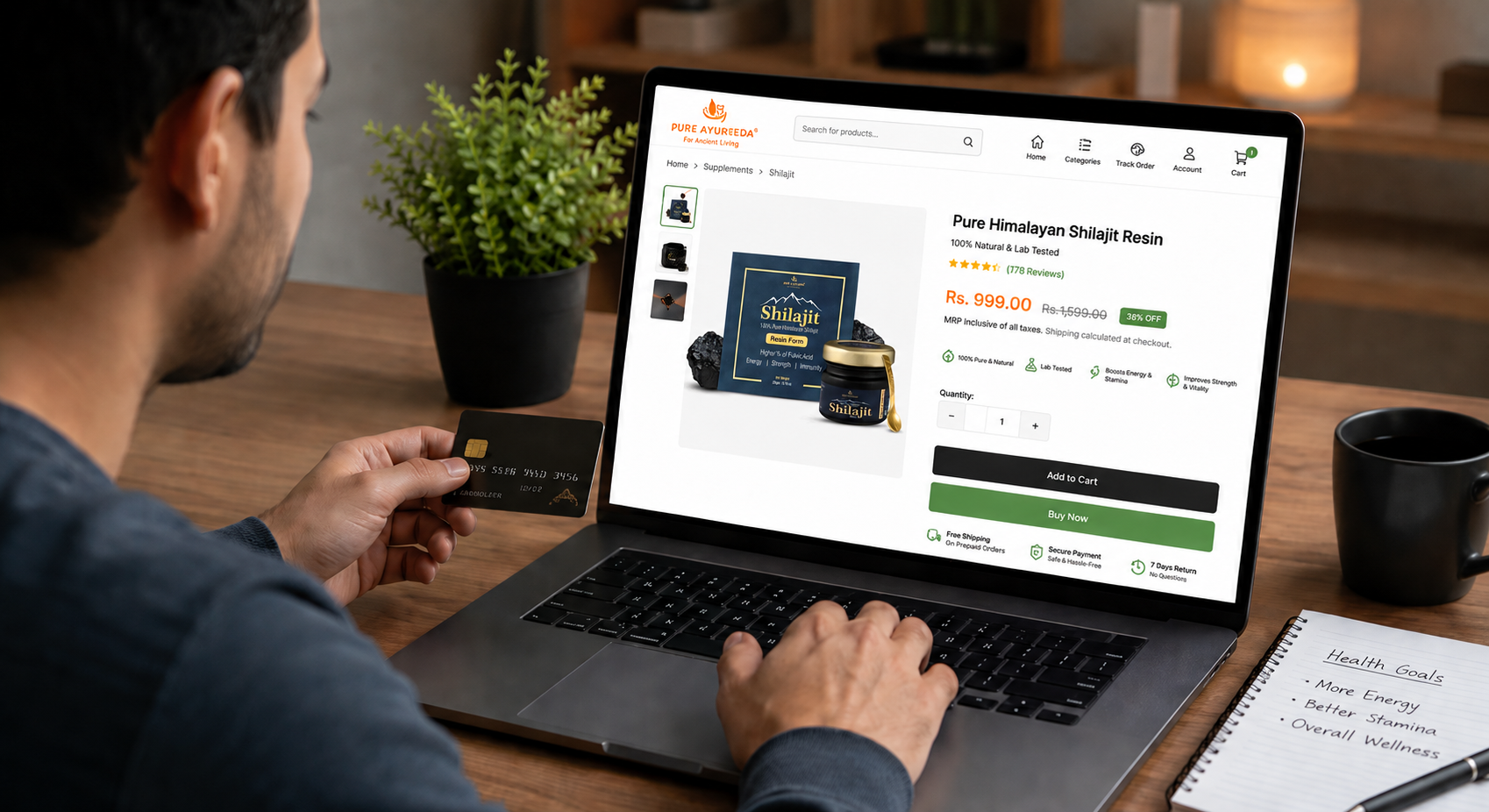
Buying Shilajit online can be confusing. Many products claim to be 100% pure, natural, Himalayan, or lab-tested, but how can you know whether a product is genuine and safe to use?
The truth is that you cannot confirm original Shilajit through colour, smell, texture, or a simple home test alone. These characteristics may provide clues, but they cannot establish the product’s identity, purity, or safety. Reliable product documentation and appropriate laboratory testing are much more useful when evaluating Shilajit.
In this guide, we explain how to identify original Shilajit, understand the difference between real and fake products, check laboratory reports, recognise common warning signs, and make a more informed purchase in India.
What Is Original Shilajit?
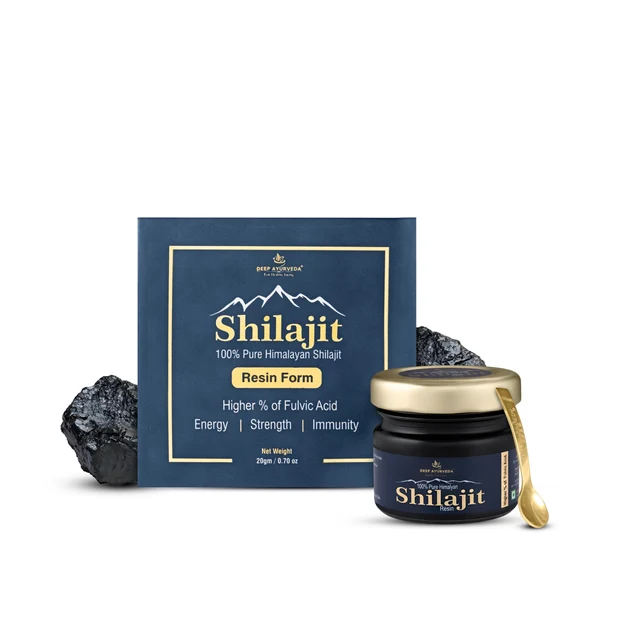
Shilajit is a naturally occurring, mineral-rich substance found in mountainous regions, including the Himalayas. It develops through complex natural processes involving organic material and geological conditions over long periods.
In traditional Ayurveda, Shilajit is known as a substance used in various formulations. Modern scientific research has investigated some of its constituents, but evidence for individual health benefits remains limited for many proposed uses.
Shilajit is available in several forms, including resin, powder, capsules, and tablets. The quality of these products can vary depending on their source, processing, purification, storage, and manufacturing practices.
It is important to understand three different terms:
- Genuine Shilajit: A product that genuinely contains Shilajit rather than an unrelated substance sold under that name.
- Purified Shilajit: Shilajit that has undergone a suitable purification process to remove unwanted materials.
- Quality-tested Shilajit: A product supported by credible testing for specified identity, quality, and safety parameters.
These terms are related, but they do not mean the same thing. A product may contain genuine Shilajit without having adequate evidence of purification or safety.
How to Identify Original Shilajit: 7 Important Checks
If you are planning to buy Shilajit in India, use the following checks to assess the product before making a purchase.
1. Check the Manufacturer and Product Source
Start by checking who manufactures and sells the product.
A responsible manufacturer should provide clear information about the company, product identity, manufacturing or marketing details, and a way to contact the seller.
Look for:
- A clearly identified manufacturer or responsible business.
- Complete product labelling and ingredient information.
- A batch or lot number.
- Manufacturing and expiry or best-before details, as applicable.
- Relevant licence or registration details where required by the applicable regulations.
- Information about the source and purification process, where available.
Be cautious when a seller provides no identifiable business information or makes impressive purity claims without supporting evidence.
Expert tip: A product’s country or mountain-region origin does not automatically prove that it is pure or safe. Traceability and quality evidence matter more than geographical claims alone.
2. Examine the Colour and Texture
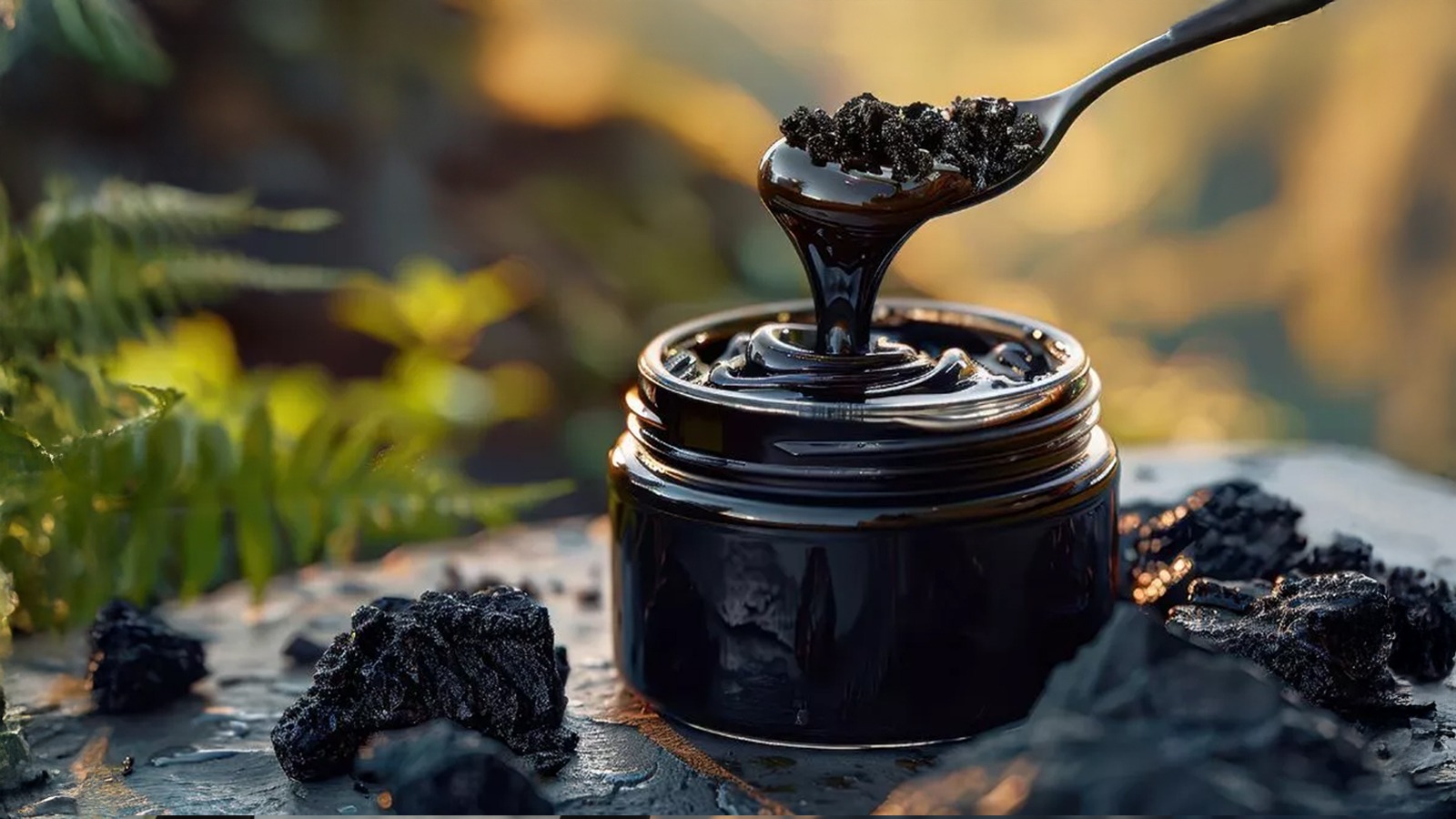
Original Shilajit resin is commonly dark brown to black and may have a thick, sticky, or tar-like appearance. Its consistency can change with temperature and storage conditions.
However, natural variation is possible. Colour and texture may differ depending on the source, processing, formulation, and storage.
When examining a resin product, consider whether its appearance is consistent with the product description and whether the packaging appears intact.
Do not assume that every dark resin is genuine or that a lighter-coloured product must be fake. Other substances can resemble Shilajit, and appearance alone cannot establish identity.
3. Understand the Warm Water Solubility Test
One of the most frequently discussed home checks is dissolving a small amount of Shilajit resin in warm water.
Shilajit resin may disperse or dissolve in water, producing a dark-coloured solution. However, the result can depend on the product’s composition, the water temperature, the amount used, and the formulation.
A home water test cannot determine whether a product contains contaminants, whether it has been properly purified, or whether it contains the amount of Shilajit claimed on the label.
What does this test tell you?
It may provide a basic observation about the product’s behaviour in water. It does not prove that the product is original.
Avoid treating a clear solution, dark solution, or absence of visible residue as definitive evidence of purity.
4. Check the Product Label and Packaging
Packaging and labelling are important parts of product verification, especially when purchasing Shilajit online.
Before buying, check the following:
- Product name and dosage or serving information, as applicable.
- Complete ingredient list.
- Manufacturer or responsible business details.
- Batch or lot number.
- Manufacturing and expiry or best-before information, where applicable.
- Storage instructions and warnings.
- Relevant regulatory details, where required.
- Contact information for product-related questions.
When buying online, compare the product information on the seller’s website with the information on the actual packaging, if photographs or documentation are available.
Damaged seals, inconsistent batch information, missing details, or packaging that differs significantly from the manufacturer’s verified product information deserve further investigation.
However, good packaging is not proof of authenticity. Counterfeit products can also be packaged professionally.
5. Ask for a Certificate of Analysis (COA)
A Certificate of Analysis, commonly called a COA, is a laboratory document that reports the results of specified tests performed on a sample.
For Shilajit, a relevant COA can be more informative than appearance-based home tests because it provides evidence about the parameters actually examined.
When reviewing a report, check:
- Product identity: Does the report identify the product or material tested?
- Batch number: Does it match the batch number on the product you intend to buy?
- Laboratory identity: Is the testing laboratory clearly identified and independently verifiable?
- Testing date: Is the report sufficiently recent and relevant to the product batch?
- Test methods: Are the methods and parameters described clearly?
- Actual results: Are measured values provided rather than only a general statement such as passed?
- Applicable limits: Can the results be compared with relevant specifications or regulatory requirements?
A report for a different batch, an unidentified sample, or a generic raw ingredient may not establish the quality of the finished product being sold.
Similarly, a document labelled lab-tested does not automatically mean that every important contaminant has been tested.
6. Check Heavy-Metal and Microbiological Testing
Shilajit quality assessment should consider potential contaminants as well as product identity.
Depending on the product, its source, and applicable requirements, relevant testing may include heavy metals such as lead, arsenic, mercury, and cadmium, along with microbiological parameters.
Why does this matter?
Some contaminants cannot be detected reliably through colour, smell, taste, or texture. A product may look normal while still presenting a quality or safety concern.
When reviewing laboratory results, look for actual measured values, appropriate test methods, and relevant acceptance criteria. A qualified professional or laboratory can help interpret results where the meaning is unclear.
Do not assume that a product is safe simply because one contaminant was tested or because a report mentions fulvic acid.
Important: A credible report provides evidence only for the sample, parameters, and testing conditions it covers. It is not an automatic guarantee of every aspect of product quality.
7. Verify the Purification Process and Product Traceability
Raw materials and finished supplements are not necessarily equivalent. The source material, purification process, manufacturing controls, and storage conditions can all influence the final product.
When assessing a Shilajit product, look for information about:
- How the material is sourced and identified.
- Whether a documented purification process is used.
- How batches are tracked during manufacturing.
- Whether finished-product testing is conducted.
- How the manufacturer maintains quality and consistency.
A company that can explain its quality-control process and provide relevant, verifiable documentation gives consumers more useful information than one relying only on words such as premium, natural, or 100% pure.
Original vs Fake Shilajit: Key Differences
The following table can help you compare products more carefully.
| Check | What to look for | What it cannot prove alone |
|---|---|---|
| Colour | Appearance consistent with the product description | Genuine identity or purity |
| Texture | Consistency appropriate to the product form | Absence of adulterants |
| Water behaviour | Observed dispersion or dissolution | Safety or contaminant levels |
| Packaging | Intact seal and consistent product information | Authenticity |
| Manufacturer | Identifiable and traceable business | Quality of every batch |
| COA | Verifiable report with relevant test results | Parameters that were not tested |
| Heavy-metal testing | Actual results compared with applicable limits | Complete product safety by itself |
| Batch traceability | Match between product and supporting records | Quality if the underlying records are unreliable |
The key takeaway is that no single physical sign can reliably distinguish every genuine product from every counterfeit or adulterated product.
The strongest approach is to combine manufacturer verification, traceability, appropriate testing, and careful review of the product documentation.
How to Test Original Shilajit at Home
Many online guides recommend water, heating, burning, taste, and smell tests. These methods are often presented as simple ways to distinguish original Shilajit from fake products.
However, their limitations are important.
Water Test
Shilajit resin may dissolve or disperse in warm water, but this behaviour is not unique enough to establish authenticity. Other substances may also dissolve or disperse.
Texture and Temperature Test
The consistency of resin can change with temperature. This observation may help you understand the product’s physical characteristics, but it cannot confirm its identity or safety.
Smell Test
A product may have a characteristic earthy or mineral-like odour, but smell varies and is subjective. It is not a reliable authenticity test.
Burning or Flame Test
Burning an unknown supplement is not recommended as a consumer authenticity test. It can create unnecessary exposure to smoke or fumes, and the result cannot establish whether a product is safe.
Taste Test
Do not taste an unknown or suspicious product to determine whether it is genuine. Taste is subjective and cannot identify heavy metals, microbial contamination, or other potentially harmful substances.
The safest conclusion: Home observations are not substitutes for credible product documentation and appropriate laboratory testing.
How to Read a Shilajit Laboratory Report
For buyers who want to make a more informed decision, understanding a laboratory report is one of the most useful steps.
Imagine that a seller provides a COA stating that a sample passed heavy-metal testing.
Before relying on that claim, ask four questions:
1. Was the tested sample from the same batch?
A report should be traceable to the product or batch you are buying. A report for an unrelated sample may not represent the product in your package.
2. Which substances were tested?
Check whether the report lists the relevant contaminants rather than using only a broad statement such as “tested for purity.”
3. What were the actual results?
A useful report should provide measured values or clearly documented results. Where appropriate, these should be compared with applicable limits.
4. Can the report and laboratory be verified?
Check the laboratory’s identity, its relevant testing scope and accreditation where applicable. Accreditation should be relevant to the particular tests, not assumed to cover every service a laboratory offers.
Remember that a laboratory report should be evaluated in context. A report can support a quality claim without proving every claim made in the product’s advertising.
Warning Signs When Buying Shilajit in India
Be cautious if you encounter any of the following:
- Claims that Shilajit cures multiple diseases or guarantees specific results.
- A seller who cannot identify the manufacturer.
- Missing or inconsistent batch information.
- A generic laboratory certificate that cannot be linked to the product.
- Unsupported claims that the product is free from every contaminant.
- Packaging or product information that conflicts with the manufacturer’s verified details.
- Pressure to purchase immediately based on exaggerated health promises.
A low price, unusual colour, or unfamiliar brand name does not by itself prove that a product is fake. Evaluate the available evidence rather than making a decision based on one characteristic.
If you suspect that a product is counterfeit, adulterated, or improperly labelled, avoid using it until the concern has been resolved. Keep the packaging, batch details, purchase receipt, and any relevant documentation so that you can contact the seller or appropriate authorities.
How to Buy Original Shilajit Online in India
Before ordering Shilajit from an online store, marketplace, or brand website, use this checklist.
- Verify the seller and manufacturer.
- Read the complete ingredient list and product label.
- Check the batch or lot information and packaging details.
- Look for relevant, verifiable laboratory reports.
- Review the parameters tested and the actual results.
- Check whether the product’s claims are supported by credible evidence.
- Follow the product’s storage instructions and applicable usage warnings.
If important information is missing, ask the seller for clarification before buying.
Do not choose a product solely because it has attractive packaging, many positive reviews, a high advertised fulvic acid percentage, or a claim of Himalayan origin. None of these factors alone establishes authenticity or safety.
Is Original Shilajit Always Safe?
No. Genuine origin does not automatically mean that a Shilajit product has been adequately purified, correctly manufactured, or tested for relevant contaminants.
Safety also depends on product quality, the amount used, individual health circumstances, and potential interactions with medicines.
People who are pregnant or breastfeeding, those with existing medical conditions, and those taking regular medication should consult an appropriately qualified healthcare professional before using Shilajit. Children should not be given supplements without appropriate medical guidance.
Avoid products making claims that Shilajit can replace prescribed treatment or guarantee improvements in testosterone, fertility, energy, or other health outcomes.
For any supplement, follow applicable label directions and seek professional advice if you experience an adverse reaction.
Final Thoughts
Identifying original Shilajit requires more than checking its colour, texture, smell, or behaviour in water. These commonly discussed home tests have important limitations and cannot establish that a product is pure or safe.
For consumers in India, a more informed approach is to verify the manufacturer, check product traceability, understand the purification process, and review credible laboratory reports for relevant quality and safety parameters.
The most important rule is simple: do not confuse a product that looks genuine with one whose quality and safety have been adequately verified.
When buying Shilajit, choose transparency and verifiable evidence over exaggerated claims. A responsible purchasing decision begins with asking the right questions before using the product.
Frequently Asked Questions About Original Shilajit
How can I identify original Shilajit?
Check the manufacturer’s identity, product traceability, batch information, purification details, and relevant laboratory reports. Colour, texture, smell, and water behaviour may provide clues but cannot prove authenticity or safety.
How can I check Shilajit purity at home?
There is no reliable home test that can conclusively establish Shilajit purity or detect all relevant contaminants. Use home observations cautiously and look for appropriate, verifiable laboratory testing.
Does original Shilajit dissolve in water?
Shilajit resin may dissolve or disperse in warm water, depending on its composition and conditions. This behaviour alone cannot confirm that a product is genuine or pure.
What colour is original Shilajit?
Shilajit resin is commonly dark brown to black, but colour can vary. Colour alone cannot reliably establish authenticity.
Can fake Shilajit look real?
Yes. A product can resemble genuine Shilajit in appearance and texture without having verified identity, adequate purification, or acceptable contaminant levels.
Is Himalayan Shilajit always pure?
No. A claim of Himalayan origin does not automatically establish purity, quality, or safety. Manufacturing controls and appropriate testing remain important.
How do I check a Shilajit lab report?
Check the product and batch identity, laboratory details, testing date, test methods, actual results, and relevant limits. Verify the report with the laboratory or manufacturer when possible.
Can original Shilajit contain heavy metals?
The fact that a substance is genuine does not establish that it is free from contaminants. Relevant laboratory testing is needed to assess specified heavy metals and other quality parameters.
Is Shilajit resin more authentic than capsules?
Not necessarily. Product form alone does not prove authenticity. Both resin and capsules should be assessed through reliable manufacturer information, traceability, and appropriate quality testing.
What should I do if I suspect my Shilajit is fake?
Stop using the product while you investigate. Retain the packaging, batch number, receipt, and supporting documents. Contact the seller or manufacturer and seek advice from the relevant consumer or regulatory authority if necessary.