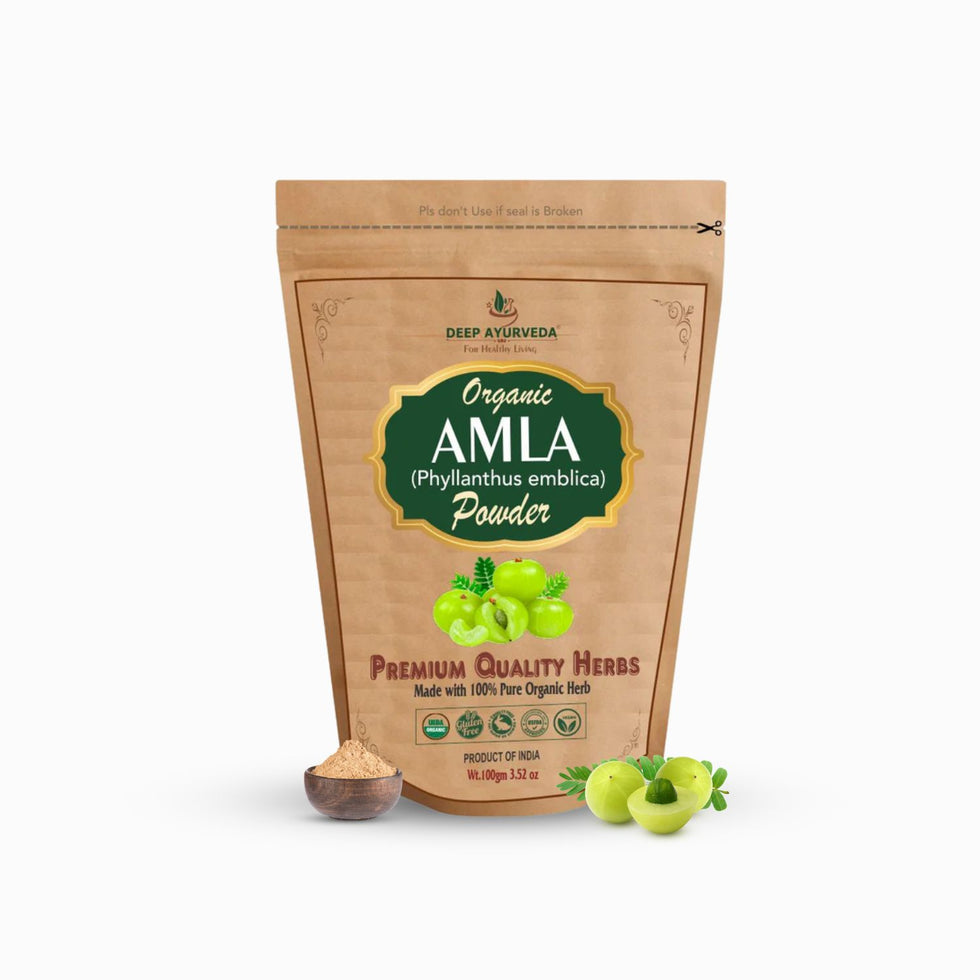
Deep Ayurveda Organic Amla Powder
✅ 100% Natural ✅ Lab-Tested ✅ Rich in Vitamin C ✅ Supports Digestion ✅ Enhances Hair & Skin Health ✅ Properties Natural Detoxifier
Amla, or Indian gooseberry, is known as one of the most extraordinary superfoods, both in traditional and modern health. It is rich in vitamin C, antioxidants and other important nutrients. Evidence from several scientific studies has shown how Amla plays an important role in boosting our immune systems and improving skin as well as promoting hair growth. In this article, we will explore Top 15 Science-Backed Benefits of Amla for Health, Skin & Hair, so read it till the end.
What is Amla?
Amla, commonly known as Indian gooseberry, is a small, round green-yellow fruit from Phyllanthus emblica tree. It is found mainly in India, widely grown across South and Southeast Asia, where it has been used for thousands of years in Ayurvedic medicine as a rejuvenating “rasayana” herb. It has a sour and slightly bitter taste but is loaded with nutrients like:
- Vitamin C (higher than oranges)
- Anti-inflammatory compounds
- Polyphenols and flavonoids
- Fiber and essential minerals
These nutrients work together to protect cells, boost immunity and improve skin and hair health.
Top 15 Science-Backed Amla Benefits for Health, Skin & Hair
1. Enhances the immune system
Research conducted on humans and animals has shown that amla increases the body’s natural antioxidant capacity and has an immunomodulatory effect, improving resistance to infection. People who take amla regularly have been shown to experience fewer cold-like illnesses and more resistance to oxidative damage.
2. Lowers blood glucose levels
Clinical studies with standardized amla extracts have shown that amla reduces fasting blood glucose levels and some indices of glycemic control from 3 weeks to 12 weeks. The effect size observed seems small but has been found to be consistent. The effects are enhanced by making lifestyle changes.
3. Improves cholesterol and heart health
Meta-analyses comparing amla to placebo show that amla supplementation decreases total cholesterol, low-density lipoprotein (LDL or bad) cholesterol as well as triglycerides and C-reactive protein (CRP, a marker of inflammation) and increases high-density lipoprotein (HDL or good) cholesterol. In one randomized placebo-controlled trial involving 98 patients with dyslipidemia, amla-treated patients experienced the same degree of cardiovascular risk reduction as with standard statin agents as measured by the amount of cardiovascular risk factor reduction over the course of a 6–12 week period.
4. Blood Pressure Control
In a clinical study of patients with unregulated hypertension (high blood pressure), the addition of Emblica officinalis extracts to the usual antihypertensive (blood-pressure-lowering) medication resulted in a statistically significant decrease (p<0.001) in both systolic and diastolic blood pressure after 8 weeks of treatment. This suggests that the addition of Emblica officinalis extract as an adjunctive agent may play a role in controlling overall BP levels but will not replace all other blood pressure-lowering medications.
5. Good for Liver
As per some studies, Emblica officinalis appears to protect the liver from oxidative stress and from damage due to toxins, in part by enhancing the body’s own antioxidant enzymes. Some evidence suggests that Emblica officinalis may also assist with mild metabolic-related stresses on the liver. However, the use of Emblica officinalis is not a substitute for substitute for medical treatment in advanced disease.
6. Supports Digestive & Intestinal Lining
The polyphenolic and tannin components of Emblica officinalis have shown anti-inflammatory and mild-to-moderate antimicrobial effects within the gastrointestinal (GI) system. So, these components may provide soothing relief from mild gastric irritations and may assist with maintaining the integrity of the intestinal barrier. Traditional Ayurvedic formulas have long used Emblica officinalis as a digestive aid and a way to reduce gas or acid-related discomfort.
7. Reduced Inflammation
Many studies have shown that Emblica officinalis reduces levels of the inflammatory disease marker CRP (C-Reactive Protein) while simultaneously reducing the amount of low-grade inflammation in the body. This is relevant for other diseases, including chronic metabolic syndrome, early diabetes, and those at risk for future cardiovascular diseases.
8. Anti-aging and antioxidant properties
With high levels of Vitamin C and polyphenols, amla helps scavenge free radicals and may slow down oxidative damage to DNA and proteins. This may be why there are so many claims for the anti-aging effects of amla regarding skin and health.
9. Promotes Glowing Skin
Research using cell cultures have shown that amla juice or powder topically applied, inhibit the enzymes that produce melanin, thus promotes glowing skin. Vitamin C also helps to stimulate collagen production and adds to brightness when used regularly as a mask or diluted in juice form.
10. Reduces acne & Pimples
Due to the anti-inflammatory and mild antibacterial properties of amla, it can help reduce comedonal and inflammatory acne lesions as shown in both lab studies as well as in traditional uses. Masks made from mixing amla powder with water or honey can reduce redness, as well as dark spots resulting from acne.
11. Improves collagen production and elasticity
Amla is a potent source of Vitamin C, which promotes collagen production by dermal cells. By producing more collagen, the dermal layer of skin will be firmer and have better elasticity, which will result in less fine lines, plus provide stronger, more durable skin over time.
12. Supports healthy scalp and reduces dandruff
Topically applying either amla oil or powder results in improved antioxidant status for the scalp, and may help to reduce flakiness and irritation of the scalp. The mild astringency of amla helps to balance the natural oils in the scalp without causing dryness.
13. Stimulates Hair Growth & Density
In 2020, a clinical trial showed in 90 days that daily use of a serum with amla-based ingredients significantly increased hair growth and its density among individuals experiencing thinning of the hair. Earlier studies on enzyme inhibition indicated that amla could work against mechanisms related to androgen-pattern thinning of the hair.
14. Strengthens Hair Shaft & Reduces Hair Breakage
Amla’s vitamin C and polyphenols support collagen that surrounds the hair follicles, providing strength to the hair cuticle and possibly reducing split ends and breakage of the hair. Individuals who use oil having either amla or an amla-based oil regularly report having shinier and less brittle hair.
15. Reduces Premature Ageing of Hair
Amla’s antioxidant quality protect the melanocytes (hair follicle pigment producing cells) in hair follicles from oxidative stress which is a primary cause of premature greying of the hair. Laboratory studies on humans have been limited, but regular use and the mechanism of action suggest that amla is a supportive therapy for early greying.
How to use Amla daily
| Amla | Usage | Good for |
| Amla Juice | Drink 20 ml in 1 glass warm water on an empty stomach in the morning. | Immunity and gentle detox. |
| Raw Amla | Eat 1 or 2 fresh amla daily, preferably in the morning or before a meal. | Overall health, digestion, and good for eyes too. |
| Amla Powder | Mix half tea spoon amla powder in warm water or with honey and drink on an empty stomach or before meals. | Digestion, immunity & antioxidant support. |
| Amla Oil | Massage amla oil into the scalp three times a week, leave for 30 minutes, then wash. | Hair growth, thickness & scalp health |
Final Words
With the many benefits that have been noted by science as proof, amla is one of the most nutritious foods around and can be used as part of your daily routine to help you with a variety of things including improved digestion, boosted immunity, enhancing glow on the face, or having stronger hair, among others. Due to its natural healing properties backed by both traditional wisdom and modern science, it is really one of the best superfoods available to you, and should therefore be use for improved health and wellness overall.
FAQ’s
How can I eat amla on a daily basis?
To eat amla on a daily basis it is depend on your preferences and health goals. You can consume amla as fresh fruit, juice, powder, or dried.
Is it safe to eat amla daily?
For most healthy person, using amla daily in small amounts considered safe and helpful.
Is amla good for skin?
Yes, amla is good for skin as it promotes glowing skin. It also helps in reducing pimples and acne on face.
Does amla help in hair growth and grey hair?
Amla is good for strengthening, adding shine to your hair and reducing its chances of breaking. It could also slow early greying and support hair growth, but changes take time and are not instant.
References:
- https://pubmed.ncbi.nlm.nih.gov/31890983/
- https://pubs.rsc.org/en/content/articlehtml/2022/fo/d2fo01862d
- https://onlinelibrary.wiley.com/doi/10.1155/2020/8592869
- https://pmc.ncbi.nlm.nih.gov/articles/PMC9137578/
- https://pubmed.ncbi.nlm.nih.gov/36934568/
- https://voldox.com/blogs/news/the-power-of-amla-a-natural-boost-for-skin-hair-and-health
- https://upakarma.com/blogs/health-update/top-15-benefits-of-amla-juice-for-hair-skin
- https://www.truebasics.com/blog/amla-benefits-for-skin-everything-you-should-know/