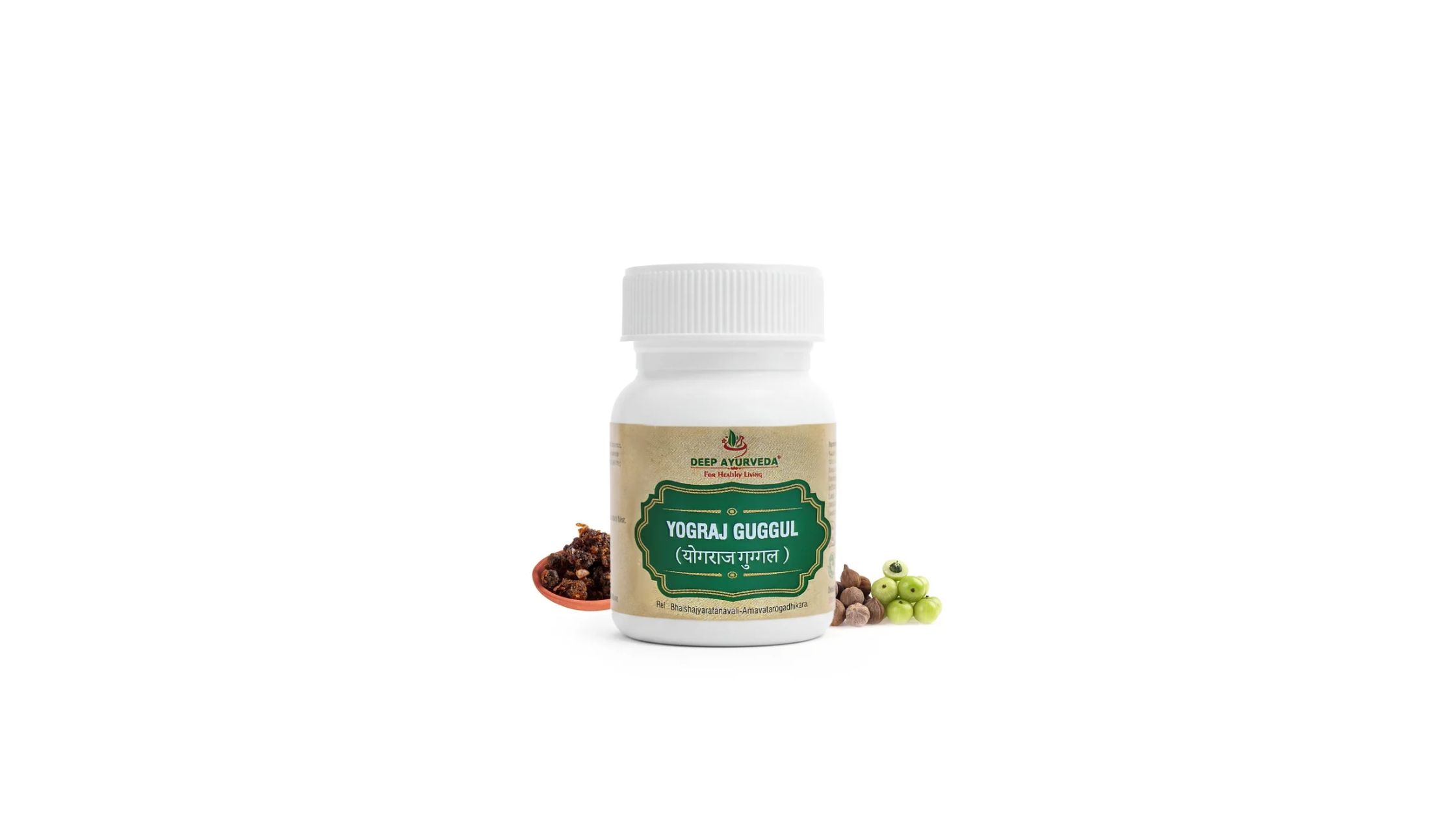

Deep Ayurveda Yograj Guggulu
✅ 100% Ayurvedic & Safe ✅ Supports joint comfort and mobility ✅ May support everyday movement ✅ Traditionally used for stiffness and joint discomfort ✅
Yograj Guggul, also known as Yogaraja Guggulu, is a classical Ayurvedic polyherbal formulation traditionally used in the management of Vata-related conditions, particularly those involving the joints, muscles and musculoskeletal system. It is a multi-herb formulation in which Guggulu is combined with several herbs traditionally described for supporting digestion, metabolism and Vata balance.
However, understanding Yograj Guggul requires more than simply looking at a list of claimed benefits. Its classical ingredients, Ayurvedic rationale, traditional applications, dosage, anupana (vehicle), individual suitability and safety considerations all play an important role.
Modern research is also beginning to investigate Yograj Guggulu more closely. A 2025 multicentre study involving 483 people with knee osteoarthritis evaluated Yograj Guggulu alongside Ashwagandha Churna and Narayana Taila, while a 2026 experimental study investigated possible molecular mechanisms of Yograj Guggulu in an animal model of osteoarthritis. These findings are interesting, but they should be interpreted according to the type and limitations of the evidence rather than treated as proof that the formulation can cure a disease.
In this guide, we will explore what Yograj Guggul is, its traditional Ayurvedic uses, ingredients, potential benefits, how dosage is approached, safety considerations and what current research actually tells us.
What Is Yograj Guggul?
Yograj Guggul is a traditional Ayurvedic formulation made from multiple herbal ingredients with Guggulu resin as an important component.
In Ayurvedic practice, formulations are generally selected according to the individual’s overall presentation rather than simply matching a medicine to the name of a modern disease. Factors such as Dosha involvement, Agni (digestive and metabolic function), Ama, the nature of symptoms, age, strength and associated conditions may all be considered.
Yograj Guggul is traditionally associated particularly with Vata-related musculoskeletal complaints, including situations characterised by stiffness, discomfort and restricted movement.
The formulation is also described in Ayurvedic literature and is listed in the Ayurvedic Formulary of India. Recent scientific literature describes Yograj Guggulu as a 29-ingredient Ayurvedic polyherbal formulation and identifies its traditional association with degenerative joint conditions such as Sandhivata.
Yograj Guggul, Yogaraja Guggulu or Yograj Guggulu?
You may see the formulation written in several ways, including:
- Yograj Guggul
- Yogaraja Guggulu
- Yograj Guggulu
- Yogaraj Guggul
These names are commonly used when referring to the same classical Ayurvedic formulation, although the actual composition, strength and directions can vary between commercial products.
Therefore, consumers should always check the ingredient list and dosage instructions of the specific product rather than assuming that every product sold under a similar name has exactly the same composition.
How Does Yograj Guggul Fit Into Ayurvedic Practice?
One of the most important differences between an Ayurvedic approach and a simple symptom-based approach is that Ayurveda does not necessarily treat every person with the same symptom in exactly the same way.
For example, two people may both complain of knee discomfort, but their overall presentations may be different.
One person may experience:
- stiffness
- dryness
- reduced mobility
- constipation
- irregular digestion
while another may have:
- swelling
- heaviness
- warmth
- digestive sluggishness
- a different Dosha pattern
From an Ayurvedic perspective, these differences can influence the choice of formulation and supportive measures.
The role of Vata
Yograj Guggul is traditionally associated with Vata-related disorders. In Ayurveda, aggravated Vata is commonly discussed in relation to movement, dryness, stiffness and pain.
This does not mean that every type of joint pain is automatically a Vata disorder. An Ayurvedic practitioner considers the complete symptom pattern before deciding whether a particular formulation is appropriate.
The importance of Agni and Ama
Another useful concept is Agni, which broadly refers to the body’s digestive and metabolic processes.
Ayurvedic descriptions also discuss Ama, a concept associated with incompletely processed or accumulated metabolic material.
Several herbs traditionally included in Yograj Guggul have Deepana and Pachana properties in Ayurvedic terminology. In simple terms, these properties are traditionally associated with supporting digestion and metabolic processing.
This is one reason why Yograj Guggul should not be viewed merely as a joint pain tablet. Its classical formulation reflects a broader Ayurvedic approach.
Yograj Guggul Ingredients
The classical Yogaraja Guggulu formulation contains multiple herbal ingredients. Modern research describes Yograj Guggulu as a 29-ingredient formulation.
The ingredients work together within the traditional formulation rather than functioning as isolated ingredients.
Some commonly discussed ingredients include herbs such as:
- Guggulu
- Chitraka
- Pippali
- Maricha
- Shunthi
- Haritaki
- Bibhitaki
- Amalaki
The complete classical formulation should be referenced from an authoritative Ayurvedic formulation source when preparing a product-specific article, because commercial products may differ in composition, processing and tablet strength.
Why are so many herbs used?
Ayurvedic formulations often combine several ingredients with complementary traditional properties.
In Yograj Guggul, the combination is traditionally intended to address more than one aspect of the individual’s presentation, including:
- Vata balance
- digestive function
- metabolic support
- stiffness
- musculoskeletal discomfort
- general support in selected Vata-related conditions
This multi-ingredient approach is different from using a single botanical extract for one isolated biological pathway.
Traditional Uses of Yograj Guggul
Yograj Guggul has traditionally been used in Ayurveda in situations associated with Vata imbalance and musculoskeletal complaints.
Its traditional applications may include support in:
- joint stiffness
- muscle and joint discomfort
- restricted movement
- selected Vata-related musculoskeletal conditions
- digestive weakness associated with certain Vata presentations
- conditions traditionally described under Vata disorders
It is important to understand that traditional use and clinically proven treatment are not interchangeable terms.
A traditional Ayurvedic indication tells us how a formulation has been used within the Ayurvedic system. Modern clinical evidence requires appropriately designed studies in humans.
Yograj Guggul Benefits: What Does Ayurveda Traditionally Say?
1. Supports Joint Comfort and Mobility
Yograj Guggul is traditionally used in Ayurvedic practice for conditions involving joint stiffness and discomfort, particularly when Vata is considered to be involved.
The formulation’s traditional use is therefore often discussed in relation to maintaining comfortable movement and supporting musculoskeletal function.
However, persistent or severe joint pain should not automatically be self-treated with an Ayurvedic formulation. The underlying cause should first be identified.
2. Traditionally Used for Stiffness
Stiffness is one of the symptoms commonly associated with Vata-related musculoskeletal complaints.
Yograj Guggul’s traditional Ayurvedic profile includes ingredients selected for their warming, digestive and Vata-oriented properties.
This traditional rationale is different from saying that the formulation is a guaranteed treatment for every cause of stiffness.
3. Supports Traditional Vata Management
Vata has an important role in Ayurveda in relation to movement and the musculoskeletal system.
Because Yograj Guggul is traditionally considered a Vata-oriented formulation, Ayurvedic practitioners may consider it in selected Vata-dominant presentations.
The suitability of the formulation depends on the individual’s overall condition rather than the presence of a single symptom.
4. Traditionally Supports Digestion and Metabolic Function
Several ingredients used in classical formulations such as Yograj Guggul are traditionally described as Deepana and Pachana herbs.
These terms relate broadly to supporting digestive capacity and the processing of food and metabolic products.
This is particularly relevant because Ayurveda commonly considers digestive function when managing Vata-related disorders.
5. Traditionally Used in Selected Musculoskeletal Conditions
Classical Ayurvedic practice has associated Yograj Guggul with several Vata-related musculoskeletal presentations.
However, modern disease names such as arthritis, osteoarthritis and rheumatoid arthritis should not simply be treated as direct equivalents of every classical Ayurvedic diagnosis.
This distinction is important when interpreting traditional Ayurvedic literature.
Yograj Guggul for Joint Health: What Does Research Say?
This is one area where newer research provides an interesting addition to the traditional understanding.
A 2025 multicentre study published in the Journal of Ayurveda and Integrative Medicine evaluated an Ayurvedic intervention consisting of Yograj Guggulu, Ashwagandha Churna and Narayana Taila in people with knee osteoarthritis.
The study enrolled 490 participants, with data from 483 participants analysed. Participants were between 40 and 65 years old and were treated for 12 weeks. The researchers reported significant improvements in WOMAC scores, pain scores and selected symptoms, and reported that the intervention was well tolerated.
What is important about this study?
The study is useful because it involved a relatively large number of participants and was conducted across 14 peripheral institutes associated with the Central Council for Research in Ayurvedic Sciences.
But there is an important limitation:
Yograj Guggulu was not tested by itself.
The intervention included:
- Yograj Guggulu
- Ashwagandha Churna
- Narayana Taila
Therefore, the study cannot establish that the improvements were caused by Yograj Guggulu alone.
It was also an open-label, single-arm study, meaning there was no placebo or separate control group for comparison.
This is a good example of why research should be read carefully rather than converted into a simple claim such as Yograj Guggul cures osteoarthritis.
What Does Newer Laboratory Research Suggest?
A 2026 study published in the Journal of Ethnopharmacology investigated Yograj Guggulu using a combination of metabolomics, proteomics and network-based approaches in a rat model of experimentally induced osteoarthritis.
The researchers reported changes involving inflammatory and extracellular-matrix-related molecular pathways and identified several candidate molecular targets associated with the formulation’s effects in that experimental model.
These findings are scientifically interesting because they provide possible clues about how a complex multi-herbal formulation might interact with biological pathways.
However, this was animal research, not a clinical trial in humans.
Therefore, these results should be considered mechanistic or preclinical evidence rather than proof of the same effect in people.
In simple terms
The current evidence can be thought of in three levels:
Traditional Ayurvedic knowledge
→ Explains how Yograj Guggul has traditionally been used.
Human clinical research
→ Provides some evidence from people, but current studies have limitations.
Laboratory and animal research
→ Helps investigate possible mechanisms but cannot by itself establish clinical effectiveness in humans.
Keeping these three levels separate makes the evidence easier to understand and prevents exaggerated health claims.
Yograj Guggul and Sandhigata Vata
In Ayurveda, joint conditions may be understood through concepts such as Sandhigata Vata, particularly when Vata-related features are prominent.
An Ayurvedic assessment may consider symptoms such as:
- joint stiffness
- discomfort during movement
- reduced range of movement
- dryness
- age-related changes
- digestive status
- strength and overall constitution
This does not mean that every person diagnosed with osteoarthritis has exactly the same Ayurvedic presentation.
For this reason, an Ayurvedic practitioner may consider the person’s broader symptom pattern before selecting Yograj Guggul or another formulation.
How to Take Yograj Guggul
There is no single internet dosage that is appropriate for everyone.
The appropriate dose can depend on:
- the exact formulation
- tablet strength
- age
- digestive capacity
- overall health
- other medicines or supplements
- reason for use
- duration of use
- individual Ayurvedic assessment
Classical references and commercial product directions may differ, so consumers should follow the dosage specified for the particular product they are using and seek professional advice when necessary.
When should Yograj Guggul be taken?
The timing can vary depending on the formulation, dose and Ayurvedic advice.
Some Ayurvedic medicines are traditionally administered with a specific Anupana, or accompanying vehicle, because the vehicle may be selected according to the formulation and individual’s requirements.
Therefore, it is better not to assume that one timing or Anupana is suitable for everyone.
How long can Yograj Guggul be taken?
There is no universal duration that applies to every person.
Long-term use should not be based solely on an online article. If you intend to use Yograj Guggul for an extended period, particularly if you have a chronic condition or take prescription medicines, discuss it with a qualified healthcare professional.
Yograj Guggul Side Effects and Safety
Natural does not automatically mean risk-free.
Like other concentrated herbal formulations, Yograj Guggul should be used thoughtfully, particularly when taken for extended periods or alongside other medicines.
Possible concerns may include digestive intolerance or other individual reactions.
The 2025 multicentre study mentioned above reported that the studied combination was well tolerated and that no adverse events were reported among the analysed participants. However, this does not establish that adverse effects are impossible in every person or during every duration of use.
Who should seek professional advice before using Yograj Guggul?
Extra caution is appropriate for:
- pregnant women
- breastfeeding women
- children
- older adults with multiple medicines
- people with chronic medical conditions
- people taking prescription medicines
- people with significant digestive complaints
- people planning long-term use
- anyone experiencing unexplained or severe joint pain
If symptoms are severe, sudden, associated with significant swelling or fever, follow an appropriate medical evaluation rather than relying on self-medication.
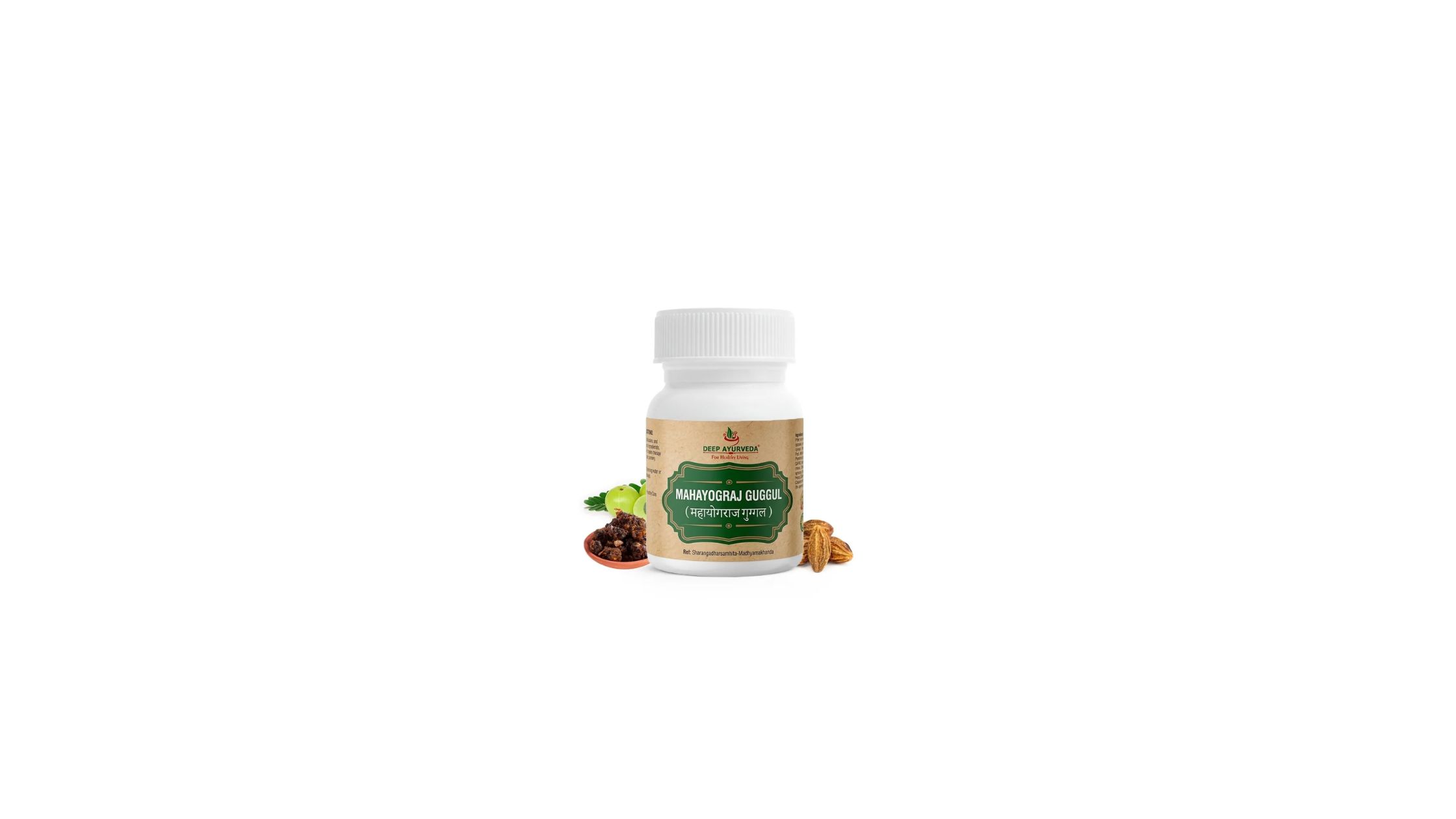
Yograj Guggul vs Mahayograj Guggul
Yograj Guggul and Mahayograj Guggul should not automatically be considered the same formulation.
Although their names are similar and both are associated with Ayurvedic practice, their classical compositions and therapeutic contexts are different.
| Aspect | Yograj Guggul | Mahayograj Guggul |
|---|---|---|
| Formulation | Distinct Ayurvedic formulation | Distinct Ayurvedic formulation |
| Composition | Formulation-specific | Formulation-specific |
| Traditional application | Mainly discussed in Vata-related contexts | Depends on its own classical formulation and indication |
| Interchangeable? | Not automatically | Not automatically |
The word Maha in a product name should not be interpreted as meaning that one formulation is simply a stronger version of another.
When choosing between formulations, the relevant factors include the person’s symptoms, Ayurvedic assessment, product composition and professional advice.
Who May Be Suitable for Yograj Guggul?
Rather than asking only Who should take Yograj Guggul?, a more useful Ayurvedic question is:
For which type of presentation might this formulation be considered?
A practitioner may consider factors such as:
Vata-related features
For example, stiffness, dryness and movement-related discomfort may be considered within a Vata-oriented assessment.
Digestive status
Agni and Ama are important considerations in traditional Ayurvedic assessment.
Age and strength
An elderly person and a young adult may not have the same requirements even if their symptoms appear similar.
Existing conditions
Underlying medical conditions can affect whether a formulation is appropriate.
Current medicines
Herbal medicines and prescription medicines may need to be considered together.
This is why a product that is traditionally used for a particular condition should not automatically be assumed to be suitable for everyone with the same modern diagnosis.
How to Choose a Yograj Guggul Product
If you are comparing different Yograj Guggul products, don’t look only at the number of tablets in the bottle.
Check:
1. The ingredient list
Confirm what is actually included in the product.
2. Tablet strength
Two products can have different strengths even when their names are similar.
3. Manufacturer information
Choose products with clear manufacturing and product information.
4. Batch and expiry details
Always check the batch number and expiry date.
5. Directions for use
Follow the instructions for the specific formulation rather than copying a dosage from another website.
6. Quality and regulatory information
Look for appropriate manufacturing and quality information provided by the manufacturer.
Common Mistakes People Make With Yograj Guggul
Mistake 1: Taking it for every type of joint pain
Joint discomfort can have many causes. A single Ayurvedic formulation should not be assumed to be appropriate for every cause.
Mistake 2: Assuming Yograj and Mahayograj are the same
They are distinct formulations and should not automatically be substituted for one another.
Mistake 3: Copying a dosage from the internet
Dosage should take the specific product, strength and individual circumstances into account.
Mistake 4: Assuming natural means completely safe
Herbal medicines can have unwanted effects and may not be suitable for everyone.
Mistake 5: Treating animal research as human clinical proof
Laboratory and animal studies can provide valuable mechanistic information, but they do not establish the same outcome in humans.
Mistake 6: Ignoring digestion
From an Ayurvedic perspective, digestion and Agni can be important parts of assessing Vata-related conditions.
Mistake 7: Using a formulation indefinitely without review
Long-term use should be periodically reassessed, especially when other medicines or health conditions are involved.
Final Perspective
The value of an Ayurvedic formulation is best understood within the context in which Ayurveda traditionally uses it.
Rather than asking only, What disease does Yograj Guggul cure?, a more meaningful question is:
For what type of individual and symptom pattern has this formulation traditionally been considered, and what does current evidence actually tell us about it?
That distinction helps preserve the traditional Ayurvedic perspective while also maintaining scientific honesty.
Yograj Guggul continues to be studied, and newer research is beginning to explore both its clinical applications and possible biological mechanisms. As evidence develops, the most responsible approach is to distinguish established traditional knowledge, human clinical findings and early laboratory evidence rather than presenting all three as equivalent.
Frequently Asked Questions About Yograj Guggul
What is Yograj Guggul used for?
Yograj Guggul is a classical Ayurvedic formulation traditionally used primarily in Vata-related conditions, particularly selected musculoskeletal complaints involving stiffness, discomfort and restricted movement. Its suitability depends on the individual’s Ayurvedic assessment and health circumstances.
What are the main benefits of Yograj Guggul?
Traditionally, Yograj Guggul is used to support Vata balance, joint comfort, mobility and selected aspects of digestive function. Modern research is investigating its potential effects, but current clinical evidence does not justify presenting it as a proven cure for a specific disease.
Is Yograj Guggul good for joint pain?
Yograj Guggul has a traditional role in selected Vata-related musculoskeletal complaints. A 2025 multicentre study evaluated it as part of a combination Ayurvedic intervention in people with knee osteoarthritis and reported improvements in clinical measures. However, because other Ayurvedic treatments were used simultaneously and there was no control group, the findings cannot establish the effect of Yograj Guggulu alone.
Can Yograj Guggul be used for arthritis?
Yograj Guggul is traditionally associated with certain Vata-related musculoskeletal conditions, and research has investigated its role in osteoarthritis. However, arthritis covers several different conditions, so the appropriate Ayurvedic formulation depends on the individual’s presentation and diagnosis.
What are the ingredients of Yograj Guggul?
Classical Yogaraja Guggulu is a multi-ingredient Ayurvedic formulation. Modern literature describes it as containing 29 ingredients. Because commercial products can vary, check the specific product label and authoritative formulation reference before comparing ingredient lists.
How long can Yograj Guggul be taken?
There is no single duration suitable for everyone. The appropriate duration depends on the formulation, purpose of use and individual assessment. Long-term use should be professionally reviewed rather than continued indefinitely based solely on online advice.
Is Yograj Guggul the same as Mahayograj Guggul?
No. Yograj Guggul and Mahayograj Guggul are distinct Ayurvedic formulations. Their similar names do not mean that they can automatically be substituted for one another.