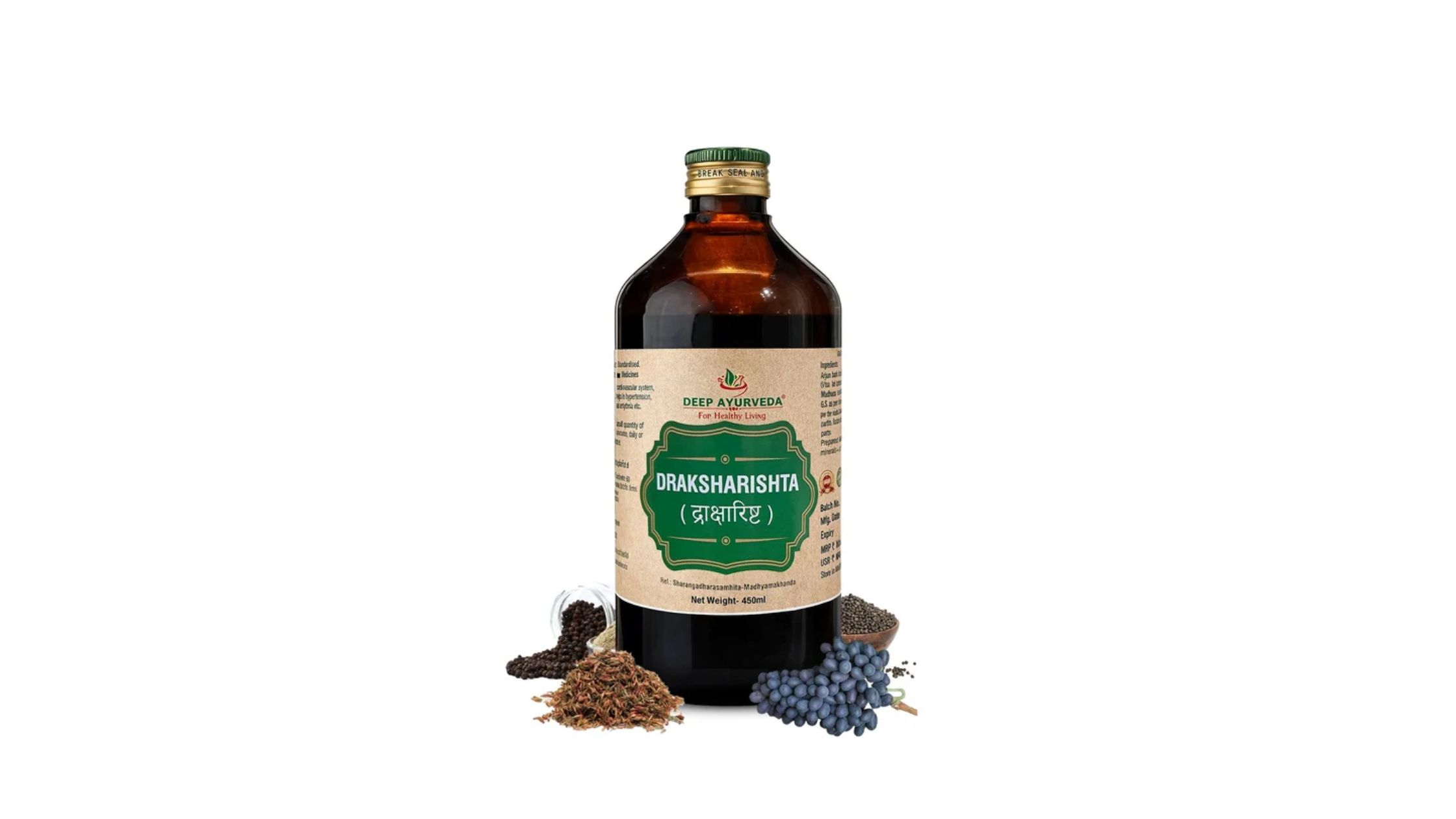
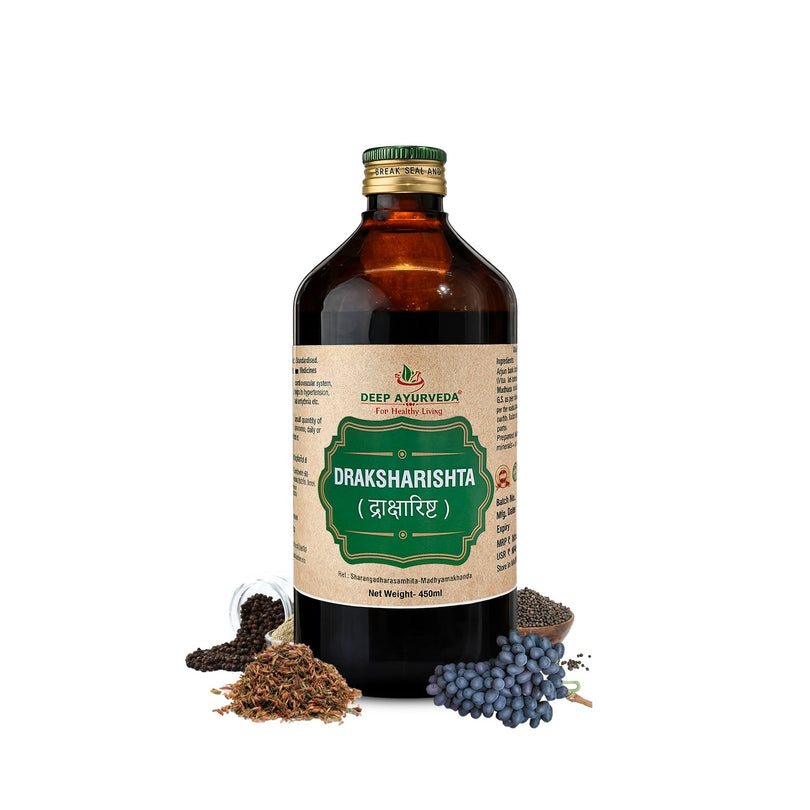
Deep Ayurveda Draksharishta
✅ Supports Healthy Digestion ✅ Boosts Energy and Stamina ✅ Supports Respiratory Wellness ✅ Supports Natural Recovery ✅ Supports Liver Health
Draksharishta is one of Ayurveda’s traditional fermented herbal formulations, prepared primarily with Draksha (grapes) along with a carefully selected group of aromatic and digestive herbs. Traditionally, it has been used to support digestion, appetite, general strength and certain respiratory concerns.
But there is more to Draksharishta than simply calling it an Ayurvedic tonic.
Because it belongs to the Arishta category, Draksharishta undergoes a natural fermentation process. This process gives the formulation its characteristic taste, helps extract different types of herbal constituents and naturally generates a small amount of alcohol within the preparation. Research on Draksharishta has examined its composition, physicochemical characteristics and fermentation-related properties.
From an Ayurvedic perspective, however, the right question is not simply, What are the benefits of Draksharishta? It is also:
Who may benefit from it, how should it be taken, when should it be avoided, and how does its traditional use fit the individual’s digestive strength and overall health?
In this guide, we will explore Draksharishta from both a traditional Ayurvedic and modern evidence-aware perspective, including its ingredients, uses, dosage, benefits, fermentation process, possible side effects and important precautions.
Medical Disclaimer: This article is intended for educational purposes and does not replace personalised medical advice. The suitability and dosage of Draksharishta may vary according to age, health status, digestive capacity, medicines being taken and individual Ayurvedic assessment. Pregnant or breastfeeding women, children, people with chronic illnesses and those taking prescription medicines should consult a qualified healthcare professional before using it.
What Is Draksharishta?
Draksharishta is a classical fermented Ayurvedic liquid formulation in which Draksha, traditionally understood as dried grapes or raisins, forms the principal ingredient.
Unlike an ordinary herbal syrup, Draksharishta is prepared through the traditional Sandhana Kalpana process. In this process, the herbal decoction, jaggery and selected herbs are allowed to undergo controlled natural fermentation.
This fermentation naturally produces alcohol within the preparation. Research examining Draksharishta has reported approximately 5–10% self-generated alcohol, although the actual characteristics can vary according to preparation and manufacturing conditions.
Ayurvedic literature and traditional practice have associated Draksharishta with areas such as:
- Digestive weakness
- Reduced appetite
- General weakness and debility
- Certain cough and respiratory complaints
- Support for healthy bowel function
It is important to understand that traditional Ayurvedic use should not be presented as proof that Draksharishta can cure a modern medical disease. The evidence for individual benefits varies, and formulation-specific clinical research remains limited.
Why Is Draksharishta Fermented?
This is one of the most interesting aspects of Draksharishta.
Many people see an Ayurvedic fermented formulation and assume that alcohol has simply been added to it. Traditionally prepared Arishtas are different.
The alcohol is generated naturally during fermentation when microorganisms act on sugars present in the preparation. Experimental research on Draksharishta has specifically studied the conversion of sugars into alcohol during fermentation.
The fermentation process can therefore be understood as part of the dosage-form technology of Ayurveda, rather than merely a flavouring or preservation technique.
What happens during preparation?
Broadly, the process involves:
- Preparing a decoction from the main herbal ingredients.
- Adding jaggery as the fermentable sugar source.
- Adding the appropriate powdered herbs.
- Introducing the traditional fermentation-supporting ingredient, such as Dhataki.
- Allowing the mixture to ferment under suitable conditions.
- Filtering and processing the fermented liquid before use.
Research describes Draksharishta as an Arishta prepared by fermentation of a plant decoction and identifies Dhataki (Woodfordia fruticosa) among its ingredients.
Does Draksharishta contain alcohol?
Yes. Naturally fermented Draksharishta can contain self-generated alcohol.
This does not mean it should be treated as a conventional alcoholic beverage. However, the alcohol content is still a relevant safety consideration for people who need to avoid alcohol-containing preparations.
This is one reason why pregnancy, breastfeeding, liver-related concerns, alcohol sensitivity and certain medication situations should be discussed with a qualified healthcare professional before use.
Draksharishta Ingredients
The formulation traditionally contains Draksha as the principal ingredient, supported by several aromatic, digestive and fermentation-related herbs.
Published research on Draksharishta identifies 10 ingredients in the formulation.
| Ingredient | Botanical Name | Traditional Role in the Formulation |
|---|---|---|
| Draksha | Vitis vinifera | Principal ingredient; traditionally nourishing and supportive of digestion |
| Twak | Cinnamomum zeylanicum | Aromatic and traditionally used to support digestion |
| Ela | Elettaria cardamomum | Traditionally supports appetite and digestion |
| Patra / Tejapatra | Cinnamomum tamala | Aromatic digestive herb |
| Maricha | Piper nigrum | Traditionally associated with Deepana-Pachana activity |
| Pippali | Piper longum | Traditionally used to support digestion and respiratory function |
| Vidanga | Embelia ribes | Traditionally used in digestive formulations |
| Nagakesara | Mesua ferrea | Traditional supportive ingredient |
| Priyangu | Callicarpa macrophylla | Traditional formulation ingredient |
| Dhataki | Woodfordia fruticosa | Traditionally associated with fermentation |
Draksha – The Principal Ingredient
Draksha, generally identified botanically as Vitis vinifera, forms the foundation of the formulation.
In Ayurveda, Draksha is valued for its nourishing and supportive qualities. Modern research on grapes has also investigated various naturally occurring polyphenolic compounds, but evidence concerning grapes themselves should not automatically be interpreted as clinical evidence for the finished Draksharishta formulation.
This distinction is important.
Evidence about an individual herb is not automatically evidence that the complete Ayurvedic formulation produces the same clinical outcome.
Traditional Uses of Draksharishta
Draksharishta has traditionally been used in Ayurveda in several health contexts.
1. Digestive Support
One of the commonly discussed traditional applications of Draksharishta is support for digestion.
Its combination of Draksha with aromatic spices such as Twak, Ela, Maricha and Pippali gives the formulation a digestive-oriented profile.
It may traditionally be considered when a person has:
- Reduced appetite
- Sluggish digestion
- Occasional digestive discomfort
- General digestive weakness
However, persistent indigestion, unexplained abdominal pain, recurrent vomiting or other ongoing symptoms should be medically evaluated rather than self-treated indefinitely.
2. Appetite Support
A weakened appetite can sometimes accompany poor digestion, recovery from illness or general debility.
Ayurvedic practitioners may consider formulations containing digestive and nourishing herbs according to the individual’s condition.
Draksharishta is traditionally used in this broader context of supporting appetite and digestion.
3. Support During General Weakness
Draksha is traditionally regarded as a nourishing ingredient, while the formulation as a whole has traditionally been used in situations involving weakness and debility.
This does not mean Draksharishta should automatically be used for unexplained fatigue.
Persistent tiredness may have many causes, including nutritional deficiencies, sleep problems, thyroid disorders, anaemia or other medical conditions. Such causes should be investigated rather than masking symptoms with a tonic.
4. Traditional Respiratory Use
Classical Ayurvedic practice has also associated Draksharishta with certain respiratory complaints, including cough and breathing-related conditions.
Some traditional references describe its use in respiratory contexts, while modern sources commonly repeat these traditional indications.
However, Draksharishta should not be presented as a replacement for medical treatment of asthma, pneumonia, tuberculosis or other serious respiratory disease.
Draksharishta Benefits
The benefits below should be understood as traditional Ayurvedic uses or potential supportive roles, not guaranteed treatments for disease.
1. Supports Healthy Digestion
Draksharishta contains several traditionally digestive herbs, including cinnamon, cardamom, black pepper and long pepper.
Together with Draksha and the fermented preparation, these ingredients give Draksharishta its traditional digestive-supporting character.
It may be considered as part of an Ayurvedic approach when digestion and appetite are reduced.
2. Traditionally Supports Appetite
A healthy appetite is closely connected with digestive function in Ayurveda.
The aromatic herbs used in Draksharishta are traditionally associated with supporting Agni, while Draksha provides a more nourishing component.
Therefore, Draksharishta is traditionally used when poor appetite occurs alongside digestive weakness.
3. May Support General Strength and Nourishment
Draksha is traditionally valued as a nourishing fruit, and Draksharishta has historically been used in situations of weakness and debility.
However, if weakness is persistent or severe, the underlying cause should be investigated.
4. Traditionally Used for Respiratory Wellness
Draksharishta has a traditional place in Ayurvedic approaches to certain cough and respiratory complaints.
Its ingredients include Pippali, Maricha and other herbs traditionally used in respiratory and digestive formulations.
Still, breathing difficulty, chest pain, high fever or persistent cough requires appropriate medical assessment.
5. May Support Healthy Bowel Function
Traditional Ayurvedic sources also describe Draksharishta in relation to bowel function.
The formulation should not, however, be treated as a universal laxative. The appropriate approach depends on the underlying digestive pattern and the person’s overall health.
6. Provides the Traditional Benefits Associated With Draksha
Draksha is the central ingredient of the formulation and is traditionally valued for its nourishing qualities.
The finished Draksharishta, however, should be viewed as a complete fermented formulation, rather than simply as concentrated grape juice.
Draksharishta Dosage
One of the most common questions people ask is:
How much Draksharishta should I take?
There is no single dose that is appropriate for every person.
Traditional and commercial references commonly mention adult doses in the approximate range of 15–30 ml, often taken after meals and sometimes diluted with an equal quantity of water. Published product directions also vary; for example, one Indian Ayurvedic manufacturer lists 15–25 ml twice daily for adults, while other products provide different instructions.
Therefore, the product label and advice of a qualified Ayurvedic practitioner should take priority over a generic internet dosage.
General Adult Guidance
For many commercially available preparations:
15–30 ml per dose is a commonly referenced adult range.
It may be diluted with an equal amount of water when recommended.
When Should Draksharishta Be Taken?
Draksharishta is commonly taken after meals.
Taking fermented preparations after food may also be more comfortable for people who are sensitive to gastric irritation.
However, the timing can depend on the purpose of use, individual digestion and the practitioner’s recommendation.
Should Draksharishta Be Diluted?
Dilution with an equal quantity of water is commonly recommended for some preparations, particularly when digestive sensitivity or acidity is a concern. Product-specific instructions should always be followed.
Can Children Take Draksharishta?
Children should not be given an adult dose.
Because Draksharishta is a fermented preparation containing naturally generated alcohol and because children have different physiological requirements, its use in children should be determined by a qualified Ayurvedic physician or paediatric healthcare professional.
How to Take Draksharishta Correctly
If your Ayurvedic practitioner has recommended Draksharishta, follow these practical steps:
- Measure the prescribed quantity accurately.
- Follow the dosage instructions on your specific product.
- Dilute with water if recommended.
- Prefer the advised timing, commonly after food.
- Do not increase the dose because you believe a higher quantity will work faster.
- Stop and seek professional advice if you develop unusual or persistent symptoms.
A simple principle I follow in Ayurvedic practice is:
More medicine does not necessarily mean more benefit. The right medicine, in the right dose, for the right person is what matters.
Draksharishta Side Effects
Draksharishta is traditionally used as an Ayurvedic formulation, but natural does not automatically mean suitable for everyone.
Some people may experience digestive discomfort or intolerance, particularly if the formulation is taken in excessive quantities or is unsuitable for their constitution or current digestive condition.
Possible concerns may include:
- Acidity or gastric irritation
- Abdominal discomfort
- Loose stools in sensitive individuals
- Intolerance to one or more ingredients
- Problems related to sugar intake
- Concerns associated with naturally generated alcohol
Some published/clinical-facing sources also highlight possible interactions and precautions, particularly around gastrointestinal medicines and other drugs.
If you develop persistent or significant symptoms after taking Draksharishta, discontinue self-use and consult a qualified healthcare professional.
Is Draksharishta Safe for Everyone?
No Ayurvedic medicine should automatically be considered suitable for everyone.
Extra caution is appropriate for:
People With Diabetes
Traditional Draksharishta preparations use jaggery as part of the fermentation process. Therefore, people managing diabetes should not assume that the product is sugar-free simply because it is Ayurvedic.
Discuss its use with your healthcare provider and consider the sugar/carbohydrate information of the specific product.
Pregnant or Breastfeeding Women
Because Draksharishta is a fermented preparation with naturally generated alcohol, pregnancy and breastfeeding require particular caution.
Do not self-prescribe it during pregnancy or breastfeeding.
People With Liver Problems or Alcohol Sensitivity
Because naturally generated alcohol is present in fermented Arishta preparations, people with liver disease, alcohol sensitivity or a medical reason to avoid alcohol-containing products should seek professional advice before use.
People Taking Prescription Medicines
Herbal formulations can interact with medicines, and the risk depends on the ingredients, dose and medicines involved.
If you take regular prescription medicines, discuss Draksharishta with your doctor or Ayurvedic practitioner before starting it.
Draksharishta and Alcohol: What You Should Know
This is one of the most important points that is often missed in simple benefits articles.
Draksharishta is a fermented preparation and therefore naturally develops alcohol during fermentation.
Research examining the formulation has reported approximately 5–10% self-generated alcohol.
This alcohol is produced as part of the traditional fermentation process rather than being equivalent to adding a conventional alcoholic beverage to the medicine.
Nevertheless, people who need to avoid alcohol should not ignore this fact.
Always check the product label and consult a healthcare professional if alcohol exposure is medically relevant to you.
Draksharishta and Diabetes
This is another area where readers should look beyond the word Ayurvedic.
Traditional Draksharishta preparation includes jaggery, which provides fermentable sugars for the preparation.
Although fermentation changes the composition of the mixture, people with diabetes should not assume that Draksharishta is automatically suitable for blood-sugar management.
The safest approach is to:
- Check the specific product formulation.
- Discuss its use with your healthcare provider.
- Monitor blood glucose as advised.
- Avoid self-prescribing prolonged courses.
Draksharishta vs Drakshasava: Are They the Same?
Draksharishta and Drakshasava are both fermented Ayurvedic preparations associated with Draksha, which is why their names are sometimes used interchangeably online.
However, they should not automatically be treated as identical formulations.
The preparation method, ingredient proportions, classical reference and product specifications should be checked before assuming that one can simply replace the other.
If you want to understand the other formulation in detail, read our guide to Drakshasava, including its ingredients, traditional uses, dosage and precautions.
Draksharishta vs Ashwagandharishta
Both belong to the broader category of fermented Ayurvedic preparations, but their principal ingredients and traditional applications differ.
Draksharishta is centred around Draksha and is traditionally associated with digestive support, appetite, nourishment, weakness and certain respiratory uses.
Ashwagandharishta, on the other hand, is centred around Ashwagandha and is traditionally used in contexts related to strength, nourishment, stress-related wellbeing and vitality.
Therefore, the fact that both end in Arishta does not mean they have the same purpose.
For a deeper understanding, you can read our detailed guide on Ashwagandharishta, including its ingredients, traditional uses, dosage and Ayurvedic perspective.
What Does Modern Research Say About Draksharishta?
Modern research on Draksharishta has primarily focused on areas such as:
- Formulation quality
- Physicochemical characteristics
- Fermentation
- Alcohol generation
- Standardisation
- Phytochemical characteristics
One published study specifically investigated quality standards for Draksharishta and documented its 10-ingredient composition and self-generated alcohol.
Another experimental study examined the fermentation of Draksharishta and observed the conversion of sugars into alcohol during the fermentation process.
What does this mean for the reader?
It means there is scientific interest in understanding how the formulation is prepared and standardised.
However, it would be incorrect to take laboratory findings or research on individual ingredients and present them as proof that Draksharishta can prevent or cure every condition mentioned online.
Traditional Ayurvedic use, laboratory evidence and clinical evidence are three different levels of evidence.
Keeping these distinctions clear is important when discussing any Ayurvedic medicine responsibly.
Final Thoughts
Draksharishta is much more than a traditional herbal syrup. It is a fermented Ayurvedic formulation built around Draksha and a combination of digestive, aromatic and supportive herbs.
Its traditional applications include supporting digestion, appetite, general strength and certain respiratory concerns. At the same time, its fermented nature means that questions about naturally generated alcohol, jaggery, dosage, interactions and individual suitability should not be overlooked.
Frequently Asked Questions About Draksharishta
What is Draksharishta and what is it used for?
Draksharishta is a classical Ayurvedic fermented formulation prepared mainly with Draksha (grapes) and other herbs. It is traditionally used to support digestion, appetite, general strength and certain respiratory concerns.
What are the main ingredients in Draksharishta?
Draksha is the principal ingredient, along with herbs such as Pippali, Maricha, Ela, Twak, Patra, Vidanga, Nagakesara, Priyangu and Dhataki.
What are the benefits of Draksharishta?
Traditionally, Draksharishta is used to support healthy digestion, appetite, bowel function, general nourishment and respiratory wellness. Its benefits should be understood in the context of traditional Ayurvedic use.
What is the recommended dosage of Draksharishta?
The commonly referenced adult dosage is around 15–30 ml, but the appropriate dose can vary depending on the product, age, health condition and individual needs. Follow the product label or advice of a qualified Ayurvedic practitioner.
Does Draksharishta contain alcohol?
Yes. Draksharishta undergoes natural fermentation, which produces self-generated alcohol. Therefore, people who need to avoid alcohol should consult a healthcare professional before using it.
What are the possible side effects of Draksharishta?
Some people may experience acidity, gastric irritation or digestive discomfort, particularly if it is unsuitable for them or taken in excessive amounts. Stop use and seek professional advice if unusual or persistent symptoms occur.
Can people with diabetes or pregnant women take Draksharishta?
People with diabetes should consider its sugar/jaggery content and consult their healthcare provider. Pregnant women should not self-use Draksharishta because it is a fermented preparation containing naturally generated alcohol.
Is Draksharishta the same as Drakshasava?
No, they should not automatically be considered the same formulation. Although both are fermented Ayurvedic preparations associated with Draksha, their ingredients, preparation methods and traditional applications can differ.