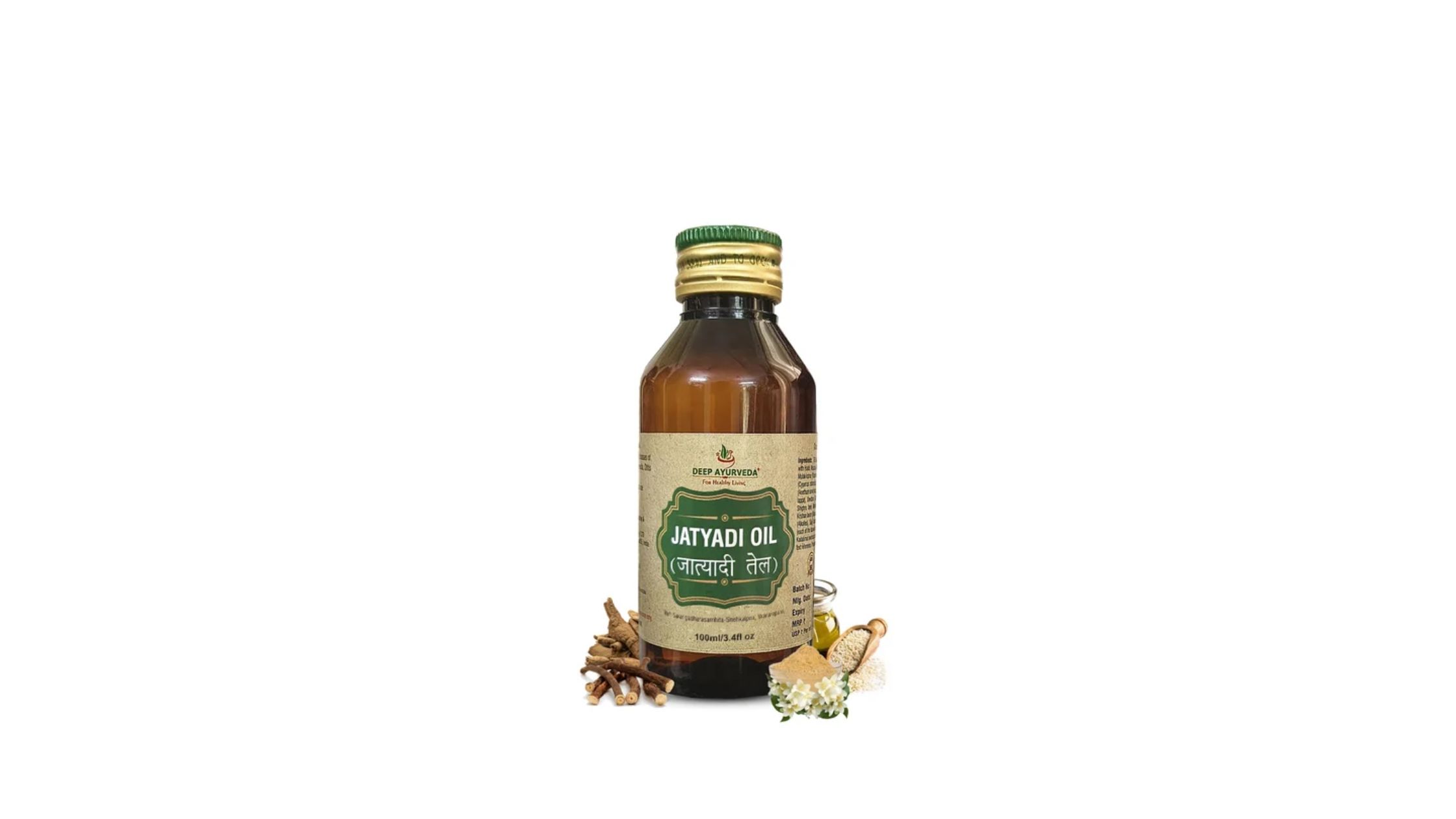

Deep Ayurveda Jatyadi Oil
✅ Supports Wound Care ✅ Soothes Irritated Skin ✅ Supports Healthy Skin ✅ Helps Manage Minor Burns ✅ Supports Skin Repair ✅ Useful for Minor Skin Problems
A wound, cut, ulcer or irritated area of skin often needs more than just an oil or cream. In Ayurveda, the condition of the affected tissue, the nature of the wound, inflammation, discharge and stage of healing are all considered before deciding on local care.
Jatyadi Oil, also known as Jatyadi Taila or Jatyadi Tel, is a classical Ayurvedic medicated oil traditionally used for external application on wounds and inflammatory wound conditions. The National AYUSH Mission’s Essential Drugs List identifies Jatyadi Taila as an AFI formulation with traditional indications of Vrana (wound) and Vranashotha (inflammation/swelling associated with a wound) and lists its use as application on a wound or injury.
The formulation contains a combination of herbs such as Jati, Nimba, Patola, Karanja, Yashtimadhu, Haridra, Daruharidra, Manjistha, Lodhra, Haritaki and other ingredients processed in an oil base. However, ingredient lists can vary between commercially available products, so the formulation printed on the individual product label should always be checked.
In this guide, we will look beyond the usual list of Jatyadi Oil benefits and understand what Jatyadi Taila is, why it is traditionally used, what its ingredients contribute, how it is applied, where it may be useful, its limitations, possible side effects and what modern research tells us.
What Is Jatyadi Oil?
Jatyadi Oil is a medicated Ayurvedic oil preparation (Taila) made by processing sesame oil with a group of medicinal herbs and other ingredients traditionally selected for wound and skin-related applications.
The word Jatyadi comes from Jati, one of the important ingredients associated with the formulation. In Ayurvedic literature, the formulation is associated with the management of Vrana, the Ayurvedic term broadly used for wounds or ulcers.
Rather than considering Jatyadi Oil simply as a moisturising oil, Ayurveda approaches such a formulation according to the properties of its individual ingredients and their combined action.
For this reason, Jatyadi Taila is traditionally used as a local application rather than as an ordinary massage oil. The AYUSH Essential Drugs List specifically records application on a wound or injury.
Jatyadi Oil vs Jatyadi Taila vs Jatyadi Tel
These names are commonly used interchangeably:
- Jatyadi Taila – the classical Ayurvedic name.
- Jatyadi Oil – the commonly used English name.
- Jatyadi Tel – the Hindi/common Indian term.
However, there is an important point that is often missed online: not every commercially available product labelled Jatyadi Oil necessarily has an identical ingredient list.
For example, current Indian product listings describe formulations containing sesame oil along with herbs including Jati, Nimba, Patola, Karanja, Yashtimadhu, Haridra, Daruharidra, Manjistha, Lodhra, Haritaki and others. Some listings differ in botanical identification or presentation of ingredients.
Therefore, when buying Jatyadi Oil, it is better to look at the complete ingredient panel and manufacturer’s information rather than assuming that every bottle contains precisely the same formulation.
Jatyadi Oil in Classical Ayurveda
To understand Jatyadi Taila properly, it helps to look at it through the Ayurvedic concept of Vrana Chikitsa, or the management of wounds.
Ayurveda does not view every wound in exactly the same way. A wound may have differences in:
- pain or tenderness
- swelling
- redness or heat
- discharge
- odour
- dryness
- tissue condition
- depth and size
- stage of healing
These characteristics influence how local care is selected.
What Is Vrana?
In simple terms, Vrana refers to a wound, ulcer or disruption of normal tissue integrity.
From an Ayurvedic perspective, management of Vrana involves more than applying a medicine to the surface. Classical wound care gives importance to processes such as:
Vrana Shodhana → Vrana Ropana
Here, Shodhana broadly refers to appropriate cleansing/purification of the wound, while Ropana refers to supporting the healing and restoration of tissue.
This distinction is important because a wound that requires proper cleaning, drainage or medical assessment should not simply be covered with oil and left unattended.
Why Is Jatyadi Taila Used in Vrana Care?
Jatyadi Taila brings together several herbs traditionally valued in Ayurveda for their cleansing, soothing, astringent and tissue-supportive properties, depending on the individual ingredient.
For example:
- Nimba (Neem) is traditionally valued in Ayurvedic skin and wound care.
- Haridra (Turmeric) is widely used in Ayurveda for inflammatory and skin-related conditions.
- Yashtimadhu (Licorice) is traditionally considered soothing and supportive to irritated tissues.
- Manjistha has a long history of use in Ayurvedic formulations concerned with skin and tissue health.
- Lodhra and other astringent herbs contribute properties relevant to local wound care.
- Tila Taila (sesame oil) acts as the principal oil medium in commonly described classical preparations.
The point is not that one individual herb heals the wound. Ayurveda traditionally considers the formulation as a whole, its preparation method and the condition for which it is being used.
The Ayurvedic Logic Behind Jatyadi Oil
One of the biggest limitations of many articles about Jatyadi Oil is that they provide a long ingredient list but never explain why those ingredients are brought together.
From an Ayurvedic perspective, the formulation can be understood by considering the qualities of its ingredients in relation to the local condition of the wound.
A wound with excessive discharge, inflammation, irritation or tissue disturbance may require a different approach from a very dry, cracked or predominantly Vata-associated lesion.
Therefore, I would not recommend thinking of Jatyadi Oil as a universal solution for every type of wound.
The more appropriate Ayurvedic question is:
What is the condition of the wound, and is Jatyadi Taila appropriate for that particular stage and presentation?
This is particularly important for chronic wounds, diabetic ulcers, infected wounds, deep injuries and wounds that are not healing normally.
What Makes Jatyadi Oil Different From Ordinary Herbal Oil?
An ordinary herbal oil may primarily be intended for massage, nourishment or general skin application.
Jatyadi Taila, in contrast, is traditionally positioned as a medicated external formulation for wound-related application. The National AYUSH Mission specifically lists it under AFI with Vrana and Vranashotha as indications.
Its purpose therefore should not be judged simply by how moisturising the oil feels on the skin.
The choice of herbs, processing into the oil medium and intended local application are what give a medicated Taila its Ayurvedic identity.
A Practical Ayurvedic Perspective
When someone asks, Is Jatyadi Oil good for wounds?, my answer as an Ayurvedic practitioner would not be an automatic yes or no.
I would first want to know:
What kind of wound is it? How old is it? Is there discharge? Is there swelling or increasing redness? Is it superficial or deep? Is there severe pain or fever? Is the person diabetic? Has the wound been medically evaluated?
Only after understanding these factors does the question of a topical Ayurvedic formulation become meaningful.
For a suitable external wound-care situation, Jatyadi Taila may be used as part of traditional local management. But it should not be used to delay proper medical treatment when a wound is deep, infected, rapidly worsening or failing to heal.
This distinction is important for anyone searching online for a quick remedy—and it is one reason a responsible Ayurvedic explanation should discuss both the traditional benefits and the boundaries of self-care.
Jatyadi Oil Ingredients: What Does Jatyadi Taila Contain?
Jatyadi Oil ki khasiyat sirf sesame oil ke base mein nahi hai. Is formulation mein kai medicinal herbs aur other traditional ingredients ko Taila Paka process ke through oil medium mein incorporate kiya jata hai.
Classical-style Jatyadi Taila formulations commonly include Jati, Nimba, Patola, Karanja, Yashtimadhu, Kushta, Haridra, Daruharidra, Katuki, Manjistha, Padmaka, Lodhra, Haritaki, Nilotpala, Sariva, Tuttha and beeswax, with sesame oil serving as the principal Sneha dravya. Published clinical research on Jatyadi Taila also describes a formulation containing these ingredients.
Jatyadi Oil Ingredients List
| Ayurvedic Name | Common Name | Botanical/Source Name | Traditionally Used Part |
|---|---|---|---|
| Jati | Chameli/Jasmine | Jasminum species | Leaf |
| Nimba | Neem | Azadirachta indica | Leaf |
| Patola | Patola | Trichosanthes dioica | Leaf/plant material |
| Karanja | Karanja | Pongamia pinnata | Leaf/seed depending on formulation |
| Yashtimadhu | Mulethi/Licorice | Glycyrrhiza glabra | Root |
| Kushta | Kushta | Saussurea lappa | Root |
| Haridra | Turmeric | Curcuma longa | Rhizome |
| Daruharidra | Daruhaldi | Berberis aristata | Stem |
| Katuki | Kutki | Picrorhiza kurroa | Rhizome |
| Manjistha | Manjistha | Rubia cordifolia | Root/stem depending on source |
| Padmaka | Padmaka | Prunus cerasoides | Heartwood |
| Lodhra | Lodhra | Symplocos racemosa | Bark |
| Haritaki | Harad | Terminalia chebula | Fruit |
| Nilotpala | Blue water lily | Nymphaea species | Flower |
| Sariva | Anantamul | Hemidesmus indicus | Root |
| Tuttha | Copper sulphate | Mineral ingredient | Purified form |
| Madhuchchhishta/Siktha | Beeswax | Beeswax | Wax |
| Tila Taila | Sesame oil | Sesamum indicum | Oil |
The exact botanical identification and proportion can differ between commercial preparations, so readers should use the ingredient panel of the particular Jatyadi Oil product they are purchasing as the final reference. For example, current Indian manufacturer listings show differences in the botanical naming of Jati and Nilotpala.
Why Are So Many Ingredients Used in Jatyadi Oil?
This is an important point to understand.
Ayurveda generally does not formulate a classical medicated oil by choosing herbs randomly. Each ingredient contributes particular Rasa, Guna, Virya, Vipaka and Karma, and the overall formulation is intended to provide a combined action.
For Jatyadi Taila, the traditional context is primarily Vrana Chikitsa—the Ayurvedic management of wounds.
Rather than thinking:
One herb = one benefit,
it is more useful to think:
Multiple ingredients + Taila medium + appropriate preparation = a formulation designed for a particular therapeutic purpose.
That is why the formulation should not be reduced to a list of individual antibacterial or anti-inflammatory ingredients.
1. Jati – Chameli
Jati is traditionally associated with the formulation’s name and is an important dravya in Jatyadi Taila.
In Ayurvedic interpretation, Jati is included in classical wound-related formulations and contributes to the formulation’s local therapeutic profile.
One point worth mentioning is that Jati’s botanical identification is not presented consistently across every modern online source, which is why a reliable formulation reference and the manufacturer’s declared composition should be preferred over copying an internet ingredient list.
2. Nimba – Neem
Nimba (Azadirachta indica) is one of Ayurveda’s best-known herbs for skin-related care.
Neem is traditionally valued for its Tikta and Kashaya-dominant profile and is commonly incorporated into Ayurvedic formulations used for conditions involving the skin.
In Jatyadi Oil, Nimba forms part of the broader herbal combination traditionally intended for local wound and skin care.
3. Patola
Patola (Trichosanthes dioica) is another classical ingredient associated with Jatyadi Taila.
Patola is traditionally used in Ayurveda in formulations concerned with skin health and inflammatory conditions.
Its inclusion alongside Nimba and other bitter/astringent herbs reflects the formulation’s broader Ayurvedic approach rather than a single-ingredient action.
4. Karanja
Karanja (Pongamia pinnata) has a long history of external use in Ayurvedic practice, particularly in formulations concerned with skin and local disorders.
Both the leaf and seed may appear in descriptions of Jatyadi Taila depending on the formulation reference or manufacturer.
This is another reason why simply copying an ingredient list from one commercial website can produce inaccuracies.
5. Yashtimadhu – Mulethi
Yashtimadhu (Glycyrrhiza glabra), commonly known as licorice or mulethi, is traditionally valued for its soothing and supportive properties.
Its inclusion adds a different dimension to the formulation, particularly in relation to irritated or sensitive tissue.
Yashtimadhu is widely used in Ayurveda across formulations where maintaining a soothing therapeutic environment is desirable.
6. Kushta
Kushta (Saussurea lappa) is a classical Ayurvedic herb traditionally used in several skin- and wound-related formulations.
Its presence in Jatyadi Taila contributes to the formulation’s overall herbal profile.
7. Haridra – Turmeric
Haridra (Curcuma longa) needs little introduction.
Turmeric has an extensive history of traditional use in Ayurveda for skin care, inflammatory conditions and wound-related applications.
Its presence in Jatyadi Oil is particularly relevant because modern research has also investigated turmeric and its constituents in relation to inflammation and tissue processes. However, the presence of turmeric in a formulation should not by itself be interpreted as proof that the finished oil will produce a particular clinical outcome.
8. Daruharidra
Daruharidra (Berberis aristata) is traditionally used in Ayurvedic formulations involving skin and local tissue disorders.
It is distinct from Haridra (turmeric), despite both being commonly translated using names related to yellow herbs.
This distinction is often missed in simplified Jatyadi Oil ingredient lists.
9. Katuki – Kutki
Katuki (Picrorhiza kurroa) is another classical herb included in commonly described Jatyadi Taila formulations.
Although Katuki is particularly well known in Ayurveda for internal therapeutic applications, its presence in this formulation is part of the traditional multi-herbal preparation.
10. Manjistha
Manjistha (Rubia cordifolia) has an important place in Ayurvedic formulations associated with skin and Rakta-related disorders.
It is traditionally considered particularly relevant where local tissue condition and inflammatory changes are part of the clinical picture.
In Jatyadi Taila, it works as one component of the larger formulation rather than as an isolated remedy.
11. Padmaka
Padmaka (Prunus cerasoides) is a classical Ayurvedic dravya included in Jatyadi Taila.
It is less familiar to most modern readers than neem or turmeric, which makes it worth explaining rather than simply placing its name in an ingredient table.
12. Lodhra
Lodhra (Symplocos racemosa) is traditionally known for its Kashaya (astringent) character.
Astringent herbs have an important place in traditional Ayurvedic approaches to certain wound and tissue conditions, particularly where local discharge and tissue laxity are considered relevant.
13. Haritaki – Harad
Haritaki (Terminalia chebula) is one of Ayurveda’s most extensively used classical herbs.
Although many people associate Haritaki primarily with digestive formulations, its traditional use extends considerably beyond digestion.
Its inclusion in Jatyadi Taila reflects the broader classical formulation approach, in which herbs are selected according to their overall therapeutic properties.
14. Nilotpala
Nilotpala, generally identified with a blue water lily in classical descriptions, is another less-discussed component of Jatyadi Taila.
Different modern sources may use different botanical identifications for Nilotpala, so this is an ingredient where source verification matters rather than blindly reproducing an online list.
15. Sariva – Anantamul
Sariva (Hemidesmus indicus) is traditionally used in Ayurveda for skin-related and inflammatory conditions.
It is generally regarded as a cooling and soothing herb within Ayurvedic pharmacological interpretation and complements the other herbs in the formulation.
16. Tuttha
Tuttha is a mineral ingredient traditionally identified as copper sulphate and is included in classical formulations in a processed/purified form.
Because this is not an ordinary herbal ingredient, it is particularly important that consumers do not attempt to prepare Jatyadi Taila themselves using raw mineral substances.
A properly manufactured Ayurvedic product should be obtained from a reputable manufacturer and used according to its labelled directions or the advice of a qualified practitioner.
17. Madhuchchhishta – Beeswax
Madhuchchhishta (beeswax) is included in commonly described Jatyadi Taila formulations.
Apart from its traditional formulation role, beeswax also contributes to the physical consistency and feel of the finished preparation.
18. Tila Taila – Sesame Oil
Tila Taila (sesame oil) serves as the principal oil medium in commonly described Jatyadi Taila preparations.
This is not merely a carrier added for convenience. In Ayurvedic Taila Kalpana, the Sneha medium is an important part of the preparation because the medicinal ingredients are processed with the oil through a specific pharmaceutical method.
For this reason, Jatyadi Taila should be understood as a medicated Taila rather than simply sesame oil mixed with herbs.
A Note About Jatyadi Oil Ingredient Lists
If you compare five Jatyadi Oil products online, you may notice that their ingredient lists do not always look identical.
This does not automatically mean that one product is fake or another is correct. There can be differences in:
- botanical nomenclature
- ingredient presentation
- plant part specified
- classical reference followed
- proprietary manufacturing practices
- whether the product is a classical preparation or a modified commercial formulation
For example, current Indian product listings from different manufacturers show variations in how ingredients such as Jati, Nilotpala and Karanja are identified or presented.
Therefore, when purchasing Jatyadi Oil, always read the actual product label and manufacturer information rather than assuming that every product named Jatyadi Oil has exactly the same composition.
Jatyadi Oil Benefits: What Is It Traditionally Used For?
Now that we understand the formulation, the more useful question is: what is Jatyadi Oil traditionally used for?
The official Essential Drugs List of the National AYUSH Mission lists Jatyadi Taila under the Ayurvedic Formulary of India (AFI) for Vrana and Vranashotha, with application on a wound or injury.
This provides a more reliable starting point than the long lists of claims commonly found on commercial websites.
In traditional Ayurvedic practice, Jatyadi Oil is mainly considered for local wound-related care, while its suitability depends on the nature and condition of the affected area.
1. Jatyadi Oil for Wound Care
Jatyadi Taila is traditionally applied to wounds as part of local Ayurvedic management.
The aim is not simply to close the wound quickly. Proper wound management involves maintaining appropriate local hygiene, addressing inflammation or discharge when present and supporting the gradual restoration of healthy tissue.
A topical formulation may be useful only when it is appropriate for the specific wound.
2. Jatyadi Oil for Non-Healing Wounds
Jatyadi Taila is frequently discussed in Ayurveda in relation to Dushta Vrana, broadly referring to difficult or unhealthy wounds.
Modern clinical research has also investigated Jatyadi Taila-containing preparations in chronic ulcer care. One multicentric randomized controlled clinical study evaluated a Jatyadi Taila aerosol dressing alongside wound care in diabetic and varicose ulcers.
However, this should not be interpreted as evidence that Jatyadi Oil alone can cure every chronic wound.
A non-healing wound deserves proper assessment, particularly when diabetes, poor circulation, infection or other underlying problems may be involved.
3. Jatyadi Oil for Irritated or Inflamed Skin
Because the formulation contains several herbs traditionally used in skin-related conditions, Jatyadi Taila is also used externally in some Ayurvedic settings where local irritation or inflammatory changes accompany the condition.
But skin irritation can have many causes. A persistent rash, spreading redness, severe itching or recurrent lesion should be diagnosed rather than repeatedly self-treated with different oils.
4. Jatyadi Oil for Ulcers
Jatyadi Taila has a traditional association with Vrana, which encompasses wound and ulcer-related conditions.
The appropriate local management depends on whether an ulcer is superficial, infected, chronic, diabetic, vascular or associated with another underlying disorder.
For this reason, an ulcer that does not heal normally should be evaluated by a qualified healthcare professional.
5. Jatyadi Oil for Anal Fissure and Piles
Jatyadi Oil is commonly searched online for fissure-in-ano and piles, and some Ayurvedic products specifically market it for these conditions.
However, the way it is used around the anal region is different from simply applying oil to intact skin.
If an Ayurvedic practitioner recommends local application, the amount, frequency and method should be based on the condition and product instructions.
Persistent bleeding, severe pain, a lump, pus, fever or recurrent symptoms should not be managed indefinitely with self-application.
6. Jatyadi Oil for Fistula-Related Wounds
Some commercial Ayurvedic products list fistula-related wounds among their traditional uses.
Here an important distinction is necessary:
Jatyadi Oil may be used as a local wound-care formulation in an appropriate clinical setting, but an oil cannot be assumed to eliminate an underlying fistula tract.
Fistula requires proper diagnosis and, depending on the condition, specialist management.
This is an area where responsible Ayurvedic guidance is especially important.
What Does Jatyadi Oil Actually Do to a Wound?
This is where it is useful to separate traditional Ayurveda from modern terminology.
Ayurveda describes wound management using concepts such as Shodhana and Ropana. Modern medicine describes wound healing using processes such as inflammation, tissue formation, epithelialisation and remodelling.
These systems use different frameworks, and they should not be treated as if they are identical.
Modern studies have investigated the antimicrobial, anti-inflammatory, antioxidant and wound-healing potential of ingredients found in Jatyadi Taila, while clinical research has also examined the formulation in wound care.
Therefore, it is reasonable to say that Jatyadi Taila has traditional and emerging research interest in wound management, but it would be scientifically inappropriate to claim that every traditional mechanism has been clinically proven in humans.
Jatyadi Oil for Different Types of Wounds
The same oil should not automatically be used for every wound.
| Wound/condition | Traditional relevance of Jatyadi Oil | Important consideration |
|---|---|---|
| Minor superficial wound | May be considered for local care | Keep the area clean |
| Chronic/non-healing wound | Traditional relevance in Vrana care | Identify the underlying cause |
| Inflamed wound | Relevant to traditional Vranashotha indication | Watch for signs of infection |
| Ulcer | Traditionally associated with Vrana care | Needs assessment if persistent |
| Anal fissure | Common Ayurvedic topical use | Persistent bleeding/pain needs evaluation |
| Piles | May be used in selected external/local care | Not a replacement for diagnosis |
| Fistula | May have local wound-care relevance | Does not mean the fistula tract is cured |
| Deep/serious wound | Not suitable for casual self-treatment | Seek medical attention |
This condition-specific approach is more useful than simply presenting Jatyadi Oil as a remedy for all types of wounds.
Jatyadi Oil and Wound Healing: What Does Research Say?
There is growing scientific interest in the formulation, but the evidence should be interpreted carefully.
A published clinical study investigated Jatyadi Taila aerosol dressing in diabetic and varicose ulcers and reported positive wound-healing outcomes.
Research on individual ingredients such as turmeric, neem, licorice and other herbs has also investigated properties relevant to inflammation, microbial activity and tissue repair.
However, evidence from individual herbs cannot automatically be treated as proof for the finished Jatyadi Oil formulation.
Jatyadi Oil Uses: Where and How Is It Traditionally Used?
Jatyadi Oil is primarily known for external application in wound-related conditions. In Ayurveda, however, the decision to use a medicated oil is not based only on the name of the condition. The nature of the wound, its stage, discharge, inflammation, tissue condition and the patient’s overall health are also important.
The National AYUSH Mission’s Essential Drugs List identifies Jatyadi Taila with Vrana and Vranashotha as traditional indications and specifies local application on a wound or injury.
Here are some of the commonly discussed uses of Jatyadi Oil.
1. Jatyadi Oil for Wounds
This is the most important traditional use of Jatyadi Taila.
In Ayurvedic wound care, a wound is assessed before deciding on local treatment. A clean, superficial wound that is progressing normally is very different from a wound with excessive discharge, swelling, unhealthy tissue or signs of infection.
Jatyadi Oil may be used as a local application in appropriate wound-care situations, particularly as part of traditional Vrana management.
The important principle is:
Jatyadi Oil should support wound care—not replace proper wound assessment and cleaning.
For a deep, contaminated or heavily bleeding wound, first aid and medical assessment take priority.
2. Jatyadi Oil for Cuts and Minor Injuries
For minor superficial cuts or uncomplicated injuries, Jatyadi Oil is traditionally used by some Ayurvedic practitioners as a local medicated oil.
Before application, the affected area should be appropriately cleaned and assessed.
A common mistake is to apply an oil immediately to every fresh wound without checking whether there is dirt, a foreign body, significant bleeding or tissue damage.
If the injury is small and uncomplicated, local application may be considered according to the product directions or an Ayurvedic practitioner’s advice.
3. Jatyadi Oil for Chronic or Non-Healing Wounds
Jatyadi Taila has a traditional connection with Vrana, including difficult wound conditions.
This is also an area where modern research has shown interest. A clinical study investigated Jatyadi Taila aerosol dressing in diabetic and varicose ulcers and reported favourable wound-related outcomes. However, this does not establish Jatyadi Oil as a standalone cure for chronic ulcers.
If a wound remains open for weeks, repeatedly breaks down, develops discharge or does not show normal healing, the cause should be investigated.
In particular, people with diabetes, poor circulation or reduced sensation should not rely on self-treatment alone.
4. Jatyadi Oil for Ulcers
In Ayurvedic terminology, Vrana can include ulcerative conditions, which explains why Jatyadi Taila is frequently discussed in relation to ulcers.
Its traditional use is as a local formulation rather than an oral medicine.
But ulcer is a broad term. A pressure ulcer, diabetic ulcer, venous ulcer, infected ulcer and traumatic ulcer can have very different causes and management requirements.
Therefore, Jatyadi Oil should be selected according to the type and condition of the ulcer, ideally after professional assessment.
5. Jatyadi Oil for Inflamed Wounds
One of the traditional indications of Jatyadi Taila is Vranashotha, referring broadly to swelling/inflammation associated with a wound.
The formulation contains several herbs traditionally valued in Ayurvedic skin and wound care, including Nimba, Haridra and Daruharidra.
This makes Jatyadi Taila relevant to the traditional management of certain inflamed wound conditions.
However, rapidly increasing redness, warmth, swelling, pus, severe pain or fever should not be assumed to be ordinary wound inflammation. These can require prompt medical evaluation.
6. Jatyadi Oil for Anal Fissure
Jatyadi Oil is commonly searched for in relation to anal fissure, where a small tear in the anal canal can cause significant pain, particularly during bowel movements.
Some Ayurvedic practitioners use Jatyadi Taila as a local supportive formulation in selected cases.
However, application around the anal region requires greater care than application to ordinary skin.
How is it traditionally applied?
The exact method depends on the product and clinical situation. An Ayurvedic practitioner may recommend carefully applying a small quantity to the affected external area using clean hands or suitable sterile/clean material.
Do not force oil into a painful or bleeding area, and do not insert applicators or other objects unless specifically advised by a qualified healthcare professional.
If fissure symptoms persist, recur frequently or are associated with substantial bleeding, proper evaluation is important.
7. Jatyadi Oil for Piles
Piles, or haemorrhoids, involve swollen blood vessels and surrounding tissues in the anal region.
Jatyadi Oil is traditionally used by some Ayurvedic practitioners for local supportive care, particularly where there is associated irritation or superficial tissue discomfort.
It is important to understand that applying an oil to the area does not necessarily address the underlying cause of haemorrhoids, such as constipation, prolonged straining or other contributing factors.
For recurring piles, the broader treatment plan may therefore include bowel-habit management, dietary measures and appropriate medical or Ayurvedic treatment depending on the case.
8. Jatyadi Oil in Fistula-Related Wound Care
Jatyadi Oil is also sometimes used in Ayurvedic local wound-care protocols around a fistula-related opening.
But there is a crucial distinction:
Local wound care is not the same as treating the fistula tract itself.
A fistula can involve an abnormal tract between tissues or organs, and simply applying oil externally should not be expected to eliminate that tract.
If there is persistent pus, recurrent swelling, increasing pain or repeated drainage around the area, professional assessment is necessary.
9. Jatyadi Oil for Cracked or Fissured Skin
Because Jatyadi Taila is an oil-based formulation containing several herbs traditionally used for skin and wound care, it may be considered for certain cracked, fissured or damaged skin areas.
The cause matters, however.
For example, recurrent cracks may be related to excessive dryness, friction, dermatitis, infection or another underlying condition. Treating only the surface without identifying the cause may provide incomplete relief.
10. Jatyadi Oil for Minor Burns
Jatyadi Oil is frequently mentioned online in relation to burns, but this area needs particular caution.
For a fresh burn, immediate appropriate first aid is more important than applying an Ayurvedic oil. Depending on the severity, a burn may require medical treatment.
Jatyadi Oil should not be used as a substitute for emergency burn care, particularly for:
- extensive burns
- deep burns
- electrical or chemical burns
- burns involving the face, hands, feet or genitals
- burns with significant blistering or tissue damage
For any burn that appears serious, seek medical attention promptly.
11. Jatyadi Oil for Post-Procedure Wound Care
Jatyadi Oil should not automatically be applied to a surgical or procedural wound.
If a wound has been created during surgery or another medical procedure, the treating doctor should determine what can safely be applied.
An Ayurvedic topical formulation may sometimes have a role in a practitioner’s wound-care plan, but post-operative wounds should not be self-treated by replacing prescribed dressings or medicines with oil.
12. Jatyadi Oil for Skin-Related Wound Conditions
Some Ayurvedic practitioners may consider Jatyadi Taila in selected conditions where the skin has become damaged, irritated or ulcerated.
The key consideration remains the actual condition of the skin, rather than simply matching a product to a symptom.
Persistent itching, recurrent lesions, unexplained ulcers or spreading skin changes deserve proper diagnosis.
How to Use Jatyadi Oil for Different Conditions
There is no single application method that is appropriate for every situation.
For general external application, the traditional approach can be understood as follows:
Step 1: Assess the affected area
Check whether the area is superficial, deep, actively bleeding, infected or otherwise concerning.
Step 2: Clean the area appropriately
For wound care, cleanliness is important before applying any topical preparation.
Step 3: Apply a small quantity
Apply the amount recommended on the product label or by your Ayurvedic practitioner.
Step 4: Avoid unnecessary rubbing
A damaged wound should not be vigorously massaged. Gentle application is preferable where topical application is appropriate.
Step 5: Use suitable dressing when required
Some wounds require gauze or another appropriate dressing. Whether the area should remain covered depends on the type and stage of the wound.
Step 6: Monitor the wound
The wound should gradually show signs of improvement. Increasing pain, swelling, redness, discharge, odour or fever warrants professional assessment.
How Often Should Jatyadi Oil Be Applied?
The frequency of application should not be treated as a universal fixed dose for every condition.
It can depend on:
- the type of wound
- the wound stage
- amount of discharge
- location
- dressing requirements
- product formulation
- practitioner’s assessment
For this reason, follow the specific manufacturer’s directions or advice from a qualified Ayurvedic practitioner rather than assuming that a frequency mentioned for one Jatyadi Oil product applies to every brand.
Can Jatyadi Oil Be Applied Directly to a Wound?
It may be used for appropriate wounds as a traditional external application, but not every wound is suitable for oil application.
A small, uncomplicated wound is very different from a deep wound, infected wound, surgical wound or chronic diabetic ulcer.
If you are unsure whether the wound is suitable for Jatyadi Oil, getting it assessed first is the safer approach.
A Useful Rule to Remember
When using any Ayurvedic topical formulation, think beyond:
Which oil is best for this problem?
Instead ask:
What is the condition of the tissue, what stage is it in, and is this formulation appropriate for it?
That small change in thinking is at the heart of responsible Ayurvedic wound care.
How to Use Jatyadi Oil: Step-by-Step Application Guide
Jatyadi Oil ka sahi use sirf oil lagane tak limited nahi hai. Affected area ki condition, cleanliness, wound ka stage aur required dressing bhi important hote hain.
Ayurvedic wound care mein topical formulation ka purpose tabhi meaningful hota hai jab underlying wound ko appropriately assess aur manage kiya gaya ho.
For general external use, Jatyadi Oil ko product label ya qualified Ayurvedic practitioner’s advice ke according apply karna chahiye.
Step 1: Wash Your Hands
Jatyadi Oil apply karne se pehle hands ko soap and water se properly clean karein.
Agar wound care ke liye dressing ya gauze use kar rahe hain, to clean material ka use karein.
Dirty hands se wound ko touch karna healing ke liye helpful nahi hota, chahe topical formulation kitni bhi अच्छी हो.
Step 2: Clean the Affected Area Appropriately
Agar Jatyadi Oil kisi wound ke liye use kiya ja raha hai, to application se pehle wound ko appropriate manner mein clean karna important hai.
Visible dirt, foreign material ya excessive discharge ko ignore karke directly oil lagana appropriate wound care nahi hai.
Agar wound deep hai, heavily contaminated hai, bite ke baad hua hai ya tissue damage significant hai, to professional medical assessment zaroori ho sakta hai.
Step 3: Take a Small Quantity of Jatyadi Oil
Jatyadi Oil ki quantity condition aur affected area’s size par depend karti hai.
Isliye ek universal spoon-based dose har wound ke liye scientifically appropriate nahi hai.
Generally, the goal is to apply enough oil to lightly cover the intended area without unnecessarily soaking the wound.
Product label par recommended quantity available ho to usse follow karein.
Step 4: Apply Gently
Oil ko affected area par gently apply karein.
Fresh or painful wound ko vigorously massage na karein.
Especially open wounds mein aggressive rubbing unnecessary tissue irritation cause kar sakti hai.
Jatyadi Taila ek massage oil nahi hai jise affected tissue mein forcefully rub karna zaroori ho.
Step 5: Decide Whether a Dressing Is Needed
Har wound ko cover karna zaroori nahi hota, aur har wound ko open rakhna bhi appropriate nahi hota.
Dressing ka decision depend karta hai:
- wound ki location
- amount of discharge
- wound size
- contamination risk
- stage of healing
- friction or pressure
- practitioner’s recommendation
Agar dressing advised hai, to clean/appropriate gauze ya dressing material use karein.
Step 6: Follow the Recommended Frequency
Jatyadi Oil ko kitni baar apply karna hai, iska answer condition-specific hona chahiye.
A simple superficial wound, chronic ulcer, anal fissure aur fistula-related wound ke application schedules necessarily same nahi hote.
Isliye:
Product label > qualified practitioner’s advice > generic internet dosage claims
Ye approach safer hai.
How to Apply Jatyadi Oil on a Wound
For an uncomplicated wound where topical application is considered appropriate:
- Wash your hands.
- Clean the affected area appropriately.
- Allow excessive moisture to be removed where appropriate.
- Take a small quantity of Jatyadi Oil.
- Apply gently over the intended area.
- Use a suitable dressing if recommended.
- Keep monitoring the wound for changes.
The purpose is to provide appropriate local care—not to keep repeatedly adding more oil throughout the day.
What Should You Watch For?
A healing wound should not progressively become more painful, swollen or foul-smelling.
Seek medical advice if you notice:
- increasing redness
- increasing swelling
- worsening pain
- pus or increasing discharge
- foul smell
- fever
- black/grey tissue
- wound becoming larger
- bleeding that does not stop
These signs can indicate infection, tissue damage or another complication.
How to Use Jatyadi Oil for Anal Fissure
Anal fissure ke case mein application method ordinary skin wound se different ho sakta hai.
If a qualified practitioner has recommended Jatyadi Oil:
- Clean the area gently.
- Use a small quantity.
- Apply carefully to the affected external area or as specifically instructed.
- Avoid aggressive rubbing.
- Do not insert fingers, cotton buds, applicators or other objects into the anal canal unless specifically advised by a qualified healthcare professional.
Why Is Gentle Application Important?
Anal fissure already involves sensitive and often painful tissue. Excessive manipulation can increase discomfort and may further irritate the area.
Also remember that topical oil alone does not address all factors that can contribute to fissure, particularly hard stools and straining.
Adequate hydration, appropriate fibre intake and maintaining soft, regular bowel movements are often important parts of fissure management.
Persistent or recurrent fissure symptoms should be evaluated rather than continuously self-treated.
How to Use Jatyadi Oil for Piles
For piles, Jatyadi Oil may be considered for local supportive care in selected situations.
If advised for external application:
- Clean the area gently.
- Pat dry without vigorous rubbing.
- Apply a small amount to the intended external area.
- Avoid unnecessary manipulation.
- Follow the recommended frequency.
Do not assume that applying more oil will produce faster results.
If there is heavy bleeding, severe pain, a rapidly enlarging lump, dizziness, fever or pus, seek medical assessment.
Not every anal symptom is caused by haemorrhoids, and persistent rectal bleeding should not automatically be attributed to piles.
How to Use Jatyadi Oil for Fistula-Related Wounds
Fistula-related care requires particular caution.
If Jatyadi Oil has been recommended as part of local wound management, it should be used only according to the practitioner’s instructions.
The oil may have a role in caring for the external wound opening, but it should not be assumed to eliminate the underlying fistula tract.
Remember:
External wound care ≠ fistula cure.
Persistent pus, recurrent swelling, increasing pain or repeated drainage requires appropriate clinical assessment.
Can Jatyadi Oil Be Applied Directly to Open Wounds?
Jatyadi Taila is traditionally used externally for wound-related conditions, including Vrana. The AYUSH Essential Drugs List specifically describes its administration as application on a wound or injury.
However, open wound covers a very broad range of injuries.
A small superficial wound is not equivalent to:
- a deep cut
- a puncture wound
- an infected wound
- a large ulcer
- a diabetic foot ulcer
- a surgical wound
- an animal bite
- a severe burn
For complicated wounds, professional assessment should come before deciding which topical formulation to use.
Should Jatyadi Oil Be Warmed Before Use?
There is no need to assume that Jatyadi Oil must always be heated before application.
If a product specifically provides instructions regarding warming, follow those instructions.
Otherwise, use it at a comfortable temperature and avoid applying excessively hot oil to damaged skin.
Never heat Jatyadi Oil until it becomes hot enough to burn the skin.
For wounds, the temperature of the application should be comfortable and should not cause additional irritation.
Can Jatyadi Oil Be Used as a Massage Oil?
Generally, Jatyadi Taila should not be treated like an ordinary full-body massage oil.
Its traditional positioning is as a medicated topical formulation for wound-related application, rather than a general-purpose massage oil.
If you are looking for an Ayurvedic oil specifically for Abhyanga or body massage, a formulation intended for that purpose would generally be more appropriate.
How Much Jatyadi Oil Should You Apply?
There is no single quantity that applies to every person or every condition.
The amount depends on:
- size of the affected area
- whether the wound is superficial or deeper
- whether dressing is required
- amount of discharge
- location of the wound
- product concentration/formulation
- practitioner’s recommendation
A useful principle is:
Apply enough to appropriately cover the intended area—not enough to saturate it unnecessarily.
More oil does not automatically mean faster healing.
How Often Can You Apply Jatyadi Oil?
Frequency should be based on the product’s instructions and the condition being managed.
Avoid copying a frequency from another website simply because it appears in a search result.
Different commercial Jatyadi Oil products can have different formulations and directions. Therefore, the label of the product you are actually using should be checked.
For chronic wounds or recurrent conditions, frequency is best decided after professional assessment.
Common Mistakes to Avoid When Using Jatyadi Oil
Mistake 1: Applying Oil Without Cleaning the Wound
A medicated oil does not replace basic wound hygiene.
Mistake 2: Using Too Much
A thick layer does not necessarily provide additional therapeutic benefit.
Mistake 3: Rubbing an Open Wound Aggressively
Damaged tissue should be handled gently.
Mistake 4: Using the Same Method for Every Condition
Application for a superficial skin wound is different from application around an anal fissure or chronic ulcer.
Mistake 5: Continuing Self-Treatment Despite Worsening Symptoms
Increasing pain, redness, swelling, pus or fever should prompt medical assessment.
Mistake 6: Assuming Natural Means Risk-Free
Ayurvedic medicines are pharmacologically active preparations. Some people may experience irritation or sensitivity, and inappropriate use can delay proper treatment.
Mistake 7: Using Jatyadi Oil Internally Without Professional Advice
Jatyadi Oil is a topical medicated oil, not an ordinary edible oil.
It should not be consumed unless a qualified healthcare professional has specifically prescribed a formulation and route of administration appropriate to the situation.
How Long Does Jatyadi Oil Take to Work?
There is no reliable single number of days that applies to everyone.
The response can depend on:
- type and size of wound
- age of the wound
- underlying disease
- infection status
- wound location
- nutrition
- circulation
- adherence to wound-care instructions
A small superficial wound may naturally heal much faster than a chronic ulcer.
Therefore, be cautious of claims such as Jatyadi Oil heals every wound in 7 days or similar fixed promises.
Good wound care is measured by the actual progression of healing, not by a predetermined number of days.
When Should You Stop Using Jatyadi Oil and See a Doctor?
Stop self-treatment and seek appropriate medical advice if the affected area develops:
- rapidly increasing redness
- significant swelling
- severe or worsening pain
- pus
- foul-smelling discharge
- fever
- persistent or heavy bleeding
- black or dead-looking tissue
- increasing wound size
- numbness or loss of sensation
- no meaningful improvement over time
People with diabetes, poor circulation, immune problems or chronic ulcers should be particularly careful with wound self-care.
Jatyadi Oil Dosage: How Much and How Often?
Jatyadi Oil does not have one fixed dosage for every condition. Since it is primarily used externally, the appropriate quantity depends on the size, depth, moisture, location, and condition of the affected area. The aim is to keep the area adequately coated without unnecessarily soaking the wound.
How Much Jatyadi Oil Should You Apply?
For most topical applications, only a small amount of oil sufficient to lightly cover the affected area is required. It should not be poured excessively over the wound.
The quantity may vary according to:
- Size of the wound or affected skin area
- Whether the area is dry, moist, or discharging
- Whether Jatyadi Oil is being used alone or with a dressing
- Location of the wound
- Type and stage of the condition
- Advice given by an Ayurvedic physician
For a small superficial area, a few drops may be sufficient, while a larger wound may require more oil to adequately moisten the dressing.
How Often Can Jatyadi Oil Be Used?
There is no universal once-daily or twice-daily rule that applies to every wound.
In practice, topical application may be recommended once or more times a day depending on the condition and dressing routine. For wounds requiring regular dressing, the oil may be applied when the dressing is changed.
For chronic wounds, diabetic ulcers, infected-looking wounds, or wounds with significant discharge, the frequency should be determined by a qualified healthcare professional rather than by following a general internet dosage.
Is More Jatyadi Oil Better?
No. Applying a larger quantity does not necessarily mean faster wound healing.
Jatyadi Oil should be used in an appropriate amount to cover the intended area. Excessive application can make dressings unnecessarily oily and may interfere with practical wound management.
A useful principle is:
Apply enough to cover the affected area, but avoid excessive soaking.
How Long Can Jatyadi Oil Be Used?
The duration depends on the reason for application and how the wound is progressing.
For a minor superficial injury, it may only be needed for a short period. Chronic wounds or ulcers require regular assessment because the underlying cause—such as infection, poor circulation, pressure, or uncontrolled blood glucose—also needs attention.
If a wound is not showing improvement, becomes increasingly painful, develops foul-smelling discharge, spreads, or shows increasing redness or swelling, do not continue self-treatment indefinitely. Seek medical evaluation.
Important: Jatyadi Oil Is Not an Oral Medicine
Jatyadi Oil is primarily intended for external application. It should not be swallowed or taken internally unless a qualified practitioner has specifically prescribed a particular formulation and route of administration.
The National AYUSH Mission’s Essential Drugs List identifies Jatyadi Taila for Vrana (wound) and Vranashotha (inflammatory wound conditions) with application on the wound or injury.
When someone asks me, How many drops of Jatyadi Oil should I use?, I would first want to know what they are treating. The right application for a small superficial wound is not necessarily appropriate for a chronic ulcer or a post-procedure wound.
Therefore, rather than following a fixed number of drops, consider the condition of the wound, the product instructions, and professional advice.
Jatyadi Oil Side Effects and Safety
Jatyadi Oil is generally intended for external application, but natural does not automatically mean that it is suitable for every person or every type of wound. Individual sensitivity, the condition of the skin, and the quality of the formulation can influence how the oil is tolerated.
When used appropriately, serious problems are uncommon, but some people may experience local irritation or an allergic reaction.
Possible Side Effects of Jatyadi Oil
Some possible reactions include:
- Mild burning or stinging after application
- Redness or irritation
- Itching
- Skin sensitivity or rash
- Contact allergy to one of the herbal ingredients
- Increased discomfort when applied to an unsuitable wound
A mild, brief sensation immediately after application may occur in some sensitive areas, but persistent burning, increasing redness, swelling, or pain should not be ignored.
Can Jatyadi Oil Cause an Allergic Reaction?
Yes. Although Jatyadi Oil contains traditionally used herbal ingredients, an individual can be sensitive to one or more ingredients in the formulation.
Before using it over a larger area, especially if you have sensitive skin or a history of reactions to herbal products, consider testing a small amount on an appropriate area of intact skin first.
If you develop significant itching, swelling, hives, worsening redness, or difficulty breathing, stop using the product and seek appropriate medical attention.
Avoid Applying Jatyadi Oil to Every Type of Wound
One of the most important safety points is that Jatyadi Oil should not be considered a universal treatment for every wound.
A wound may require medical treatment if it is:
- Deep or gaping
- Heavily bleeding
- Associated with a serious burn
- Showing signs of infection
- Producing pus or foul-smelling discharge
- Associated with spreading redness or swelling
- Accompanied by fever
- Caused by a bite, puncture, or contaminated object
- Not healing as expected
For these situations, identifying and treating the underlying problem is more important than simply applying an oil.
What About Diabetic or Chronic Wounds?
Extra caution is necessary with diabetic ulcers, venous ulcers, pressure wounds, and other chronic wounds.
Clinical research has investigated Jatyadi Taila as part of topical wound-care approaches, including a randomized controlled study involving diabetic and varicose ulcers. However, this does not mean that Jatyadi Oil should replace professional wound assessment or standard medical care.
For chronic wounds, a healthcare professional should assess factors such as circulation, infection, pressure, blood glucose control, tissue condition, and the underlying cause.
Keep Jatyadi Oil Away From the Eyes
Jatyadi Oil should not be allowed to enter the eyes. If accidental contact occurs, rinse the eyes thoroughly with clean water. Persistent irritation or visual symptoms require medical assessment.
Do Not Swallow Jatyadi Oil
Jatyadi Taila is primarily described for external application to wounds/injuries in the National AYUSH Mission Essential Drugs List.
Therefore, do not consume Jatyadi Oil simply because it is an Ayurvedic formulation. Topical use and oral use are different routes of administration, and an oil intended for external application should not be taken internally unless a qualified practitioner has specifically prescribed an appropriate formulation and route.
Can Children Use Jatyadi Oil?
Children have more delicate skin, and the appropriate use depends on their age and the nature of the injury.
For a child with a significant wound, burn, infected area, or unexplained skin lesion, professional assessment is preferable rather than relying solely on home application.
Jatyadi Oil During Pregnancy and Breastfeeding
There is limited high-quality evidence establishing the safety of every commercial Jatyadi Oil formulation during pregnancy and breastfeeding.
If you are pregnant or breastfeeding and want to use Jatyadi Oil, particularly over a large area, broken skin, or for prolonged periods, discuss it with your healthcare professional or qualified Ayurvedic physician first.
When Should You Stop Using Jatyadi Oil?
Stop application and seek appropriate advice if you notice:
Increasing pain + spreading redness + swelling + pus/foul smell + fever = do not rely on self-treatment.
These signs may indicate infection or another condition requiring prompt medical evaluation.
Who Should Use It With Caution?
Although Jatyadi Oil is traditionally used externally in Ayurvedic wound care, the suitability of the oil depends on the type and condition of the affected area. It should not be treated as a one-size-fits-all remedy.
Certain people should take additional care before using it, particularly when the skin is severely damaged or the underlying condition may require medical treatment.
1. People With Deep or Severe Wounds
Jatyadi Oil should not be used as a substitute for proper medical assessment when a wound is deep, gaping, extensively damaged, or associated with significant bleeding.
Such wounds may require cleaning, closure, infection prevention, or other treatment depending on their severity.
2. People With Diabetes
People with diabetes should be particularly careful with wounds because healing can be affected by circulation, nerve function, and blood-glucose control.
Jatyadi Oil may be considered as part of an appropriate wound-care approach, but a diabetic wound should not be managed with oil alone. Persistent or worsening wounds require professional assessment.
3. People With Chronic or Non-Healing Ulcers
A wound that repeatedly fails to heal can have an underlying cause such as poor circulation, pressure, infection, or another medical condition.
In Ayurveda, chronic wounds may require a more individualized approach based on the characteristics of the Vrana. From a modern clinical perspective, identifying the underlying cause is equally important.
4. People With Sensitive or Allergy-Prone Skin
If you frequently develop reactions to herbal preparations, cosmetics, or essential oils, check the complete ingredient list before application.
A small-area test on intact skin can help identify obvious sensitivity, although it cannot guarantee that a reaction will not occur on damaged skin.
5. Children
For minor superficial skin problems, use should be guided by the product’s instructions and age suitability. For significant wounds, burns, infected-looking areas, or unexplained lesions in children, consult a healthcare professional rather than relying solely on self-care.
6. Pregnant or Breastfeeding Women
There is not enough high-quality evidence to assume that every commercially available Jatyadi Oil formulation is suitable for prolonged or extensive use during pregnancy or breastfeeding.
If application is needed over broken skin, a large body area, or for an extended period, it is sensible to seek advice from a qualified healthcare professional or Ayurvedic physician.
7. People With an Unknown Skin Condition
Not every red, painful, cracked, or oozing skin lesion is a wound. It could represent dermatitis, fungal infection, an abscess, or another condition requiring a different treatment.
Before applying Jatyadi Oil repeatedly, make sure you know what you are treating.
When Professional Advice Is Important
Seek medical attention rather than continuing self-treatment if you notice:
- Increasing pain or swelling
- Spreading redness or warmth
- Pus or foul-smelling discharge
- Fever
- Persistent bleeding
- Black or dead-looking tissue
- A wound that is getting larger
- No meaningful improvement over time
Jatyadi Oil vs Jatyadi Ghrita: What Is the Difference?
Jatyadi Oil and Jatyadi Ghrita are both Ayurvedic preparations used in traditional external wound-care approaches, but they are not the same formulation. One is prepared using an oil base, while the other uses ghee as the lipid medium.
The choice between them should depend on the nature of the condition, the affected area, and the practitioner’s assessment rather than assuming that one is universally better.
| Feature | Jatyadi Oil (Jatyadi Taila) | Jatyadi Ghrita |
|---|---|---|
| Base | Medicated oil, traditionally sesame oil-based | Medicated ghee |
| Consistency | Liquid and oily | Thicker and semi-solid depending on temperature |
| Common practical use | Convenient for topical application and dressings | Useful where a more unctuous preparation is preferred |
| Application | Can be applied directly or used with dressing | Generally applied as a topical preparation |
| Ayurveda context | Traditionally associated with Vrana and Vranashotha | Used according to the specific formulation and clinical indication |
| Best choice | Depends on wound characteristics | Depends on wound characteristics |
Why Is the Base Important?
In Ayurvedic pharmaceutics, the base (Sneha Dravya) is not merely a carrier. It influences the texture, application, stability, absorption characteristics, and practical handling of the finished preparation.
Jatyadi Oil is particularly convenient when a liquid preparation is preferred for external application or dressing. A ghee-based preparation has a different consistency and may be selected in situations where its particular properties are considered desirable.
Is Jatyadi Oil Better Than Jatyadi Ghrita?
Not necessarily.
It would be misleading to say that Jatyadi Oil is always better than Jatyadi Ghrita—or vice versa. They are different preparations, and the appropriate choice depends on the condition being managed.
For example, a practitioner may consider:
- The stage and appearance of the wound
- Presence of moisture or discharge
- Inflammation and tenderness
- Location of the affected area
- Skin condition surrounding the wound
- Whether dressing is required
- The patient’s individual constitution and clinical condition
Can You Use Both Together?
Do not automatically layer different Ayurvedic preparations over the same wound simply because both are traditionally used in wound care.
Using multiple products can make it difficult to determine which preparation is responsible for an improvement or irritation. If a wound requires a specific Ayurvedic treatment protocol, the combination and sequence should be decided by a qualified Ayurvedic physician.
A Simple Way to Remember the Difference
Jatyadi Oil = liquid medicated oil preparation
Jatyadi Ghrita = medicated ghee preparation
Both belong to the broader Ayurvedic tradition of Sneha-based formulations, but they should not be considered interchangeable products.
How to Choose a Good Jatyadi Oil?
Not every product sold under the name Jatyadi Oil, Jatyadi Taila, or Jatyadi Tel will necessarily have an identical ingredient profile or manufacturing process. When choosing one, look beyond the name on the front label and check the formulation, ingredients, manufacturer, and intended use.
1. Check the Complete Ingredient List
A quality Jatyadi Oil should clearly mention its ingredients rather than relying only on the term Ayurvedic herbal oil.
Classical Jatyadi Taila contains multiple herbs processed in an oil base. However, commercial formulations can differ in the number, botanical identity, proportions, or processing of ingredients.
This is particularly important because some online sources use different botanical names for certain ingredients. Therefore, the product’s own label and manufacturer’s formulation information should be checked before assuming that two products are identical.
2. Look for Proper Manufacturing Information
Prefer products that clearly provide:
- Manufacturer’s name and address
- Batch or lot number
- Manufacturing and expiry dates
- Complete ingredient information
- Net quantity
- Directions for use
- Appropriate Ayurvedic manufacturing/licensing information
- Storage instructions
Transparent labeling makes it easier to understand exactly what you are applying to the skin.
3. Check Whether It Is Intended for External Use
Jatyadi Oil is primarily used as an external Ayurvedic preparation. The label should clearly indicate the intended route of use.
Do not assume that an Ayurvedic oil is suitable for oral consumption simply because it contains herbs.
4. Prefer Appropriate Packaging
Because oils can be affected by heat, light, air, and contamination, packaging and storage also matter.
After opening:
- Keep the container properly closed.
- Store it according to the manufacturer’s instructions.
- Avoid repeatedly touching the oil with unclean hands.
- Do not allow water or other substances to enter the bottle.
- Check for unusual changes in smell, appearance, or consistency.
5. Don’t Choose a Product Only Because It Has More Herbs
A longer ingredient list does not automatically mean a better Jatyadi Oil.
In Ayurveda, formulation design and preparation method matter, not simply the number of herbs included. Two products with different ingredient lists should not automatically be considered equivalent.
6. Avoid Products Making Unrealistic Claims
Be cautious of products claiming that Jatyadi Oil can cure every wound, guarantee permanent results, or replace medical treatment.
Wound healing depends on several factors, including the type of wound, infection status, circulation, nutrition, underlying diseases, and appropriate wound care.
A responsible Ayurvedic product should present its traditional use without promising unrealistic outcomes.
7. Consider the Type of Wound You Are Treating
The most expensive or highly marketed product is not necessarily the right choice.
Before using Jatyadi Oil, ask:
What am I treating?
A minor superficial injury is very different from a diabetic ulcer, deep wound, infected wound, or post-surgical wound.
If the wound is chronic, worsening, infected, or associated with an underlying medical condition, product selection should not replace professional assessment.
What Does Modern Research Say About Jatyadi Oil?
Jatyadi Oil has a long history of use in Ayurvedic wound care, but it is important to distinguish classical Ayurvedic use from modern scientific evidence.
Modern research has investigated Jatyadi Taila and its ingredients for properties that may be relevant to wound management, including antimicrobial, anti-inflammatory, antioxidant, and wound-healing activity. However, the amount and quality of clinical evidence available for the complete formulation are still limited compared with well-established modern wound-care treatments.
Clinical Research on Jatyadi Taila
One randomized, controlled, open-label, multicentric clinical study evaluated topical herbal aerosol preparations in people with diabetic and varicose ulcers, including a Jatyadi Taila-based dressing. The study provides clinical evidence that the formulation has been investigated in chronic ulcer care, but it should not be interpreted as proof that Jatyadi Oil alone can cure diabetic or varicose ulcers.
This distinction is particularly important because chronic ulcers often have underlying causes—such as impaired circulation, infection, pressure, or diabetes—that must also be addressed.
What Laboratory Research Suggests
Research on Jatyadi Taila and its constituent herbs has explored several properties potentially relevant to wound care:
- Antimicrobial activity – may be relevant to maintaining a healthier wound environment.
- Anti-inflammatory activity – may help explain its traditional use in inflammatory wound conditions.
- Antioxidant activity – oxidative stress is one of several biological factors involved in tissue injury and repair.
- Wound-healing activity – experimental research has investigated its potential influence on the wound-healing process.
These findings are encouraging, but laboratory or experimental activity does not automatically mean the same effect will occur in every person using the oil.
Ayurveda and Modern Research Look at the Formulation Differently
Ayurveda traditionally evaluates Jatyadi Taila as a complete formulation, considering its ingredients, preparation method, Sneha Paka, and therapeutic application.
Modern science often investigates individual ingredients, extracts, laboratory mechanisms, animal models, or clinical outcomes separately.
Therefore, it is not scientifically accurate to say:
Every herb in Jatyadi Oil has a particular laboratory property, therefore the oil will definitely produce the same effect in humans.
The evidence needs to be considered according to its level.
Evidence Hierarchy for Jatyadi Oil
| Type of evidence | What it can tell us |
|---|---|
| Classical Ayurvedic texts | Traditional indication and therapeutic rationale |
| Laboratory studies | Possible biological mechanisms |
| Animal studies | Preliminary evidence of activity |
| Clinical studies | Potential effects in human patients |
| Large, high-quality trials | Stronger evidence of effectiveness and safety |
For Jatyadi Oil, the traditional Ayurvedic evidence and preliminary scientific findings are more established than the body of large, high-quality modern clinical trials.
Does Research Prove Jatyadi Oil Heals Every Wound?
No.
The available research does not justify claiming that Jatyadi Oil can independently cure every type of wound, ulcer, burn, or skin condition.
Its traditional use is best understood within an appropriate wound-care plan. For serious, infected, diabetic, deep, or non-healing wounds, professional assessment remains essential.
Final Thoughts
Jatyadi Oil is a classical Ayurvedic medicated oil traditionally used for wound and inflammatory wound care. When used appropriately, it may support the natural healing process and provide local care.
However, it is not a universal remedy for every wound. Proper wound assessment, hygiene, and timely medical care are especially important for deep, infected, diabetic, or non-healing wounds.
Frequently Asked Questions About Jatyadi Oil
1. What is Jatyadi Oil used for?
Jatyadi Oil (Jatyadi Taila) is a classical Ayurvedic medicated oil traditionally used externally for wounds, inflammatory wound conditions, ulcers, and certain local skin-related conditions.
Can Jatyadi Oil be applied directly to a wound?
Yes, when appropriate for the particular wound, it can be applied externally after proper cleaning. Avoid aggressive rubbing, and seek professional care for deep, infected, heavily bleeding, or non-healing wounds.
How often should Jatyadi Oil be applied?
There is no fixed frequency for every condition. Application depends on the wound’s size, stage, discharge, location, and dressing requirements. Follow the product instructions or advice from a qualified practitioner.
Can Jatyadi Oil be used for diabetic wounds?
Jatyadi Taila has been investigated as part of topical care for diabetic and chronic ulcers. However, diabetic wounds require proper medical assessment and should not be managed with Jatyadi Oil alone.
Can Jatyadi Oil be used for piles and anal fissures?
Jatyadi Oil is traditionally used in some Ayurvedic approaches for local care of anal fissures and hemorrhoidal conditions. However, persistent pain or bleeding should be evaluated to confirm the diagnosis before prolonged self-treatment.
Can Jatyadi Oil be used for burns?
Jatyadi-based preparations have been studied for wound healing, but serious, deep, extensive, chemical, electrical, or facial burns require appropriate medical attention rather than home treatment with oil.
Does Jatyadi Oil have any side effects?
Some people may experience irritation, burning, itching, redness, or an allergic reaction. Stop using it if symptoms become significant or worsen, and seek medical advice when necessary.
Can Jatyadi Oil be taken orally?
Jatyadi Oil is primarily intended for external application. It should not be consumed unless a qualified practitioner has specifically prescribed an appropriate formulation and route of administration.