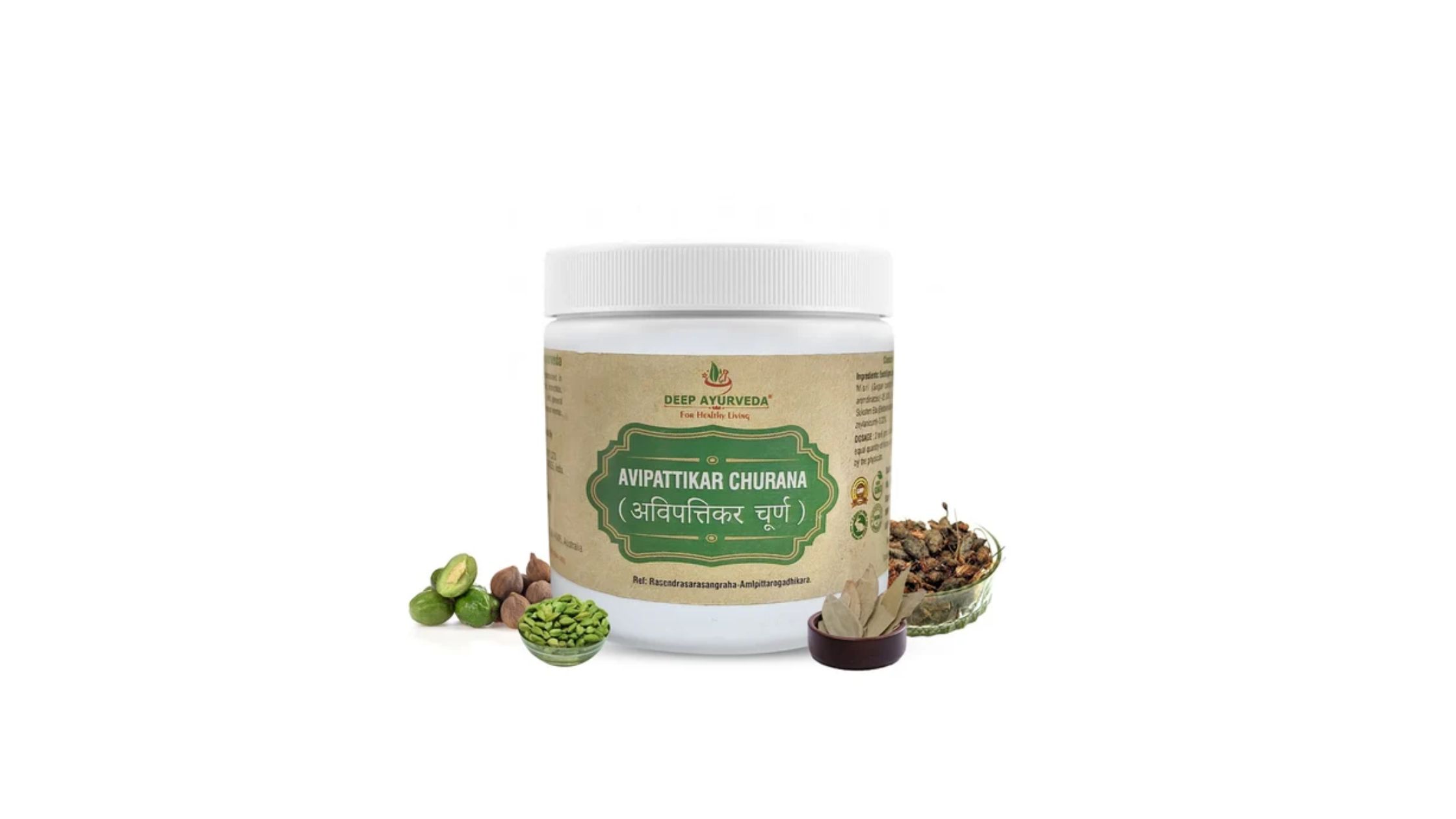
Digestive discomfort is often described simply as acidity, but from an Ayurvedic perspective, digestive symptoms can have different underlying patterns. Avipattikar Churna is a classical Ayurvedic polyherbal formulation traditionally used for digestive complaints, particularly those associated with Amlapitta, excess Pitta and irregular bowel function.
Unlike a single-herb remedy, Avipattikar Churna combines multiple ingredients—including Trikatu, Triphala, Musta, Vidanga, Ela, Tejpatra, Lavanga, Trivrit, Vida Lavana and Sharkara. The classical formulation is therefore better understood as a coordinated digestive formulation rather than simply an acidity powder.
In this guide, we will look at Avipattikar Churna from both a traditional Ayurvedic and modern evidence-informed perspective, including its ingredients, traditional uses, benefits, dosage, safety, precautions and situations where digestive symptoms should be medically evaluated.
What Is Avipattikar Churna?
Avipattikar Churna is a classical Ayurvedic powder formulation containing a combination of digestive herbs, spices, Triphala ingredients, a bowel-regulating herb, salt and sugar.
It is traditionally associated with Amlapitta Chikitsa, an Ayurvedic approach to digestive complaints involving Pitta and disturbed digestion. Classical and contemporary Ayurvedic literature commonly describes its use in conditions characterized by symptoms such as sour belching, burning sensations, nausea, indigestion and bowel irregularity.
From an Ayurvedic practitioner’s perspective, it is important not to reduce the formulation to a modern label such as antacid. Ayurveda approaches digestive complaints according to factors such as:
- Agni (digestive capacity)
- Dosha involvement
- bowel movement
- food habits
- digestion after meals
- symptom pattern
- duration and recurrence of symptoms
This distinction is important because two people may both describe their problem as acidity, while their digestive patterns may be quite different.
Avipattikar Churna Ingredients
Avipattikar Churna is traditionally prepared using a combination of 14 ingredients. Commonly described ingredients include:
| Ayurvedic Ingredient | Common Name | Botanical/Scientific Name |
|---|---|---|
| Shunthi | Dry Ginger | Zingiber officinale |
| Maricha | Black Pepper | Piper nigrum |
| Pippali | Long Pepper | Piper longum |
| Haritaki | Chebulic Myrobalan | Terminalia chebula |
| Bibhitaki | Beleric Myrobalan | Terminalia bellirica |
| Amalaki | Indian Gooseberry | Phyllanthus emblica |
| Musta | Nut Grass | Cyperus rotundus |
| Vidanga | False Black Pepper | Embelia ribes |
| Ela | Cardamom | Elettaria cardamomum |
| Patra/Tejpatra | Indian Bay Leaf | Cinnamomum tamala |
| Lavanga | Clove | Syzygium aromaticum |
| Trivrit | Indian Turpeth | Operculina turpethum |
| Vida Lavana | Vida Salt | Traditional Ayurvedic salt |
| Sharkara | Sugar | — |
Different commercial products may present ingredients and quantities differently, so the product label and applicable Ayurvedic formulation standard should always be checked. Published descriptions of the classical formulation identify these 14 ingredients.
Why Are So Many Ingredients Combined in Avipattikar Churna?
This is one aspect of Avipattikar Churna that is often missed in basic online articles.
Ayurvedic formulations are not necessarily designed by selecting one herb for one symptom. Instead, multiple ingredients can be combined because they contribute different actions within the overall formulation.
1. Trikatu: Shunthi, Maricha and Pippali
These three ingredients form Trikatu, a well-known Ayurvedic combination traditionally associated with Deepana and Pachana actions.
They are commonly included in formulations intended to support digestion.
2. Triphala: Haritaki, Bibhitaki and Amalaki
The three fruits of Triphala bring another important dimension to the formulation.
Rather than focusing only on stomach discomfort, their traditional use also relates to bowel function and digestive balance.
3. Musta and Other Digestive Ingredients
Musta, Vidanga, Ela, Patra and Lavanga contribute traditional digestive and aromatic properties to the formulation.
4. Trivrit
Trivrit is particularly important because of its traditional Virechana/purgative action.
This helps explain why Avipattikar Churna should not be viewed merely as a product for occasional heartburn. Its effects on bowel movement are an important part of understanding the formulation.
5. Sharkara and Vida Lavana
Sharkara provides sweetness and is part of the classical composition, while Vida Lavana is traditionally used as an Ayurvedic salt.
The presence of Sharkara is also relevant for people who need to monitor their sugar intake.
Ayurvedic Properties of Avipattikar Churna
To understand Avipattikar Churna properly, it helps to move beyond the modern phrase “acidity relief” and look at the Ayurvedic concepts behind its traditional use.
Avipattikar Churna and Pitta
Pitta is one of the three Doshas and is closely associated with transformation, metabolism and digestive processes.
When digestive complaints present with features traditionally associated with aggravated Pitta—such as burning sensations, sour taste or sour belching—Ayurvedic assessment may consider a Pitta-dominant pattern.
Avipattikar Churna is traditionally used in such digestive presentations.
However, “Pitta imbalance” should not be treated as a direct medical equivalent of GERD, gastritis or another modern diagnosis. These are different systems of understanding disease.
Avipattikar Churna and Agni
Agni, or digestive fire, is central to Ayurvedic understanding of digestion.
From an Ayurvedic practitioner’s perspective, digestion is not judged only by whether someone feels hungry. Factors such as:
- appetite
- digestion after meals
- bloating
- belching
- bowel regularity
- heaviness
- food tolerance
can all provide useful clues about digestive function.
This is why an Ayurvedic consultation does not necessarily begin with the question:
“How much acidity do you have?”
It may instead explore when symptoms occur, what foods trigger them, bowel habits, appetite and the overall digestive pattern.
Avipattikar Churna Benefits
Avipattikar Churna is traditionally used for several digestive concerns. The following benefits should be understood as traditional Ayurvedic uses, not as guaranteed treatments for diagnosed medical conditions.
1. Traditionally Used for Amlapitta
One of the best-known Ayurvedic applications of Avipattikar Churna is Amlapitta.
Amlapitta is an Ayurvedic condition characterized by digestive symptoms that may include sour or bitter belching, burning sensations, nausea and digestive discomfort.
A small 2024 pilot study comparing Avipattikar Churna with Chitrakadi Kwath evaluated 30 patients with Amlapitta symptoms over 15 days. Both interventions showed improvements in several subjective parameters. However, this was a small study, so its results should not be interpreted as definitive proof of efficacy.
2. May Support Comfortable Digestion
The combination of traditionally digestive ingredients makes Avipattikar Churna a commonly used Ayurvedic formulation for digestive discomfort.
It may traditionally be considered when symptoms include:
- heaviness after meals
- indigestion
- reduced digestive comfort
- occasional bloating
- irregular bowel habits
The appropriate use, however, depends on the individual’s digestive pattern.
3. Traditionally Used for Acidity-Related Symptoms
Avipattikar Churna is widely used in Ayurveda in relation to Amlapitta and symptoms commonly described as acidity.
However, it is important to make one distinction:
Acidity is a symptom description, not always a diagnosis.
Frequent heartburn may have different causes, and persistent reflux symptoms should not simply be masked with a digestive formulation.
Current medical reviews also note that high-quality human evidence for Avipattikar Churna in conditions such as GERD remains limited.
4. May Support Regular Bowel Movement
Trivrit has traditionally recognized purgative properties, while other ingredients contribute to the broader digestive formulation.
For this reason, Avipattikar Churna may traditionally be used when digestive discomfort occurs alongside occasional constipation.
However, taking more than the recommended quantity in an attempt to obtain faster results is not advisable.
5. May Support Appetite and Digestive Function
Traditional Ayurvedic practice uses several of the ingredients in Avipattikar Churna in relation to Deepana and Pachana.
For someone experiencing poor appetite associated with digestive heaviness, an Ayurvedic practitioner may consider digestive formulations according to the individual’s overall presentation.
Avipattikar Churna for Acidity: What Does Ayurveda Say?
This is where Avipattikar Churna is often oversimplified.
A person may say:
I have acidity.
But an Ayurvedic practitioner may want to know:
- Is there burning?
- Is there sour or bitter belching?
- Does it happen after meals?
- Is there constipation?
- Is appetite normal?
- Is there bloating?
- Are spicy or oily foods triggering symptoms?
- Are symptoms worse at night?
- How long has the problem been occurring?
These details can change the Ayurvedic assessment.
Therefore, Avipattikar Churna should not be viewed as a universal solution for every type of acidity.
The traditional rationale is more nuanced and relates to Pitta, Agni and bowel movement, rather than simply reducing stomach acid.
Is Avipattikar Churna Suitable for Everyone With Acidity?
No.
This is an important point for responsible Ayurvedic self-care.
Occasional digestive discomfort in an otherwise healthy adult is very different from:
- persistent heartburn
- recurrent vomiting
- difficulty swallowing
- unexplained weight loss
- black or bloody stools
- severe abdominal pain
- chest pain
- symptoms that repeatedly return despite lifestyle changes
Such symptoms require appropriate medical assessment rather than continued self-treatment.
Avipattikar Churna Dosage
There is no single universal dosage that should be applied to every Avipattikar Churna product.
Different manufacturers provide different directions. For example, some products recommend around 3–6 g, while other products provide different quantities and timings. Patanjali’s current product information lists 3–6 g before meals with water or as directed by a physician, while Baidyanath gives a different product-specific direction.
Therefore:
General Ayurvedic guidance
For an adult, the dose should be based on:
- the specific product
- the formulation strength
- age
- digestive condition
- purpose of use
- bowel pattern
- individual tolerance
- physician’s recommendation
Always follow the dosage printed on the product label or prescribed by your Ayurvedic physician.
Do not increase the quantity because you believe a higher dose will provide faster relief.
When Should Avipattikar Churna Be Taken?
The timing can vary depending on the product and the intended use.
Some Ayurvedic product directions recommend administration before meals, while other products or practitioners may advise different timings.
Therefore, rather than giving one timing as universally correct:
Follow the directions of your specific formulation or your Ayurvedic physician.
The appropriate Anupana, or accompanying vehicle, may also vary according to the formulation and therapeutic purpose.
Can Avipattikar Churna Be Taken Every Day?
This is one of the most important questions to ask before starting long-term use.
Daily long-term use should not be assumed to be appropriate simply because Avipattikar Churna is an Ayurvedic formulation.
Its traditional purgative component means excessive or prolonged use may not be suitable for everyone.
If you feel that you need Avipattikar Churna every day to control acidity, constipation or digestive discomfort, the better approach is to investigate why the symptoms are recurring.
An Ayurvedic consultation can assess diet, lifestyle, Agni, Dosha involvement and bowel habits, while persistent or concerning symptoms may require medical evaluation.
Avipattikar Churna Side Effects
Many people tolerate Ayurvedic digestive formulations well when appropriately selected and used, but side effects are still possible.
Because Avipattikar Churna contains Trivrit and other digestive ingredients, excessive use may lead to:
- loose stools
- increased bowel movements
- abdominal cramping
- digestive discomfort
- nausea in some individuals
If significant diarrhoea develops, continued use may contribute to dehydration and electrolyte disturbances.
Recent health guidance also highlights the importance of caution with long-term or inappropriate use, particularly in people with existing health conditions or those taking multiple medicines.
Who Should Use Avipattikar Churna With Caution?
Professional advice is particularly important for:
- pregnant or breastfeeding women
- children
- older adults
- people with chronic digestive disease
- people with kidney, liver or heart conditions
- people taking several medicines
- people with persistent diarrhoea
- people with electrolyte problems
- people who need to carefully monitor sugar intake
Because the classical formulation contains Sharkara, people managing blood glucose should also check the product’s ingredient information before use.
Can Avipattikar Churna Be Taken With Other Medicines?
If you regularly take prescription medicines, do not assume that an Ayurvedic formulation can automatically be combined with them.
Digestive formulations may potentially affect gastrointestinal transit or absorption, while individual herbs may have their own pharmacological properties.
Therefore, people taking regular medicines should discuss the combination with their doctor, pharmacist or qualified Ayurvedic physician.
This is especially important when medicines have a narrow therapeutic range or when the person has multiple medical conditions.
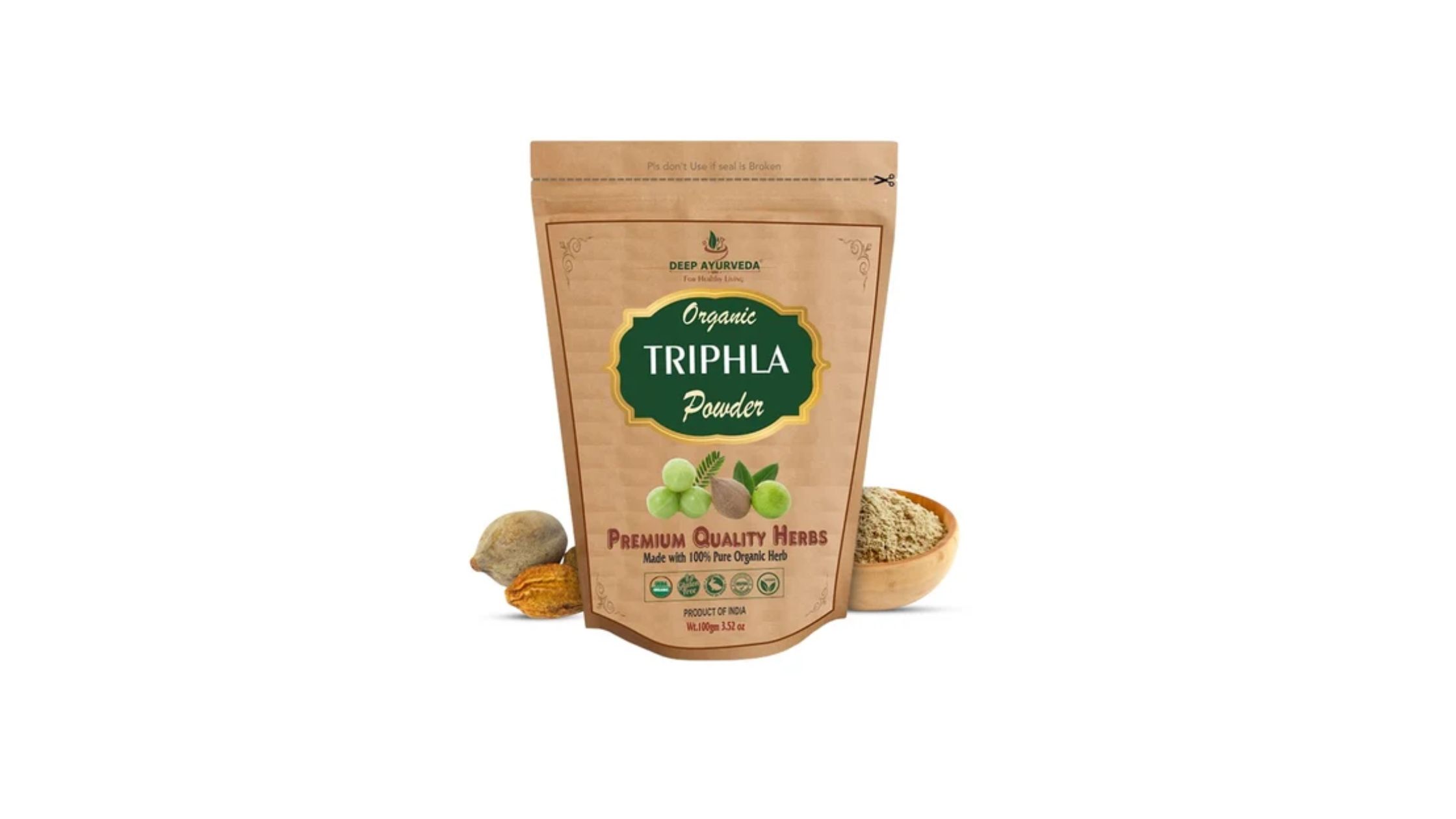
Avipattikar Churna vs Triphala Churna
Both formulations contain Triphala ingredients, but they are not the same formulation.
| Feature | Avipattikar Churna | Triphala Churna |
|---|---|---|
| Formulation | Multi-ingredient classical churna | Primarily three fruits |
| Main traditional focus | Digestive/Pitta-related complaints | Digestive and bowel support |
| Contains Triphala | Yes | Yes |
| Contains Trikatu | Yes | No |
| Contains Trivrit | Yes | No |
| Contains Sharkara | Classical formulation includes it | Generally no |
| Use | Depends on digestive pattern | Depends on individual needs |
So, one should not assume that Avipattikar Churna is simply a stronger version of Triphala.
They have different formulations and traditional applications.
What Does Scientific Research Say About Avipattikar Churna?
A responsible health article should distinguish traditional Ayurvedic use from modern scientific evidence.
Research on Avipattikar Churna includes experimental studies and small clinical investigations.
An earlier experimental study investigated anti-secretory and anti-ulcer activity of Avipattikar Churna in rats. Such findings can provide scientific hypotheses, but animal research cannot establish that the same effect will occur in humans.
A clinical study published in 2016 investigated Avipattikar Churna along with Kapardika Bhasma in 33 patients with Amlapitta. The study reported improvement, but because the intervention involved a combination and the study size was small, it should not be interpreted as definitive evidence for Avipattikar Churna alone.
More recently, a pilot study compared Avipattikar Churna with Chitrakadi Kwath in 30 patients with Amlapitta symptoms. Both groups showed improvement across several subjective measures. Again, larger and better-controlled studies would be needed to establish stronger conclusions.
What does this mean for consumers?
The evidence is interesting but not conclusive.
Avipattikar Churna has a long history of traditional Ayurvedic use, but modern clinical evidence is not yet strong enough to present it as a proven treatment for every form of acidity, GERD, gastritis or ulcer disease.
That distinction is important when making informed health decisions.
When Should You See a Doctor Instead of Self-Treating?
Do not rely on Avipattikar Churna or any home remedy alone if digestive symptoms are severe, persistent or unusual.
Seek medical attention for symptoms such as:
- difficulty swallowing
- persistent vomiting
- unexplained weight loss
- blood in vomit
- black or tarry stools
- severe or persistent abdominal pain
- unexplained chest pain
- recurrent symptoms that are getting worse
These symptoms can sometimes indicate conditions that require proper diagnosis and treatment.
How to Choose a Good Avipattikar Churna
If you are purchasing Avipattikar Churna, look for:
- a reputable Ayurvedic manufacturer
- complete ingredient information
- clearly stated net quantity
- batch and expiry details
- appropriate manufacturing/licensing information
- clear dosage instructions
- proper packaging
- transparent quality information
Do not choose a product solely because it promises to “cure” multiple diseases.
A responsible Ayurvedic product should provide clear information about what it contains and how it should be used.
Practical Ayurvedic Tips for Better Digestive Health
Taking an Ayurvedic formulation while continuing habits that aggravate digestion may not provide lasting improvement.
From an Ayurvedic perspective, consider simple habits such as:
Eat according to your digestive capacity
Avoid repeatedly eating when the previous meal has not been digested comfortably.
Be mindful of very heavy meals
Excessively oily, fried or very spicy meals may aggravate digestive discomfort in susceptible individuals.
Avoid unnecessarily late meals
Large meals close to bedtime may worsen digestive and reflux-related symptoms in some people.
Pay attention to your own triggers
Keep note of foods or routines that consistently precede symptoms.
Do not rely on digestive formulations to compensate for lifestyle
A churna should not become a substitute for appropriate food habits, sleep and medical assessment when needed.
Final Ayurvedic Perspective
Avipattikar Churna is a traditional Ayurvedic digestive formulation commonly used for Amlapitta, digestive discomfort and bowel irregularity. Its use should be based on individual symptoms, Agni and Ayurvedic assessment. For persistent or severe digestive problems, consult a qualified healthcare professional.
Frequently Asked Questions About Avipattikar Churna
What is Avipattikar Churna used for?
Avipattikar Churna is traditionally used in Ayurveda for digestive complaints, particularly Amlapitta and symptoms associated with Pitta-related digestive imbalance. It is also traditionally used to support bowel regularity.
Is Avipattikar Churna good for acidity?
It is traditionally used for Amlapitta and acidity-related digestive symptoms. However, persistent heartburn or reflux should be medically evaluated rather than managed indefinitely with self-treatment.
Can Avipattikar Churna help with constipation?
It may traditionally support bowel movement, partly because the formulation contains Trivrit, which has purgative properties. It should not be taken in excessive amounts for constipation.
What are the main ingredients in Avipattikar Churna?
The classical formulation contains 14 ingredients, including Shunthi, Maricha, Pippali, Triphala, Musta, Vidanga, Ela, Patra, Lavanga, Trivrit, Vida Lavana and Sharkara.
How much Avipattikar Churna should I take?
Dosage varies by product and individual. Follow the manufacturer’s label or your Ayurvedic physician’s recommendation rather than applying one universal dose.
Can Avipattikar Churna be taken daily?
Daily use should not be assumed to be appropriate for everyone. If you need it continuously for digestive symptoms, consult a qualified healthcare professional to understand the underlying cause.
Can Avipattikar Churna cause loose stools?
Yes, excessive or unsuitable use may increase bowel movements or cause loose stools, particularly because the formulation contains Trivrit.
Is Avipattikar Churna the same as Triphala Churna?
No. Both may contain Triphala ingredients, but Avipattikar Churna contains several additional herbs and ingredients, including Trikatu and Trivrit.