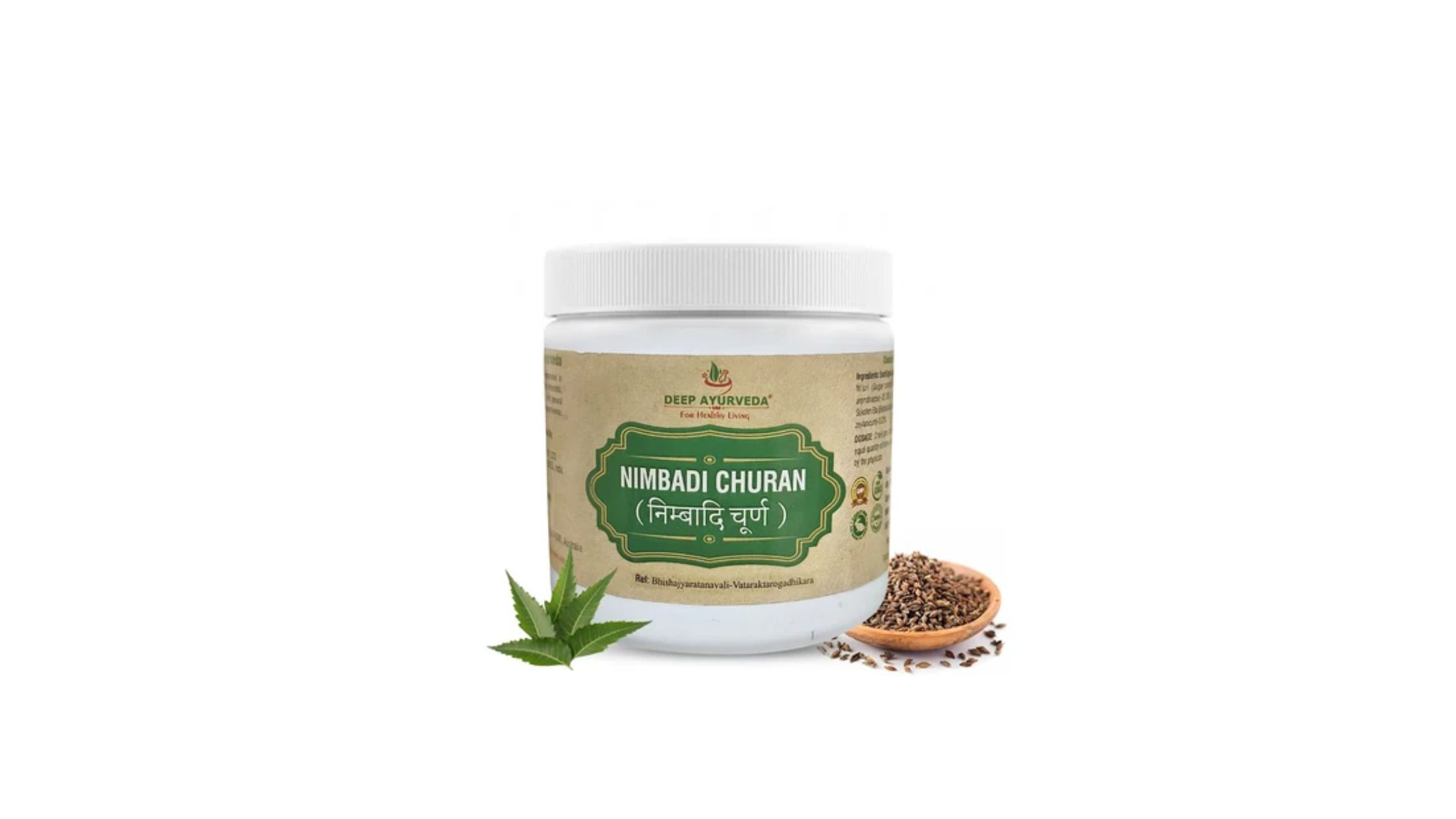
Nimbadi Churna is a traditional Ayurvedic herbal powder formulation associated with specific therapeutic applications, particularly in the Ayurvedic management of Vatarakta and certain skin-related conditions. However, there is an important point that is often missed online: products sold under the name Nimbadi Churna may not always contain exactly the same ingredients or follow the same formulation reference.
Classical Ayurvedic references identify Nimbadi Curna in the context of Vatarakta, with a reported dose of 1–3 g in the cited formulation. The Ministry of Ayush’s Standard Treatment Guidelines for Ayurvedic metabolic disorders also list Nimbadi Churna at 1–3 g after meals for 2–3 weeks, with Guduchi decoction or warm water, for a specific therapeutic context. This should not be interpreted as a universal dose for every Nimbadi Churna product.
This guide explains what Nimbadi Churna is, its ingredients, traditional Ayurvedic uses, potential benefits, dosage, anupana, safety precautions, and how to distinguish a classical formulation from a commercial product.
Important: Nimbadi Churna is not a single standardized modern medicine. Before using it, check the exact ingredient list and directions on the product you have. For persistent or significant health problems, consult a qualified Ayurvedic practitioner or appropriate healthcare professional.
What Is Nimbadi Churna?
The word Nimbadi comes from Nimba, the Ayurvedic name for neem (Azadirachta indica), while Churna refers to a finely powdered herbal preparation.
In Ayurveda, a churna is prepared by appropriately processing and pulverizing herbal ingredients into a powder that can be administered internally or, in some formulations, used externally.
Nimbadi Churna is therefore best understood as a polyherbal Ayurvedic formulation rather than simply powdered neem.
The traditional formulation referenced in Bhaishajya Ratnavali is associated with Vatarakta, and the formulation has also been discussed in Ayurvedic literature in relation to disorders involving Rakta and Twak (skin).
An important point about the name
Searching for Nimbadi Churna online can be confusing because different websites and manufacturers describe different compositions under similar names.
For example, one published formulation contains a broad combination of herbs including Nimba, Amalaki, Guduchi, Haritaki, Vidanga, Shunthi, Haridra, Daruharidra, Pippali, Mustaka, Khadira and other ingredients.
Therefore:
Nimbadi Churna should be identified by its formulation and ingredient list—not by the name alone.
This distinction becomes particularly important when discussing its dosage, indications and safety.
Nimbadi Churna Ingredients
The ingredients depend on the specific formulation or product reference. A classical formulation should not automatically be assumed to be identical to every commercially available Nimbadi Churna.
One documented formulation includes several herbs traditionally selected for their different Ayurvedic properties. These include:
Ayurvedic Ingredient Botanical Name Traditional Ayurvedic relevance Nimba Azadirachta indica Traditionally associated with skin and Rakta-related applications Amalaki Phyllanthus emblica Rasayana and Pitta-supportive applications Guduchi Tinospora cordifolia Traditionally used in formulations addressing Pitta and inflammatory presentations Haritaki Terminalia chebula Traditionally valued for digestive and Vata-related applications Vidanga Embelia ribes Traditionally used in digestive and Krimi-related formulations Shunthi Zingiber officinale Supports Agni and digestion in Ayurvedic practice Haridra Curcuma longa Traditionally used in inflammatory and skin-oriented formulations Daruharidra Berberis aristata Traditionally associated with skin and Pitta-related applications Pippali Piper longum Traditionally used to support Agni and respiratory/digestive formulations Mustaka Cyperus rotundus Traditionally used in digestive and Pitta-related formulations Khadira Acacia catechu Traditionally associated with skin and Rakta-related applications The complete ingredient list can be considerably longer depending on the particular classical or commercial formulation.
Why does the ingredient list matter?
Two products carrying the same or similar name may have different compositions.
That means the following should not automatically be assumed to be interchangeable:
- Classical Nimbadi Churna
- Nimbadi Churna from one pharmacy
- Nimbadi Choornam from another manufacturer
- Nimbadi Kashayam
- Nimbadi-based proprietary formulations
This is one reason dosage and therapeutic use should always be connected to the specific formulation being used.
How Is Nimbadi Churna Understood in Ayurveda?
Ayurveda does not evaluate a formulation solely by asking what disease it cures. Its application is traditionally considered in relation to factors such as:
- Dosha
- Dushya
- Agni
- Ama
- Srotas
- Rasa
- Guna
- Virya
- Vipaka
- The individual’s constitution and clinical presentation
For Nimbadi Churna, the importance of bitter, astringent and pungent herbs in the formulation is particularly relevant to understanding its traditional therapeutic profile.
However, the exact Ayurvedic properties depend on the actual ingredients and proportions of the formulation.
This is another reason why simply saying that Nimbadi Churna balances all three doshas is an oversimplification.
What Is Nimbadi Churna Traditionally Used For?
The strongest classical reference identified for Nimbadi Curna places it under Vataraktadhikara in Bhaishajya Ratnavali.
Ayurvedic sources also discuss Nimbadi formulations in connection with various skin-related presentations.
Depending on the formulation, traditional applications may include:
- Vatarakta-related management
- Certain skin disorders
- Itching and skin irritation in appropriate Ayurvedic contexts
- Rakta- and Pitta-related presentations
- Digestive considerations when relevant to the formulation
However, these traditional indications should not be converted into modern claims that Nimbadi Churna can cure psoriasis, eczema, gout, fungal infections or other diagnosed diseases.
A better way to understand the formulation is:
Ayurveda selects a formulation according to the individual’s presentation and underlying doshic and tissue considerations, rather than simply matching one herb or churna to one modern disease name.
Nimbadi Churna Benefits
The benefits of Nimbadi Churna should be discussed in the context of traditional Ayurvedic use, rather than promising guaranteed medical outcomes.
1. Traditionally Used in Skin-Related Conditions
Nimba and other bitter herbs are prominent in several Ayurvedic approaches to skin and Rakta-related disorders.
The presence of herbs such as Nimba, Haridra, Daruharidra and Khadira in documented formulations gives the preparation a strong traditional association with skin health and Pitta-Rakta considerations.
However, not every skin problem has the same cause.
A rash caused by a fungal infection, for example, should not automatically be treated as an Ayurvedic blood impurity. Proper diagnosis remains important.
2. Traditionally Used in Vatarakta
One of the most important classical associations of Nimbadi Curna is Vatarakta.
Vatarakta is an Ayurvedic disease concept involving an interaction between Vata and Rakta. Modern descriptions sometimes compare it with gout because of overlapping features, but the two concepts should not be treated as exact equivalents.
The classical reference specifically places Nimbadi Curna in the Vatarakta section of Bhaishajya Ratnavali.
This makes Vatarakta a more meaningful traditional indication to discuss than simply describing Nimbadi Churna as a generic detox powder.
3. May Support Digestive Function According to Its Formulation
Several herbs found in documented Nimbadi formulations, including Shunthi, Pippali, Haritaki and Vidanga, have established roles in traditional Ayurvedic digestive formulations.
Ayurveda places considerable importance on Agni, or digestive/metabolic capacity, when selecting internal medicines.
However, this does not mean every Nimbadi Churna product should be marketed as a digestive supplement. The actual ingredient composition determines its appropriate application.
4. Traditionally Associated With Pitta-Rakta and Skin Balance
The bitter and astringent nature of several herbs used in Nimbadi-type formulations is traditionally considered relevant to Pitta and Rakta-related conditions.
This is an Ayurvedic framework and should not be confused with the modern biomedical idea that a product literally cleanses or purifies blood.
What does blood purification mean in Ayurveda?
This is an important distinction.
When Ayurvedic literature uses concepts such as Rakta Shodhana, it refers to a traditional therapeutic framework involving Rakta and associated doshas.
It should not automatically be translated into a claim that the product physically removes toxins from human blood, as though it were a modern detoxification procedure.
This distinction makes health information more accurate and prevents exaggerated claims.
Nimbadi Churna for Skin Health
Nimbadi formulations are frequently discussed online in connection with skin health, but this subject needs more nuance than a simple list of skin benefits.
Ayurveda considers skin (Twak) in relation to multiple factors, including:
- Dosha
- Rakta
- Agni
- Ama
- Diet
- Lifestyle
- Individual constitution
- The specific nature of the skin disorder
A person experiencing itching, redness, scaling, pigmentation or recurrent eruptions may have very different underlying conditions.
Therefore, Nimbadi Churna should not be treated as a universal remedy for every skin complaint.
If a skin problem is persistent, rapidly spreading, painful, associated with discharge, involves a non-healing wound, or is accompanied by fever or other systemic symptoms, professional evaluation is important.
Nimbadi Churna and Vatarakta
The relationship between Nimbadi Curna and Vatarakta deserves special attention because it is supported by the classical reference identified above.
In Ayurveda, Vatarakta describes a pathological interaction involving Vata and Rakta. Its presentation can include pain, tenderness, swelling and other features depending on the stage and individual condition.
Modern readers sometimes interpret Vatarakta simply as gout. That comparison can be useful for orientation, but it is not a perfect one-to-one translation.
For someone with suspected gout, particularly recurrent severe joint pain or swelling, modern medical evaluation may be necessary to establish the diagnosis and assess uric acid and other relevant factors.
Therefore, it is more accurate to write:
Nimbadi Curna has a classical Ayurvedic association with Vatarakta; it should not be presented as a guaranteed treatment for modern gout without appropriate diagnosis and professional guidance.
How to Take Nimbadi Churna
There is no single universal way to take every product labelled Nimbadi Churna.
The correct method depends on:
- The exact formulation
- The therapeutic purpose
- The prescribed dose
- The anupana
- The individual’s age and health status
- Other medicines or therapies being used
The Ministry of Ayush’s Standard Treatment Guidelines list Nimbadi Churna at 1–3 g after meals for 2–3 weeks, with Guduchi Kwatha or warm water, in a specific Ayurvedic treatment context.
That is more useful than giving readers a blanket instruction to take it every day indefinitely.
Nimbadi Churna Dosage
A classical reference cited in the literature gives 1–3 g for Nimbadi Curna.
The Ministry of Ayush guideline similarly lists:
- Dose: 1–3 g
- Timing: After meals
- Duration: 2–3 weeks
- Anupana: Guduchi decoction or warm water
Again, these directions belong to a specific therapeutic context and should not be interpreted as a universal prescription for every Nimbadi Churna available in the Indian market.
Classical dose vs product-label dose
This is an important practical distinction:
Situation What should guide use? Classical formulation Relevant classical reference and practitioner guidance Branded Nimbadi Churna Product label and formulation details Existing health condition Qualified practitioner/doctor Other medicines being taken Professional advice Pregnancy or breastfeeding Individual professional assessment Children Pediatric/qualified practitioner guidance Do not increase the dose simply because a smaller amount does not produce an immediate result.
What Is the Anupana for Nimbadi Churna?
Anupana refers to the substance or liquid administered along with an Ayurvedic medicine.
Its selection is not merely about making a powder easier to swallow. Traditionally, anupana is selected according to the formulation, therapeutic objective and individual condition.
For the Nimbadi Curna dosage listed in the Ministry of Ayush guideline, Guduchi Kwatha or warm water is specified as the anupana.
Therefore, it is better not to state that Nimbadi Churna must always be taken with honey, milk or any other vehicle unless that instruction belongs to the specific formulation being discussed.
Nimbadi Churna Side Effects and Safety
Naturally occurring does not automatically mean suitable for everyone.
Because Nimbadi formulations may contain multiple herbs, tolerance can vary according to the formulation, dose and individual.
Possible concerns with inappropriate use may include:
- Digestive discomfort
- Excessive dryness or irritation in sensitive individuals
- Intolerance to one or more ingredients
- Interactions or therapeutic conflicts with existing treatment
- Problems from excessive or prolonged unsupervised use
The risk cannot be assessed accurately without knowing which Nimbadi formulation is being used.
Use extra caution if you:
- Are pregnant or breastfeeding
- Are giving it to a child
- Are elderly or medically frail
- Have a chronic medical condition
- Take prescription medicines regularly
- Have a history of sensitivity to herbal products
- Plan to use it for a prolonged period
A qualified Ayurvedic practitioner can determine whether the formulation, dose, anupana and duration are appropriate for the individual.
Who Should Not Self-Use Nimbadi Churna?
Self-treatment is particularly inappropriate when the underlying condition has not been identified.
Seek professional evaluation for:
- A persistent or worsening skin condition
- A non-healing wound
- Severe or recurrent joint pain
- Sudden swelling of a joint
- Fever accompanying a skin or joint problem
- Rapidly spreading redness
- Unexplained pigmentation or depigmentation
- Recurrent symptoms despite treatment
A similar-looking skin complaint can have very different causes. Eczema, psoriasis, fungal infection, bacterial infection, allergic dermatitis and other conditions should not be assumed to be the same problem.
Are All Nimbadi Churna Products the Same?
No.
This is one of the most important points consumers should understand.
The name Nimbadi Churna does not by itself guarantee an identical ingredient list across manufacturers or references.
A documented formulation may contain a broad group of herbs, while a commercial product using the same name may have a different composition.
Therefore, before purchasing or using Nimbadi Churna, check:
- Full ingredient list
- Botanical names where available
- Quantity/proportion of ingredients
- Manufacturer
- Batch information
- Expiry date
- Recommended dosage
- Intended route of administration
- Classical reference, if stated
The formulation matters more than the name on the front of the package.
How to Choose a Good Nimbadi Churna
When comparing products in India, don’t judge quality solely by marketing phrases such as 100% natural, powerful detox, or instant results.
Instead, look for transparent product information.
A useful checklist
1. Check the ingredients
You should be able to identify what is actually in the product.2. Check the dosage instructions
A reputable product should provide clear directions.3. Look for manufacturer information
The label should clearly identify the manufacturer and relevant batch details.4. Check the formulation reference
If the product claims to follow a classical formula, look for the cited Ayurvedic reference.5. Don’t confuse different formulations
Nimbadi Churna, Nimbadi Kashayam and Nimbadi Choornam should not automatically be assumed to be interchangeable.Nimbadi Churna vs Nimbadi Kashayam
The two names can sound similar, but Churna and Kashayam are different dosage forms.
Feature Nimbadi Churna Nimbadi Kashayam Form Herbal powder Herbal decoction/preparation Administration Depends on formulation Prepared/administered as a liquid decoction Dose Usually expressed in grams Usually expressed in millilitres Composition Depends on reference/product Depends on reference/product Interchangeable? No—not automatically No—not automatically Therefore, someone should not substitute one for the other simply because both contain Nimbadi in the name.
Final Ayurvedic Perspective
Nimbadi Churna is best understood as a traditional Ayurvedic polyherbal formulation whose appropriate use depends on the exact composition, therapeutic context, dose and individual assessment. Its classical association with Vatarakta and its broader traditional relationship with skin and Rakta-related conditions make it an interesting formulation, but it should not be presented as a universal cure for modern diseases.
The most important practical lesson is simple: don’t identify an Ayurvedic formulation by its name alone. Check its ingredients, classical reference, dosage and intended use before taking it. For persistent or significant symptoms, individualized guidance from a qualified practitioner is preferable to self-medication.
Frequently Asked Questions About Nimbadi Churna
What is Nimbadi Churna used for?
Nimbadi Churna is a traditional Ayurvedic polyherbal formulation. A classical Nimbadi Curna reference is associated with Vatarakta, while Nimbadi-type formulations are also discussed in Ayurvedic contexts involving skin and Rakta-related conditions.
What is the dosage of Nimbadi Churna?
A classical reference gives 1–3 g, while the Ministry of Ayush guideline lists 1–3 g after meals for 2–3 weeks with Guduchi decoction or warm water in a specific therapeutic context. Product-specific directions may differ.
Can Nimbadi Churna be taken every day?
Daily use should not be assumed to be appropriate for every formulation or person. The appropriate duration depends on the formulation, purpose and individual assessment.
Is Nimbadi Churna useful for skin problems?
Some Nimbadi formulations have traditional associations with skin and Rakta-related conditions. However, the suitability depends on the exact formulation and the nature of the skin problem.
Is Nimbadi Churna the same as Nimbadi Kashayam?
No. Churna is a powder dosage form, whereas Kashayam is a decoction-based preparation. They should not be considered interchangeable merely because their names are similar.
Can children take Nimbadi Churna?
Children should not be given an adult dose. Because formulations differ and pediatric dosing requires individual consideration, consult a qualified practitioner before use.
Can Nimbadi Churna be taken during pregnancy?
Pregnancy requires individualized assessment. Do not self-start a multi-herbal Ayurvedic formulation during pregnancy without professional guidance.