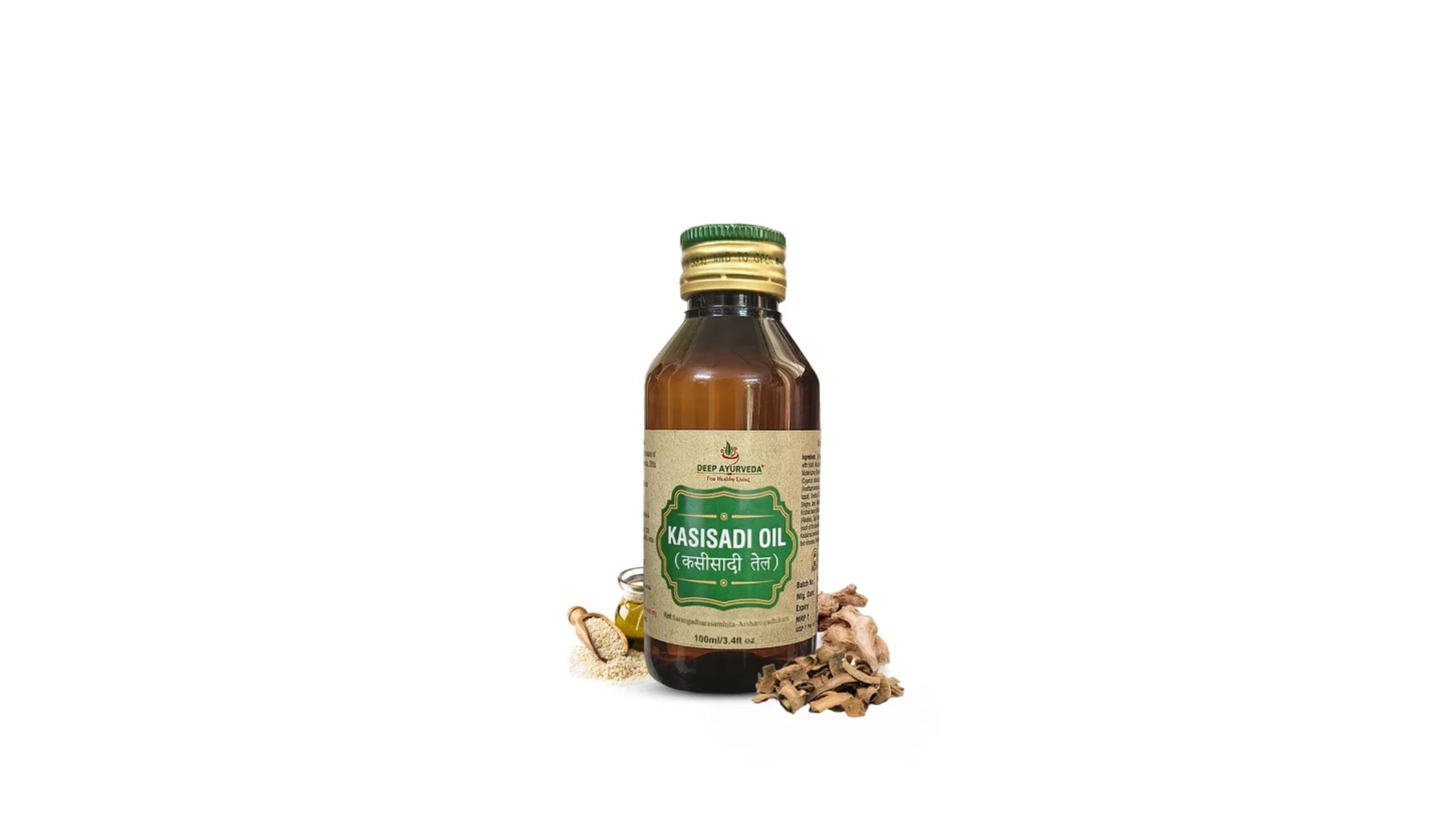
Kasisadi Oil, traditionally known as Kasisadi Taila, is an Ayurvedic medicated oil associated particularly with the management of Arsha, the Ayurvedic term commonly correlated with haemorrhoids or piles. It is a specialized formulation rather than an ordinary massage oil, and its traditional use involves local application in specific conditions.
But there is an important detail that is often missed when discussing Kasisadi Oil: not every product carrying the name Kasisadi Oil necessarily has an identical composition or is intended to be used in exactly the same way.
The classical reference, ingredients, preparation method, route of application, and the condition being addressed all matter.
In this guide, we will look at Kasisadi Oil from an Ayurvedic perspective while also examining what clinical research has investigated, how the formulation may vary, how it is traditionally applied, and what precautions are worth knowing before use.
Important: This article explains traditional Ayurvedic use and available research. It is not a substitute for an individual examination or prescription from a qualified Ayurvedic physician or medical doctor.
What Is Kasisadi Oil?
Kasisadi Oil, or Kasisadi Taila, is a medicated Ayurvedic oil traditionally used in specific therapeutic applications, particularly in relation to Arsha.
The word Taila refers to an oil-based preparation, while Kasisadi indicates that the formulation is associated with Kasis (Kasisa) and other ingredients used according to the relevant Ayurvedic formulation.
Unlike a simple herbal oil prepared for routine massage, Kasisadi Taila belongs to the category of medicated oils prepared for a particular therapeutic purpose.
Its importance in Ayurveda comes not simply from the oil base but from the combination of ingredients, their processing, and the intended route of application.
The National AYUSH Mission’s Essential Drugs List for Ayurveda includes Kasisadi Taila under Arsha and specifies external application on Arshankura. This provides an important official reference for understanding its traditional therapeutic context.
Kasisadi Taila, Kasisadi Oil and Kasisadi Tailam: Are They the Same?
You may see several names while searching for this formulation:
- Kasisadi Taila
- Kasisadi Tailam
- Kasisadi Oil
- Kashisadi Oil
- Kashisadi Taila
In general usage, these names may refer to the same Ayurvedic formulation family. However, the name alone should not be treated as proof that two products have exactly the same composition.
This is particularly important when purchasing an Ayurvedic formulation.
Different manufacturers may follow different references, and formulations sharing a similar name may have variations in ingredients or preparation.
Therefore, when comparing two Kasisadi products, look beyond the front label.
Check:
- The complete ingredient list
- The classical reference mentioned by the manufacturer
- The dosage form and route of application
- Directions on the product label
- Manufacturer and licensing information
- Batch and expiry details
A useful rule to remember
Don’t identify an Ayurvedic formulation by its name alone. Identify it by its formulation and reference.
This small distinction can prevent considerable confusion.
Why Is Kasisadi Oil Called Kasisadi Taila?
The name provides a clue about the formulation but does not describe every ingredient or every therapeutic action.
In Ayurvedic terminology, Taila refers to an oil preparation. The term -adi broadly indicates and others, while Kasis or Kasisa refers to a specific mineral substance used in Ayurvedic pharmaceutics.
However, the exact ingredients and proportions depend on the formulation reference being followed.
This is one reason why simply copying an ingredient list from one commercial website and presenting it as the universal composition of Kasisadi Oil can be misleading.
Kasisadi Oil in Traditional Ayurveda
To understand Kasisadi Oil properly, it helps to begin with Arsha, rather than starting with a modern disease label.
What is Arsha?
Arsha is an Ayurvedic disease concept traditionally associated with abnormal tissue growth or swelling in the anal region and is commonly correlated with haemorrhoids.
Modern haemorrhoids and Ayurvedic Arsha are related concepts, but they should not automatically be treated as perfectly identical diagnostic categories.
Ayurveda approaches a condition through its:
- Dosha involvement
- Agni and digestion
- bowel habits
- stool consistency
- local pathology
- chronicity
- individual constitution
- associated symptoms
This is why Ayurvedic treatment is traditionally individualized rather than based solely on the name of a condition.
Kasisadi Oil for Piles: What Does Ayurveda Say?
The association between Kasisadi Taila and Arsha is one of the most important reasons people search for this formulation.
Official AYUSH material lists Kasisadi Taila under Arsha and specifies its external application on Arshankura.
In practical terms, this means that Kasisadi Taila has a documented traditional context for local application in relevant haemorrhoidal presentations.
However, this does not mean that every person experiencing anal discomfort or rectal bleeding should automatically apply Kasisadi Oil.
Why not?
Because symptoms around the anus can have several causes.
For example:
- haemorrhoids
- anal fissure
- fistula
- abscess
- dermatitis
- infection
- inflammatory bowel conditions
- polyps or other intestinal conditions
Rectal bleeding should therefore not be self-diagnosed as piles simply because piles are common.
When should you seek medical evaluation?
Seek professional evaluation if you experience:
- repeated or unexplained rectal bleeding
- significant or worsening pain
- fever
- pus or discharge
- a rapidly increasing swelling
- black or tar-like stools
- dizziness or weakness associated with bleeding
- persistent symptoms despite self-care
The purpose is not to create fear. It is simply to avoid treating an incorrect diagnosis.
What Are the Ingredients in Kasisadi Oil?
This is one area where online information requires particular care.
You may find very different ingredient lists when searching for Kasisadi Oil.
Some commercially available preparations list a combination of herbal, mineral, and oil-based ingredients, while published Ayurvedic literature also describes variations in the composition of Kasisadi Taila.
Therefore, it is not scientifically responsible to assume that one ingredient table represents every product sold under the Kasisadi name.
What can be said more reliably?
Kasisadi formulations may involve:
- Kasis/Kasisa
- herbal ingredients
- a suitable oil base
- other processing ingredients depending on the classical formulation
The precise formulation should be verified against the specific classical reference or manufacturer’s label.
Why Can Two Kasisadi Oils Have Different Ingredients?
This is an important question that deserves more attention than it usually receives.
Ayurvedic formulations can be transmitted through different classical references, and some formulations have more than one textual description or have undergone pharmaceutical interpretation during manufacturing.
Recent Ayurvedic literature has specifically reviewed variations in the composition of Kasisadi Taila.
Therefore, if two products have different ingredient lists, it does not automatically mean that one is counterfeit.
The right questions are:
- Which classical reference does the manufacturer follow?
- Is the formulation clearly declared?
- Are the ingredients listed transparently?
- Is the product manufactured by a properly licensed company?
- Are directions and precautions clearly provided?
This is especially important with mineral ingredients.
If a formulation contains mineral or processed substances, consumers should not assume that the raw material and the final Ayurvedic preparation are interchangeable.
Ayurvedic pharmaceutical processing matters.
For this reason, home preparation of a complex medicated oil should not be attempted by simply purchasing individual raw ingredients and mixing them together.
Traditional Uses of Kasisadi Oil
The strongest and clearest traditional association of Kasisadi Taila is with Arsha.
Depending on the particular formulation and Ayurvedic reference, other traditional applications may also be described.
However, online commercial articles sometimes combine multiple indications from different formulations and present them as though they are universally applicable to every Kasisadi Oil.
That approach can create confusion.
A better way to understand the formulation is to separate:
Traditional indication
What the classical Ayurvedic reference describes.
Product indication
What a particular manufacturer declares on its label.
Clinical research
What researchers have actually studied.
These three categories should not automatically be treated as interchangeable.
What Does Modern Research Say About Kasisadi Oil?
Kasisadi Taila has been investigated in clinical and academic Ayurvedic research, particularly in relation to Arsha/haemorrhoids.
The Central Council for Research in Ayurvedic Sciences (CCRAS) has documented a clinical evaluation involving Triphala Guggulu and Kasisadi Taila in the management of Arsha (haemorrhoids). The study was designed as a prospective, open-label interventional clinical study across multiple centres.
This is important because it shows that the formulation has not only been discussed traditionally but has also been the subject of clinical investigation.
However, a research study should not automatically be converted into a universal treatment claim.
What Does a Clinical Study Actually Tell Us?
Suppose a study reports improvement among participants who received a particular Ayurvedic intervention.
That tells us something about the participants and the conditions under which the study was conducted.
It does not automatically establish that:
Kasisadi Oil cures piles in everyone.
Several factors must be considered:
- study design
- number of participants
- comparison group
- duration
- outcome measures
- diagnostic criteria
- other treatments used simultaneously
- follow-up period
- reproducibility of the findings
This distinction is particularly important in health content.
Traditional use and clinical evidence are different forms of information.
Traditional Ayurvedic use tells us what the formulation has historically been used for.
Clinical research tells us what has been investigated under defined study conditions.
Neither should be exaggerated beyond what the evidence supports.
Kasisadi Oil and Anal Fissure
Another common search query is Kasisadi Oil for fissure.
There is emerging Ayurvedic literature examining Kaseesadi/Kasisadi Taila in relation to Parikartika, an Ayurvedic condition often correlated with anal fissure.
For example, a published case study reported the use of Kaseesadi Taila by rectal administration in a patient with fissure-in-ano.
However, a single case study is not equivalent to high-quality evidence establishing efficacy for all patients.
This distinction is worth emphasizing because commercial health pages can sometimes turn an individual case report into a broad treatment claim.
So, can Kasisadi Oil be used for fissure?
The answer depends on the specific formulation, diagnosis, route of administration, and clinical assessment.
Someone with severe anal pain and bleeding should not assume that the condition is simply a fissure and begin internal application without professional guidance.
How Is Kasisadi Oil Traditionally Applied?
The route of application matters.
The official AYUSH listing identifies Kasisadi Taila for external application on Arshankura in the context of Arsha.
Therefore, consumers should first follow the specific product label or prescription provided by a qualified practitioner.
External application
Where external application is indicated, the oil is applied locally according to the practitioner’s or product manufacturer’s instructions.
The area should be handled gently.
Avoid vigorous rubbing, particularly when the tissue is painful, inflamed, cracked, or bleeding.
How much Kasisadi Oil should you use?
There is no responsible universal amount that should be prescribed to every person reading a general health article.
The appropriate quantity can depend on:
- the formulation
- the intended application
- the condition
- age
- sensitivity
- whether other treatments are being used
If an Ayurvedic physician has prescribed the oil, follow the prescribed method rather than copying an amount mentioned in an unrelated internet article.
Can Kasisadi Oil Be Used Internally?
This is one of the most important questions to answer carefully.
Do not assume that because a clinical study used a particular internal or rectal administration method, the same method is appropriate for self-treatment.
Published Ayurvedic research has investigated specific routes and quantities under study protocols. Those protocols are designed for defined patients under clinical conditions.
They should not be treated as general consumer instructions.
For routine consumer use, follow:
- the product label
- the specific prescription
- qualified Ayurvedic medical advice
If a product is labelled for external use only, it should not be used internally.
Kasisadi Oil: Traditional Ayurvedic Perspective on Its Action
Ayurvedic interpretation of a formulation is not limited to the modern concept of active ingredients.
Practitioners may evaluate a medicine through concepts such as:
- Rasa – taste
- Guna – qualities
- Virya – potency
- Vipaka – post-digestive effect
- Karma – therapeutic action
- Dosha interaction
- condition-specific application
The actions attributed to a formulation should therefore be interpreted in the context of its complete composition and method of preparation, rather than assigning a single modern pharmacological effect to one ingredient.
This is another reason why copying a list of isolated ingredient benefits does not adequately explain an Ayurvedic formulation.
Kasisadi Oil Benefits: What Can We Responsibly Say?
Searches for Kasisadi Oil benefits often produce long lists of claimed benefits.
A more accurate approach is to classify them.
Traditionally associated use
Kasisadi Taila has a documented Ayurvedic association with Arsha, particularly local application in relevant presentations.
Areas investigated in research
Clinical and academic research has investigated Kasisadi preparations in conditions including haemorrhoids and, in some reports, fissure-in-ano.
Claims that require caution
Claims such as:
- permanently cures piles
- guarantees fissure healing
- works for every type of haemorrhoid
- has no side effects
- replaces surgery
- works instantly
should not be presented as established facts without strong evidence.
The more responsible approach is to describe traditional use and available evidence separately.
Kasisadi Oil Safety and Precautions
Kasisadi Oil is a therapeutic Ayurvedic formulation, so natural should not automatically be interpreted as risk-free.
Before using it, consider the following:
1. Check the label
Confirm whether the product is intended for external use.
2. Check the ingredients
This is especially important when the formulation contains mineral or processed ingredients.
3. Don’t use it on unexplained lesions
If you do not know what a swelling, ulcer, wound, or bleeding area represents, get it evaluated first.
4. Stop if significant irritation develops
Burning or irritation that is persistent or severe should not simply be ignored.
5. Take extra care in pregnancy and breastfeeding
Consult a qualified healthcare professional before using therapeutic formulations during pregnancy or breastfeeding.
6. Children need professional guidance
Do not automatically use an adult Ayurvedic formulation on a child.
7. Follow the prescribed route
External application and internal/rectal administration are not interchangeable.
How to Choose a Good Kasisadi Oil
If you are purchasing Kasisadi Oil, don’t judge the product only by its marketing claims.
Use this checklist.
Look for:
1. Clear formulation
The product should provide a complete ingredient list.
2. Manufacturer information
The manufacturer should be clearly identifiable.
3. Licensing information
Look for appropriate Ayurvedic manufacturing and regulatory information.
4. Batch number
A legitimate packaged product should have traceable batch information.
5. Manufacturing and expiry dates
Never use an expired formulation.
6. Directions for use
The route of administration should be clearly stated.
7. Storage instructions
Follow the manufacturer’s storage requirements.
8. Classical reference where available
If the manufacturer states that the product follows a particular classical formulation, that information can help you compare products more meaningfully.
Kasisadi Oil vs Jatyadi Oil
Kasisadi Taila and Jatyadi Taila are both Ayurvedic medicated oils, but they should not be treated as interchangeable products.
Their:
- ingredients
- classical indications
- therapeutic context
- preparation
- intended application
can differ.
Jatyadi Taila is traditionally associated with Vrana, or wound-related applications, while Kasisadi Taila has a prominent traditional association with Arsha.
The appropriate formulation should therefore depend on the actual condition rather than simply choosing whichever oil has more online reviews or broader marketing claims.
Kasisadi Oil vs Kasisadi Ghrita
The words Taila and Ghrita are important here.
- Taila refers to an oil-based preparation.
- Ghrita refers to a ghee-based preparation.
They are different dosage forms and should not automatically be assumed to have the same ingredients, properties, indications, or method of administration.
When comparing them, always check the exact formulation and classical reference.
What Makes Kasisadi Oil Different From an Ordinary Herbal Oil?
This is an important distinction for first-time users.
An ordinary herbal oil may be intended primarily for:
- massage
- moisturization
- scalp care
- general skin care
A medicated Ayurvedic oil such as Kasisadi Taila is prepared with a specific therapeutic purpose.
Its relevance comes from the complete formulation and pharmaceutical processing, not simply from the fact that it contains herbs.
Therefore, it should be used according to its intended application.
7 Things to Know Before Using Kasisadi Oil
1. It is a medicated Ayurvedic formulation
It is not simply a general-purpose massage oil.
2. Arsha is its key traditional association
Government AYUSH material lists Kasisadi Taila under Arsha with external application on Arshankura.
3. Not every Kasisadi product has the same composition
Always check the ingredient list and formulation reference.
4. Traditional use is not the same as modern clinical proof
Research exists, but individual studies have limitations.
5. Do not self-diagnose rectal bleeding
Bleeding can have causes other than haemorrhoids.
6. Internal application requires particular caution
A study protocol should never automatically become a self-treatment instruction.
7. A qualified practitioner can individualize its use
The right formulation and application depend on the diagnosis and individual circumstances.
Final Thoughts
Kasisadi Oil (Kasisadi Taila) is a traditional Ayurvedic medicated oil with a well-established association with Arsha (piles/haemorrhoids). Its formulation, traditional application, and available clinical research make it important to understand in the right context.
However, not every Kasisadi Oil product has the same composition, and traditional use should not be confused with proven treatment claims. Always check the formulation, follow the recommended method of use, and seek professional guidance when symptoms such as persistent bleeding or severe pain are present.
Understanding the formulation and using it appropriately is more important than simply choosing an oil based on its name or marketing claims.
Frequently Asked Questions About Kasisadi Oil
What is Kasisadi Oil used for?
Kasisadi Oil, or Kasisadi Taila, is a traditional Ayurvedic medicated oil with a prominent association with Arsha, commonly correlated with haemorrhoids or piles. The National AYUSH Mission lists it for external application on Arshankura in the context of Arsha.
Is Kasisadi Oil traditionally used for piles?
Yes. Arsha is the principal traditional indication listed for Kasisadi Taila in the Ayurvedic Essential Drugs List. However, the appropriate formulation and application depend on the individual condition.
Can Kasisadi Oil be used for anal fissure?
Kasisadi/Kaseesadi preparations have been investigated in Ayurvedic literature in relation to Parikartika, which is often correlated with anal fissure. However, evidence from case reports or individual studies should not be interpreted as proof that the oil is suitable for every fissure.
How should Kasisadi Oil be applied?
The application method depends on the specific formulation and indication. For products intended for external use, follow the manufacturer’s directions or a qualified Ayurvedic practitioner’s instructions. Do not assume that an internal or rectal administration method described in a clinical study is suitable for self-use.
Are all Kasisadi Oils the same?
No. Different products may have different ingredient lists or may follow different formulation references. Always check the complete label and classical reference where provided.
Does Kasisadi Oil permanently cure piles?
There is not enough evidence to make a universal claim that Kasisadi Oil permanently cures piles. Its traditional use and clinical research should be discussed separately from claims of guaranteed cure.
Can Kasisadi Oil be used every day?
Frequency depends on the specific product, indication, and method of application. Follow the product label or advice from a qualified healthcare professional rather than adopting a generic internet dosage.
Can Kasisadi Oil cause irritation?
Any topical preparation can potentially cause irritation or sensitivity in some individuals. If significant burning, swelling, worsening pain, or other concerning symptoms occur, stop using the product and seek professional advice.
When should I see a doctor for piles or anal pain?
Seek medical evaluation for persistent or significant bleeding, severe pain, fever, pus or discharge, rapidly increasing swelling, black stools, weakness associated with bleeding, or symptoms that do not improve.