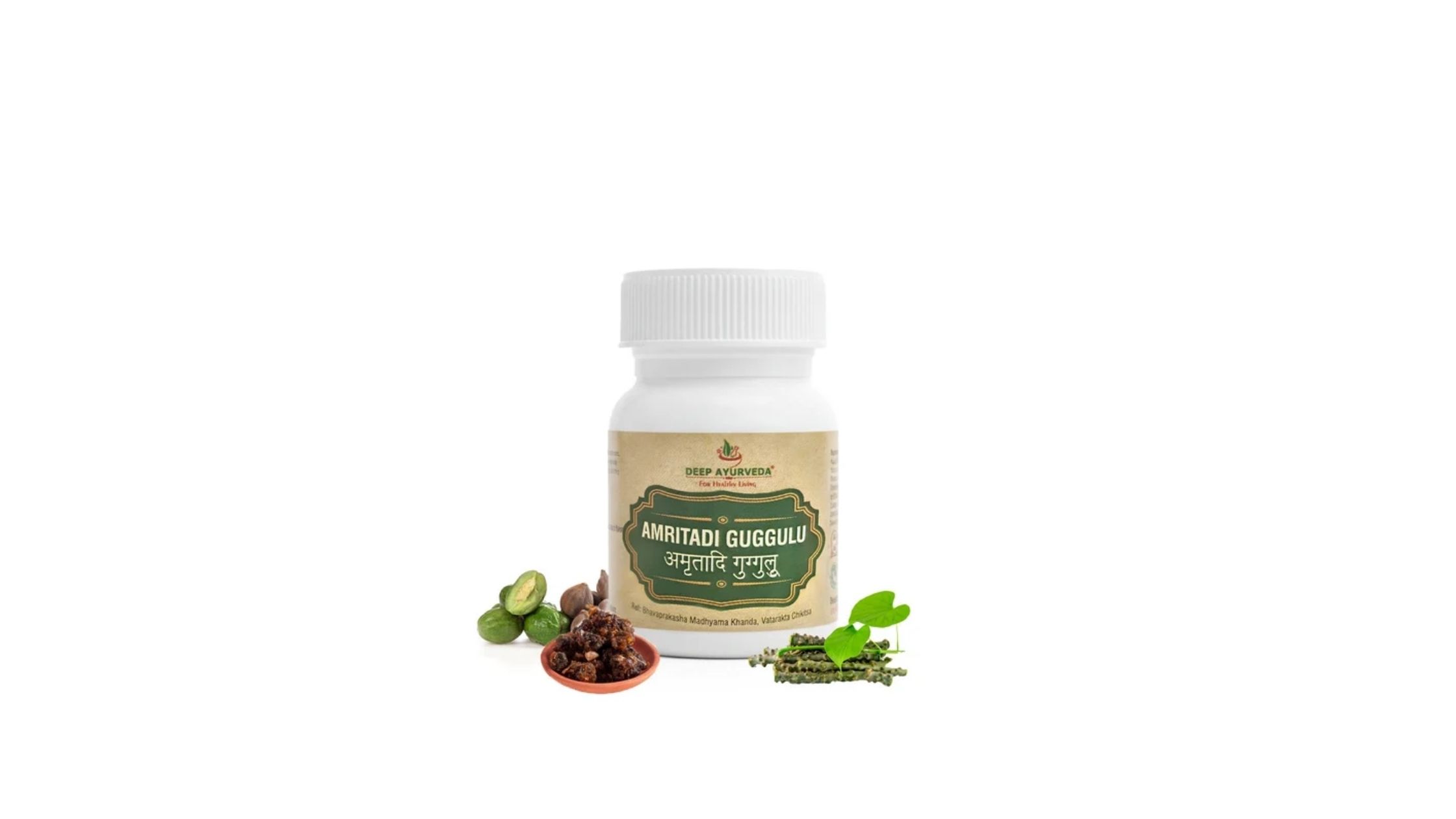

Deep Ayurveda Amritadi Guggulu
✅ 100% Ayurvedic & Safe ✅ Supports Healthy Joints & Mobility ✅ Promotes Healthy Digestion & Metabolism ✅ Supports Natural Detoxification ✅ Helps Maintain Muscle & Joint Comfort ✅ Supports Overall Wellness & Vitality
Amritadi Guggulu is a classical Ayurvedic formulation traditionally used in conditions associated with Vata-Rakta (Vatarakta), certain skin disorders and other conditions described in classical Ayurvedic texts. It is a Guggulu-based formulation prepared with a combination of herbs selected for their complementary Ayurvedic properties.
The formulation is particularly interesting from an Ayurvedic perspective because it is not simply about one herb or one symptom. Its traditional use is understood through concepts such as Vata, Rakta, Agni, Ama and the overall condition of the individual.
The National AYUSH Mission lists Amritadi Guggulu with Bhavaprakasha (BR) as its reference text and identifies Vata Rakta, Dushtavrana and Charma Vikara among its main indications. The same government source lists a dose range of 500 mg–1 g and notes long-term use during pregnancy as a precaution.
What Is Amritadi Guggulu?
Amritadi Guggulu is a classical Guggulu-based Ayurvedic formulation. The word Amritadi refers to a formulation in which Amrita, commonly identified with Guduchi (Tinospora cordifolia), is an important ingredient.
Guggulu formulations are widely used in Ayurveda when a formulation is intended to address patterns involving Vata, Kapha, metabolic imbalance, inflammation-like symptoms, stiffness or impaired movement, depending on the specific combination of herbs.
However, one important point is often missed in modern product descriptions: not every Guggulu formulation is interchangeable.
For example, Amritadi Guggulu should not simply be considered another version of Yogaraja Guggulu, Kaishora Guggulu or Gokshuradi Guggulu. Each formulation has its own classical composition, indications and therapeutic rationale.
The government Essential Drugs List places Amritadi Guggulu under the Guggulu category and records its classical reference as BR (Bhavaprakasha).
Amritadi Guggulu in Classical Ayurveda
To understand Amritadi Guggulu properly, it is useful to look beyond modern terms such as joint supplement or uric acid support.
Classical Ayurveda describes Vatarakta as a condition involving an interaction between Vata and Rakta. Therefore, an Ayurvedic practitioner does not necessarily select a formulation based only on the name of a modern diagnosis. The person’s symptoms, digestion, bowel habits, strength, diet, dosha involvement and overall presentation may all be considered.
This is one reason why the same Ayurvedic formulation may be appropriate for one person but not necessarily for another.
The National AYUSH Mission lists the principal traditional indications of Amritadi Guggulu as Vata Rakta, Dushtavrana and Charma Vikara.
What Is Vatarakta According to Ayurveda?
Vatarakta, also called Vatashonita in Ayurvedic literature, describes a pathological interaction between Vata and Rakta.
From an Ayurvedic perspective, Vata is associated with movement and regulation of bodily functions, while Rakta is considered an important dhatu with its own physiological role. When the normal functioning of these factors becomes disturbed, characteristic symptoms may develop.
Vatarakta is traditionally discussed in relation to symptoms such as:
- Pain or discomfort in the joints
- Swelling
- Stiffness
- Tenderness
- Changes in skin appearance around affected areas
- Difficulty with movement in more pronounced cases
Modern readers often connect Vatarakta directly with gout or elevated uric acid. There can be overlapping symptoms, but Vatarakta should not automatically be treated as a direct synonym for every case of gout or hyperuricemia.
This distinction matters because modern gout is diagnosed and monitored using medical assessment, including clinical findings and, when appropriate, laboratory investigations. Ayurveda and modern medicine may describe the same patient’s condition using different diagnostic frameworks.
Amritadi Guggulu Ingredients
The classical composition of Amritadi Guggulu contains a combination of herbs along with Guggulu. Depending on the classical reference and the specific commercial preparation, ingredient names and proportions should always be verified against the product label.
Commonly associated ingredients include:
| Ingredient | Common Name | Ayurvedic Relevance |
|---|---|---|
| Guduchi / Amrita | Giloy | Traditionally valued for its balancing and supportive properties |
| Shuddha Guggulu | Purified Guggulu | Important base ingredient in the formulation |
| Triphala | Haritaki, Bibhitaki & Amalaki | Traditionally used to support digestion and elimination |
| Trikatu | Pippali, Maricha & Shunthi | Traditionally associated with Agni and digestion |
| Danti | Danti | Used in classical Ayurvedic formulations for specific therapeutic purposes |
| Vidanga | Vidanga | Traditionally used in digestive and metabolic formulations |
| Trivrit | Trivrit | Included in certain classical formulations for its traditional therapeutic action |
| Tvak | Cinnamon | Traditionally valued for its warming and digestive properties |
Important: Commercial Amritadi Guggulu products may differ in composition or proportions. Readers should therefore check the manufacturer’s ingredient list rather than assuming that every product has an identical formula.
Why Are These Ingredients Combined?
This is where Amritadi Guggulu becomes more interesting than a simple list of ingredients.
Ayurvedic formulations are traditionally designed around synergy. An ingredient is not necessarily included only because of one isolated benefit. Its rasa, guna, virya, vipaka, dosha action and interaction with the other ingredients may all contribute to the formulation’s overall purpose.
For example, Guduchi, Guggulu, Triphala and digestive herbs are not simply four unrelated ingredients placed together. Their combination reflects an Ayurvedic approach in which dosha balance, digestion, tissue-level involvement and elimination may all be considered.
This formulation-based thinking is an important difference between understanding an Ayurvedic medicine traditionally and viewing it as a collection of individual herbal extracts.
Ayurvedic Properties of Amritadi Guggulu
The properties of a classical formulation are best understood by examining the individual ingredients and the overall therapeutic intention of the combination.
From an Ayurvedic practitioner’s perspective, attention may be given to:
- Dosha involvement
- Agni (digestive strength)
- Ama
- Rakta and other dhatus
- Srotas
- Prakriti and Vikriti
- The nature, duration and severity of symptoms
This is also why it is not ideal to describe Amritadi Guggulu simply as an anti-inflammatory tablet. That type of description reduces a complex Ayurvedic formulation to a single modern pharmacological concept.
Amritadi Guggulu Benefits and Traditional Uses
Amritadi Guggulu is traditionally associated with several Ayurvedic applications. Its benefits should therefore be described as traditional Ayurvedic uses, rather than promising that it will treat or cure a particular disease.
1. Traditionally Used in Vatarakta
Vatarakta is one of the most important classical indications associated with Amritadi Guggulu.
From an Ayurvedic perspective, the formulation may be selected when the clinical presentation corresponds with the Vata-Rakta pattern described in Ayurveda.
This is particularly relevant when symptoms include joint discomfort, stiffness, swelling or tenderness, but the complete Ayurvedic assessment remains important.
2. Supports Joint Comfort and Mobility
The Guggulu-based nature of the formulation makes Amritadi Guggulu relevant to traditional Ayurvedic approaches involving joint discomfort and restricted movement.
Rather than thinking only in terms of pain suppression, Ayurveda considers factors such as Vata aggravation, stiffness, digestion and the presence or absence of Ama while deciding whether a particular formulation is appropriate.
3. Traditional Use in Certain Skin Disorders
The AYUSH Essential Drugs List includes Charma Vikara among the traditional indications of Amritadi Guggulu.
However, skin disorder is a broad category. It should not be interpreted as meaning that Amritadi Guggulu is suitable for every skin condition.
An Ayurvedic physician would consider the nature of the skin changes, dosha involvement, digestion, diet, duration and other clinical factors before recommending an internal formulation.
4. Traditional Application in Dushtavrana
Dushtavrana is another classical indication listed for Amritadi Guggulu by the National AYUSH Mission.
This does not mean that the formulation should replace appropriate wound assessment or modern wound care. Persistent, infected or non-healing wounds require professional medical evaluation.
5. Supports Healthy Digestion and Metabolic Balance
Several ingredients traditionally used in Amritadi Guggulu have digestive or Agni-supportive properties in Ayurveda.
This becomes relevant because Ayurveda often considers Agni and Ama when assessing disorders involving heaviness, stiffness, metabolic disturbance or impaired tissue function.
However, this should not be interpreted as a claim that Amritadi Guggulu directly treats diabetes, high cholesterol, obesity or other modern metabolic diseases.
Amritadi Guggulu for Vatarakta: An Ayurvedic Doctor’s Perspective
When a person comes to an Ayurvedic clinic with recurrent joint discomfort, I would not select Amritadi Guggulu merely because the person says, I have uric acid.
That is an important distinction.
In Ayurveda, the assessment may include:
- Nature and location of the pain
- Swelling and stiffness
- Digestive strength
- Bowel habits
- Dietary pattern
- Sleep and activity
- Prakriti
- Current Vikriti
- Presence of Ama
- Vata and Rakta involvement
Two people can have similar laboratory values but very different clinical presentations.
Therefore, the formulation should follow the Ayurvedic assessment—not the other way around.
This individualized approach is one of the key principles readers should understand before starting any classical Ayurvedic formulation.
Amritadi Guggulu and Uric Acid: What Should You Know?
Amritadi Guggulu for uric acid is a common modern search intent, but the subject needs some clarification.
Ayurveda traditionally describes Vatarakta, while modern medicine uses terms such as hyperuricemia and gout. These frameworks are not identical.
If someone has elevated uric acid, recurrent attacks of severe joint pain, sudden swelling, redness or significant tenderness, it is important not to rely on self-medication alone.
A proper medical assessment can determine whether the symptoms are actually related to gout or another condition.
Amritadi Guggulu may be considered by an Ayurvedic practitioner when the individual’s presentation corresponds to its traditional indications. It should not be promoted as a guaranteed method for lowering uric acid or replacing prescribed medical treatment.
Amritadi Guggulu Dosage: How Much Should You Take?
The National AYUSH Mission Essential Drugs List gives a listed dose of 500 mg to 1 gram for Amritadi Guggulu.
However, this should not be interpreted as a universal self-medication instruction.
The appropriate dose may depend on:
- The strength of the particular product
- Tablet or formulation size
- Age
- Digestive capacity
- Constitution and current imbalance
- Nature and severity of the condition
- Other medicines being taken
- Duration of use
- Advice of the Ayurvedic physician
Therefore, readers should follow the product label and qualified practitioner’s recommendation rather than increasing the dose because a higher quantity appears to promise faster results.
How Should Amritadi Guggulu Be Taken?
The method of administration can vary according to the clinical situation and the physician’s recommendation.
In Ayurveda, the liquid or substance used along with a medicine is known as Anupana. The choice of Anupana is not merely a matter of taste; traditionally, it can be selected according to the formulation and the patient’s condition.
For this reason, it is better to avoid giving a single best Anupana for every individual without considering the person’s condition.
How Long Can Amritadi Guggulu Be Taken?
There is no universal duration that is appropriate for every person.
The length of use can depend on:
- Why the formulation was prescribed
- Whether the condition is acute or chronic
- Individual response
- Digestive tolerance
- Other medicines being used
- Clinical monitoring
Long-term self-use is particularly inappropriate for people who are pregnant, taking multiple medicines or managing a chronic health condition.
A physician can decide whether the formulation should be continued, modified or stopped.
Amritadi Guggulu Side Effects and Precautions
Like any active herbal formulation, Amritadi Guggulu should not automatically be assumed to be suitable for everyone simply because it is Ayurvedic.
The National AYUSH Mission specifically lists long-term use in pregnancy as a precaution for Amritadi Guggulu.
Who Should Take Extra Precaution?
Professional guidance is particularly important for:
- Pregnant women
- Breastfeeding women
- Children
- Older adults with multiple medicines
- People with chronic health conditions
- People taking prescription medicines
- Individuals with significant digestive sensitivity
- Anyone planning prolonged use
If unusual symptoms develop after taking the formulation, stop self-medication and consult a qualified healthcare professional.
Amritadi Guggulu vs Other Guggulu Formulations
One common mistake is assuming that all Guggulu formulations perform the same function.
They do not.
For example, the AYUSH Essential Drugs List gives different traditional indications for formulations such as Gokshuradi Guggulu, Kanchanara Guggulu, Kaishora Guggulu, Punarnava Guggulu and Yogaraja Guggulu.
| Formulation | Traditional Ayurvedic focus |
|---|---|
| Amritadi Guggulu | Vata Rakta, Dushtavrana, Charma Vikara |
| Kaishora Guggulu | Vatashonita, selected skin/wound-related conditions |
| Gokshuradi Guggulu | Urinary and Prameha-related indications |
| Yogaraja Guggulu | Amavata, Agnimandya, Sandhigata Vata |
| Punarnava Guggulu | Vatarakta and selected Vata-related conditions |
The purpose of this comparison is not to decide which formulation is best. It shows why the formulation should be matched to the Ayurvedic presentation.
Amritadi Guggulu: Diet and Lifestyle According to Ayurveda
Ayurvedic management rarely depends on a medicine alone.
For individuals experiencing recurring joint discomfort or a Vatarakta-like presentation, lifestyle assessment may be equally important.
A balanced approach may include:
- Eating according to digestive capacity
- Avoiding frequent overeating
- Maintaining adequate hydration
- Staying physically active according to one’s capacity
- Avoiding prolonged sedentary habits
- Maintaining a healthy body weight
- Paying attention to foods that repeatedly aggravate symptoms
- Maintaining regular sleep and meal patterns
If a person has medically diagnosed gout or persistently elevated uric acid, dietary and lifestyle decisions should also be discussed with an appropriate healthcare professional.
Final Take
Amritadi Guggulu is best understood as a classical Ayurvedic formulation with a specific therapeutic rationale, rather than simply a herbal tablet for joint pain or uric acid.
Its traditional association with Vata Rakta, Dushtavrana and Charma Vikara, its combination of Guggulu and multiple herbs, and its place within classical Ayurvedic formulation science make it a formulation worth understanding in context.
From an Ayurvedic perspective, the most important question is not simply What does Amritadi Guggulu treat? but rather For which individual, with which Ayurvedic presentation, and under what circumstances is this formulation appropriate?
That distinction helps readers make more informed decisions and avoids reducing traditional Ayurvedic medicine to a collection of generic health claims.
Note: This article is for educational purposes and should not replace diagnosis or treatment from a qualified Ayurvedic physician or other healthcare professional. People who are pregnant, breastfeeding, taking regular medicines or managing a chronic condition should seek professional advice before using Amritadi Guggulu.
Frequently Asked Questions About Amritadi Guggulu
What is Amritadi Guggulu used for?
Amritadi Guggulu is a classical Ayurvedic formulation traditionally associated with Vata Rakta, Dushtavrana and Charma Vikara.
Is Amritadi Guggulu traditionally used for Vatarakta?
Yes. Vata Rakta is one of the main traditional indications listed for Amritadi Guggulu by the National AYUSH Mission.
Can Amritadi Guggulu be used for high uric acid?
It may be considered by an Ayurvedic practitioner when the person’s overall presentation corresponds with its traditional indications. It should not be promoted as a guaranteed uric-acid-lowering treatment.
What is the dosage of Amritadi Guggulu?
The National AYUSH Mission lists 500 mg–1 g. Individual dosing should be determined according to the formulation, patient and clinical situation.
Can Amritadi Guggulu be taken daily?
It may be prescribed for regular use in some situations, but the duration and dose should be determined according to individual needs rather than assumed to be suitable for everyone.
What is the best time to take Amritadi Guggulu?
The appropriate timing can vary depending on the formulation, condition and physician’s instructions. Follow the product label or practitioner’s advice.
Can pregnant women take Amritadi Guggulu?
Pregnant women should not self-medicate with Amritadi Guggulu. The AYUSH Essential Drugs List specifically notes long-term use in pregnancy as a precaution.
Is Amritadi Guggulu the same as Kaishora Guggulu?
No. Both are Guggulu formulations, but their classical compositions and traditional indications differ.
Can Amritadi Guggulu replace gout medicine?
It should not be used to replace prescribed treatment without medical supervision. Gout and elevated uric acid require appropriate diagnosis and monitoring.
How long can Amritadi Guggulu be taken?
There is no single duration suitable for everyone. Long-term use should be guided by a qualified practitioner.