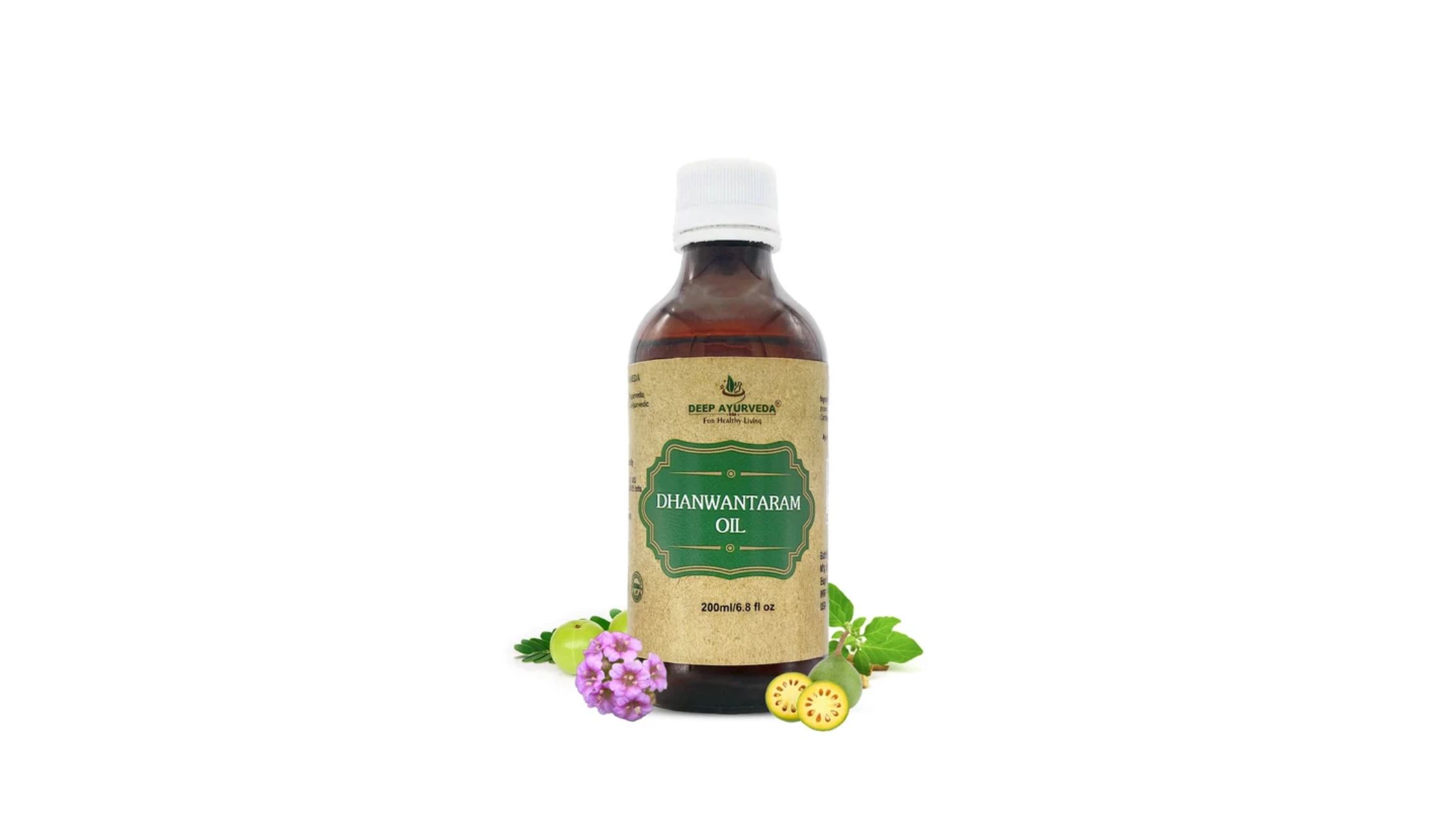
Dhanwantharam Oil, also known as Dhanwantharam Thailam or Dhanwantharam Taila, is a classical Ayurvedic oil traditionally associated with Abhyanga (oil massage), Vata-oriented care and selected Ayurvedic therapeutic applications. Its formulation brings together oil, herbal decoctions and a wide range of botanicals such as Bala, Yava, Kola, Kulattha, Dashamoola, Ashwagandha, Shatavari, Punarnava and Triphala.
Unlike a simple massage oil containing one or two herbs, Dhanwantharam Thailam is understood in Ayurveda as a multi-ingredient formulation, where the choice and combination of herbs are part of the traditional formulation approach. It is commonly discussed in relation to massage for muscular and joint comfort, stiffness, physical fatigue and certain postnatal Ayurvedic practices.
However, there is an important point to understand before using it: Dhanwantharam Oil does not necessarily mean every bottle has an identical composition or is intended for exactly the same purpose. Classical formulations, manufacturer-specific products and concentrated or processed variants can differ. Therefore, the product label and the advice of a qualified Ayurvedic practitioner matter—particularly when the oil is being considered for a therapeutic condition.
In this guide: we’ll look at what Dhanwantharam Oil is, its Ayurvedic background, key ingredients, traditional uses, massage application, precautions, and how it differs from simply choosing an oil based on a list of benefits.
What Is Dhanwantharam Oil?
Dhanwantharam Oil is an Ayurvedic Taila formulation, traditionally prepared using a sesame-oil base along with herbal ingredients and other processing materials. Classical descriptions of Dhanwantharam Taila include Bala, Yava, Kola, Kulattha, Dashamoola and several additional herbs, along with oil and milk in the preparation.
In Ayurveda, the word Taila generally refers to an oil-based preparation. But the important point is that the finished formulation is not simply sesame oil mixed with herbs. Classical Taila preparations are produced through specific processing methods intended to transfer properties of the selected ingredients into the oil medium.
This is why Dhanwantharam Oil is better understood as a formulated Ayurvedic Taila, rather than simply a herbal body oil.
Dhanwantharam Oil, Dhanwantharam Tailam or Dhanwantharam Thailam?
You may see all three terms online:
- Dhanwantharam Oil
- Dhanwantharam Tailam
- Dhanwantharam Thailam
In practical search usage, these terms are often used interchangeably to refer to the same Ayurvedic oil tradition. Tailam and Thailam are commonly transliterated forms associated with the Sanskrit term Taila.
When purchasing, however, don’t rely on the name alone. Check the complete ingredient list and manufacturer’s formulation, because commercial products can differ.
The Ayurvedic Background of Dhanwantharam Tailam
Dhanwantharam Tailam is traditionally referenced in Sahasrayogam, within the Taila formulations, and sources discussing the classical preparation also associate it with Ashtanga Hridayam.
This classical connection is significant because Ayurveda does not select an oil merely because one ingredient is considered beneficial.
Instead, traditional formulation thinking considers factors such as:
- Dosha involvement
- qualities such as dryness, heaviness, coldness or unctuousness
- the condition of the tissues
- the method of administration
- the stage and nature of the condition
- the individual’s constitution and current state
Dhanwantharam Tailam is particularly associated with Vata-oriented applications.
Why is Vata relevant?
In Ayurvedic theory, Vata is associated with qualities such as:
- dryness (ruksha)
- lightness (laghu)
- coldness (sheeta)
- mobility (chala)
Oil-based therapies such as Abhyanga are traditionally used where an unctuous, warming and grounding approach is considered appropriate.
This does not mean that every person experiencing pain or stiffness automatically has a Vata imbalance, or that every type of pain should be treated with Dhanwantharam Oil.
That distinction is important.
Ayurvedic oil selection is traditionally individualized rather than based only on the name of a symptom.
Dhanwantharam Oil Ingredients
One reason Dhanwantharam Oil is frequently discussed in Ayurveda is its extensive ingredient profile.
A classical description includes ingredients such as Bala, Yava, Kola, Kulattha, Dashamoola, Ashwagandha, Shatavari, Punarnava, Yashtimadhu and Triphala, alongside numerous other herbs.
The exact ingredient list can vary between manufacturers and formulations, so the label of the specific product should always be checked.
Key Ingredients
Ingredient Common Ayurvedic name Traditional context Bala Sida cordifolia Traditionally associated with strength and nourishment Yava Barley Part of the classical herbal group Kola Ziziphus species Included in the traditional formulation Kulattha Horse gram Classical ingredient Dashamoola Ten-root group Traditionally associated with Vata-oriented formulations Ashwagandha Withania somnifera Traditionally used in strengthening and nourishing formulations Shatavari Asparagus racemosus Traditionally associated with nourishment Punarnava Boerhavia diffusa Traditional Ayurvedic botanical Yashtimadhu Licorice Traditional supportive ingredient Triphala Haritaki, Bibhitaki, Amalaki Classical three-fruit combination These ingredients should not be viewed independently. The formulation as a whole is what gives Dhanwantharam Tailam its classical identity.
Why Does Dhanwantharam Oil Contain So Many Herbs?
This is where Dhanwantharam Oil becomes more interesting than a standard herbal massage oil.
A common way of reading an Ayurvedic product is:
Ashwagandha is good for X, Bala is good for Y, therefore the oil does X + Y.
That is an oversimplification.
Classical Ayurvedic formulations are generally designed around combinations of ingredients, their qualities and the method through which they are processed.
For Dhanwantharam Tailam, the formulation brings together groups of herbs traditionally associated with:
- strength and nourishment
- Vata-oriented care
- musculoskeletal support
- grounding and unctuousness
- traditional massage and external application
Therefore, the formulation logic matters as much as the individual herbs.
This is one reason it is better to discuss Dhanwantharam Oil as a classical Ayurvedic Taila rather than presenting it as a mixture of isolated super herbs.
Traditional Uses of Dhanwantharam Oil
Dhanwantharam Oil has traditionally been used in several Ayurvedic settings, particularly where oil-based external application and Vata-oriented care are considered appropriate.
Common traditional applications include:
1. Abhyanga — Ayurvedic Oil Massage
Abhyanga is one of the best-known applications of Ayurvedic oils.
Dhanwantharam Oil is used by some Ayurvedic practitioners as a massage oil, particularly where the traditional qualities of the formulation are considered suitable.
Massage itself is also an important part of the application.
The experience and outcome of using an Ayurvedic oil are not determined only by the oil. Factors such as:
- quantity of oil
- temperature
- massage pressure
- direction and technique
- duration
- timing
- individual’s condition
can all influence how the therapy is performed.
2. Muscle Stiffness and Physical Fatigue
Commercial and Ayurvedic sources commonly describe Dhanwantharam formulations in relation to muscle stiffness, muscular discomfort, weakness and physical fatigue.
From an Ayurvedic perspective, the relevance of an oil is traditionally considered in the context of the person’s overall presentation rather than the symptom alone.
For example, stiffness associated with dryness and Vata characteristics may be approached differently from acute inflammation, injury or a skin condition.
That is why a qualified practitioner may recommend different oils for different people experiencing what appears to be the same complaint.
3. Joint Comfort and Flexibility
Dhanwantharam Oil is also traditionally used in massage practices intended to support joint comfort and flexibility. Several current Indian product listings describe its use for joint and muscle wellness or stiffness.
However, this should not be interpreted as evidence that Dhanwantharam Oil can cure arthritis, osteoarthritis, rheumatoid arthritis or another diagnosed disease.
A massage oil may be part of supportive care, while the underlying medical condition may require diagnosis and a broader treatment plan.
4. Postnatal Ayurvedic Massage
Dhanwantharam Tailam is frequently associated with postnatal massage in Ayurvedic practice, and several Indian product sources specifically describe this traditional use.
But pregnancy and the postpartum period require additional care.
The fact that a particular Dhanwantharam product is traditionally used during pregnancy or after childbirth does not mean every formulation is automatically suitable for every pregnant or postpartum woman.
The formulation, timing, individual’s health status and massage technique should be considered by a qualified practitioner.
Dhanwantharam Oil Benefits: What Does Ayurveda Traditionally Say?
Rather than describing Dhanwantharam Oil as a cure for multiple diseases, it is more accurate to discuss its traditional applications and supportive benefits.
Supports Muscle and Joint Comfort
Dhanwantharam Oil is traditionally used in external massage where supporting muscular and joint comfort is the therapeutic objective.
Traditionally Used for Stiffness
Its use in Ayurvedic massage is commonly associated with stiffness and physical discomfort, especially in Vata-oriented contexts.
Supports Relaxation Through Massage
The massage process itself can form an important part of the experience. Warm oil and gentle massage are traditionally used as part of Abhyanga.
Supports Nourishing Oil-Based Care
Ayurveda traditionally values snehana, or oleation, as an approach that uses unctuous substances in appropriate contexts.
Used in Selected Ayurvedic Therapeutic Practices
Dhanwantharam Tailam is not limited to ordinary body massage. Certain formulations are also used by Ayurvedic practitioners in specialized procedures such as Pichu, Kati Vasti and other therapeutic applications.
These procedures should not be treated as DIY massage techniques. Their suitability and method depend on professional assessment.
How to Use Dhanwantharam Oil for Abhyanga
For general external massage, the method of application matters.
Step 1: Start with the appropriate quantity
Take enough oil to comfortably cover the area being massaged without excessive dripping.
Step 2: Warm the oil gently
Traditionally, lukewarm oil may be preferred for Abhyanga.
Avoid overheating the oil.
The objective is comfortable warmth—not high temperature.
Step 3: Apply the oil
Spread the oil evenly over the body or the intended area.
Step 4: Massage gently
Use comfortable pressure appropriate to the person and body area.
For general Abhyanga, massage is traditionally performed with smooth, rhythmic movements.
Step 5: Allow the oil to remain for an appropriate period
The exact duration can depend on the purpose of use and the practitioner’s advice.
There is no universal rule that a particular number of hours is required for every person.
Step 6: Bathe afterward
After the massage and appropriate resting period, bathing may be performed according to the individual’s routine and Ayurvedic advice.
Dhanwantharam Oil: Massage vs Therapeutic Application
This distinction is often missed in online content.
Applying Dhanwantharam Oil at home for a general massage is not the same as receiving an Ayurvedic therapeutic procedure.
For example:
Abhyanga
A form of Ayurvedic oil massage.
Pichu
A localized method involving prolonged application of medicated oil.
Kati Vasti
A specialized localized Ayurvedic procedure involving retention of warm oil over the lower back region.
Pizhichil / Dhara
Specialized procedures involving controlled application or pouring of medicated liquids/oils.
These procedures require appropriate training and assessment.
Do not attempt specialized Panchakarma procedures at home simply because the same oil is commercially available.
Who May Consider Dhanwantharam Oil?
Dhanwantharam Oil may be considered in Ayurvedic practice for people whose presentation is appropriate for an oil-based, Vata-oriented approach.
It may be discussed in contexts such as:
- general Ayurvedic Abhyanga
- muscular stiffness
- physical fatigue
- joint discomfort
- selected postnatal massage practices
- certain practitioner-guided Ayurvedic therapies
But the right question is not simply:
Do I have pain?
A better Ayurvedic question is:
Is this particular oil appropriate for my constitution, current condition and intended application?
That is where professional Ayurvedic assessment becomes valuable.
When Should You Be Careful With Dhanwantharam Oil?
Although herbal oils are commonly perceived as gentle, natural does not automatically mean appropriate for everyone.
Avoid applying oil over:
- open wounds
- actively infected skin
- significant skin irritation
- areas with unexplained rashes
- known sensitivity to an ingredient
Stop use if significant irritation or an allergic reaction develops.
If you have persistent or severe pain, numbness, weakness, swelling, fever, unexplained weight loss, recent trauma or another concerning symptom, an oil massage should not replace appropriate medical evaluation.
Is Dhanwantharam Oil Safe During Pregnancy?
This question deserves a more careful answer than a simple yes or no.
Some traditional and commercial Ayurvedic sources specifically describe Dhanwantharam Tailam in pregnancy and postnatal massage contexts.
However:
Not every Dhanwantharam product is necessarily identical.
Pregnancy also changes throughout the three trimesters, and individual medical circumstances vary.
Therefore, pregnant women should use a specific Dhanwantharam formulation only after confirming its suitability with their qualified healthcare or Ayurvedic practitioner.
Dhanwantharam Oil for Postnatal Massage
Postnatal massage is one of the traditional contexts in which Dhanwantharam Tailam is frequently discussed.
Ayurvedic postnatal care is broader than simply applying oil. It can involve considerations such as:
- digestion
- strength
- sleep
- recovery
- nutrition
- musculoskeletal comfort
- individual constitution
- stage of postpartum recovery
Therefore, Dhanwantharam Oil should be viewed as one possible component of a broader Ayurvedic approach, rather than a standalone solution for every postpartum concern.
Dhanwantharam Oil vs Other Ayurvedic Oils
There is no universally best Ayurvedic massage oil.
The appropriate oil depends on the purpose, formulation and individual assessment.
For example:
Oil Traditional context Dhanwantharam Oil Vata-oriented external care, Abhyanga and selected therapeutic applications Mahanarayan Oil Commonly used in Ayurvedic massage and musculoskeletal care Ksheerabala Oil Traditionally associated with Bala and milk-based preparation and selected Vata-oriented applications Bala Oil Traditionally used in strengthening/nourishing contexts The correct choice should be based on the intended use rather than simply choosing the oil with the longest list of claimed benefits.
Traditional Ayurveda vs Modern Evidence
A responsible Ayurvedic article should distinguish between traditional Ayurvedic knowledge and modern clinical evidence.
Ayurvedic texts and practitioners may describe Dhanwantharam Tailam within frameworks such as Vata management, Snehana and Abhyanga.
Those traditional concepts should not automatically be translated into modern medical claims such as:
- cures arthritis
- repairs nerves
- rebuilds bones
- treats paralysis
- eliminates sciatica
Those are much stronger claims and require appropriate clinical evidence for the specific product, condition and outcome.
This distinction does not diminish Ayurveda. Instead, it helps readers understand what comes from traditional Ayurvedic practice and what has—or has not—been established through modern clinical research.
Common Mistakes When Using Dhanwantharam Oil
1. Choosing an oil only because of the keyword pain
Pain can have many causes. The appropriate Ayurvedic oil may depend on the complete presentation.
2. Heating the oil too much
Warm does not mean hot. Excessive heat can irritate the skin.
3. Using excessive massage pressure
More pressure is not automatically better.
4. Treating every Dhanwantharam product as identical
Always check the specific formulation.
5. Performing Panchakarma procedures without professional guidance
Specialized procedures require appropriate assessment and technique.
6. Expecting an oil to replace diagnosis
Persistent or serious symptoms deserve appropriate medical evaluation.
7. Using the oil without checking the label
Manufacturer instructions should take priority for the particular product you purchased.
Final Takeaway
Dhanwantharam Oil is more than a generic herbal massage oil. In the Ayurvedic tradition, it is a multi-ingredient Taila associated particularly with Vata-oriented care, Abhyanga and selected therapeutic applications.
Its traditional formulation brings together ingredients such as Bala, Yava, Kola, Kulattha, Dashamoola, Ashwagandha, Shatavari, Punarnava and Triphala, among others.
Frequently Asked Questions About Dhanwantharam Oil
What is Dhanwantharam Oil traditionally used for?
Dhanwantharam Oil is traditionally used in Ayurveda for external oil massage, particularly Abhyanga and selected Vata-oriented applications. It is also associated with muscular and joint comfort, stiffness and certain postnatal practices.
Can Dhanwantharam Oil be used for daily massage?
Some Dhanwantharam products are marketed for regular Abhyanga, but suitability depends on the specific formulation and individual needs. Follow the product label or advice of a qualified Ayurvedic practitioner.
Is Dhanwantharam Oil good for joint stiffness?
It is traditionally used in Ayurvedic massage for joint and muscular stiffness and comfort. However, persistent or severe joint symptoms should be properly assessed rather than treated solely with massage oil.
Can I use Dhanwantharam Oil after exercise?
Some commercial formulations describe external massage after physical exertion as an intended use. If soreness is severe, follows an injury or is accompanied by swelling or weakness, seek appropriate evaluation.
Should Dhanwantharam Oil be warmed?
Lukewarm oil is commonly used for Ayurvedic massage. Avoid overheating the oil and test the temperature before application.
Can pregnant women use Dhanwantharam Oil?
Some traditional and commercial sources describe Dhanwantharam Tailam in pregnancy-related massage, but suitability depends on the specific product and individual circumstances. Pregnancy use should be discussed with an appropriate healthcare professional.
Is Dhanwantharam Oil suitable for everyone?
No. Product composition, individual constitution, skin sensitivity, medical conditions and intended use all matter.