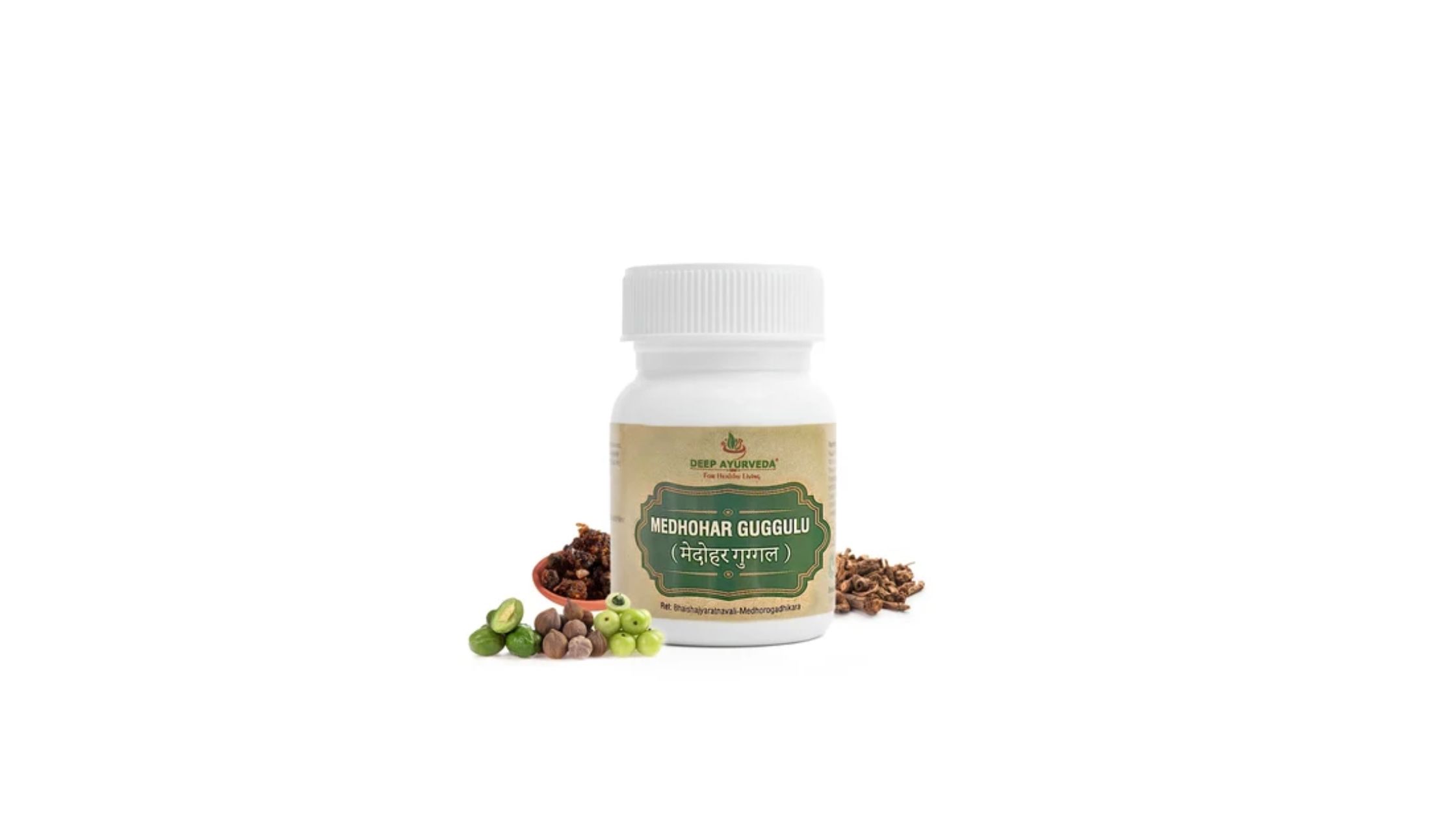
Medohar Guggulu is a traditional Ayurvedic formulation commonly discussed in relation to Meda (adipose tissue), Kapha imbalance, digestion and metabolic health. It contains purified Guggulu along with herbs traditionally described for properties such as Deepana, Pachana and Lekhana.
But there is an important point to understand: Medohar Guggulu is not simply an Ayurvedic fat-burning tablet. In Ayurveda, its use is considered in the context of an individual’s digestion, Dosha balance, Meda accumulation, diet, activity level and overall health.
This guide explains what Medohar Guggulu is, its traditional uses and benefits, ingredients, Ayurvedic mechanism, dosage, how to take it, precautions, possible side effects and what current evidence does—and does not—tell us.
What Is Medohar Guggulu?
Medohar Guggulu, also written as Medohara Guggulu, is a traditional Ayurvedic formulation containing Shuddha Guggulu (purified Guggulu) along with a combination of herbs.
The word Medohar comes from the Ayurvedic concept of Meda, which broadly relates to adipose tissue or body fat, and hara, meaning to reduce or remove. Therefore, the name reflects the formulation’s traditional association with excess Meda.
However, translating Medohar simply as fat burner can be misleading.
Ayurveda approaches excess body weight through a broader framework involving:
- Meda Dhatu
- Kapha Dosha
- Agni
- Ama
- Srotas
- Ahara (diet)
- Vihara (daily activity and lifestyle)
The Ayurvedic Standard Treatment Guidelines include Medohara Guggulu among formulations used in the management of Sthaulya (obesity) and metabolic disorders.
This means the traditional Ayurvedic context is more comprehensive than simply taking a tablet with the expectation of rapid weight loss.
Medohar Guggulu in Ayurveda: Understanding the Basic Concept
To understand why Medohar Guggulu is traditionally used, it helps to understand four Ayurvedic concepts: Agni, Meda, Kapha and Ama.
1. Agni
In Ayurveda, Agni represents the body’s digestive and metabolic processes.
When Agni is considered balanced, digestion and transformation of food are thought to occur appropriately. When it is impaired, Ayurveda describes symptoms such as heaviness, sluggish digestion and accumulation of Ama in certain contexts.
2. Meda Dhatu
Meda Dhatu is one of the seven Dhatus described in Ayurveda and is associated with adipose tissue and fat metabolism.
Excessive accumulation of Meda is discussed in relation to Sthaulya, the Ayurvedic description of obesity or excessive body weight.
3. Kapha Dosha
Kapha has qualities such as heaviness, stability, unctuousness and slowness.
When Kapha and Meda become excessive, Ayurveda describes a tendency toward heaviness, reduced activity and accumulation.
4. Ama
Ama is an Ayurvedic concept associated with improperly processed or incompletely digested material. It should not automatically be translated as toxins, because the Ayurvedic concept does not exactly correspond to a specific modern biomedical substance.
This distinction is important when explaining Ayurvedic medicine accurately.
How Does Medohar Guggulu Work According to Ayurveda?
Medohar Guggulu is traditionally understood through several Ayurvedic actions rather than through one single mechanism.
Deepana
Deepana refers to supporting or stimulating digestive capacity.
Several herbs present in formulations of Medohar Guggulu, such as Shunthi, Pippali and Maricha, are traditionally described in this context.
Pachana
Pachana refers to supporting the processing of Ama or improperly digested material according to Ayurvedic principles.
This is one reason digestive function is an important part of the traditional approach to Meda management.
Lekhana
Lekhana literally conveys a scraping or reducing concept in Ayurvedic terminology.
In the context of Medohar formulations, Lekhana is traditionally associated with reducing excessive accumulation, particularly Meda and Kapha.
It should not be interpreted literally as physically scraping fat from the body.
Srotoshodhana
Ayurvedic texts use the concept of Srotas, or channels of circulation and transportation within the body.
Srotoshodhana refers to supporting the proper functioning or clearing of these channels according to Ayurvedic theory.
The Ministry of Ayush guideline describes the relevant formulations used in metabolic disorders as having properties including Agnidipana, Amapachana, Srotoshodhana and Kapha-Meda Nashaka.
Medohar Guggulu Ingredients
The exact composition can vary between classical references and commercially available products, so the label of the specific product should always be checked.
A commonly described Medohar Guggulu formulation contains:
| Ingredient | Botanical name | Traditional Ayurvedic relevance |
|---|---|---|
| Shuddha Guggulu | Commiphora species | Traditionally used in Meda/Kapha-related formulations |
| Shunthi | Zingiber officinale | Deepana and Pachana |
| Maricha | Piper nigrum | Deepana/Pachana |
| Pippali | Piper longum | Deepana and formulation support |
| Chitraka | Plumbago zeylanica | Traditionally associated with digestive stimulation |
| Musta/Nagarmotha | Cyperus species | Traditionally used in digestive and Kapha-related contexts |
| Haritaki | Terminalia chebula | Traditionally used for digestion and bowel regulation |
| Bibhitaki | Terminalia bellirica | Part of Triphala; traditionally associated with Kapha balance |
| Amalaki | Phyllanthus emblica | Part of Triphala; traditionally used for Rasayana support |
| Vidanga | Embelia ribes | Traditionally used in digestive and Krimi-related contexts |
Current Indian product listings demonstrate why checking the individual label matters: different manufacturers may use different strengths, processing methods and even different ingredient profiles. For example, current listings for Medohar Guggulu products show variations in tablet strength and ingredient quantities.
Why is Guggulu important?
Guggulu is a resin obtained from Commiphora species and has a long history of use in Ayurvedic formulations.
In Medohar Guggulu, it is combined with other herbs rather than being used as an isolated ingredient. Therefore, the traditional action of the formulation should be understood as a multi-herb combination, not simply as the effect of Guggulu alone.
Medohar Guggulu Benefits
Medohar Guggulu is traditionally used for several purposes in Ayurveda. However, these traditional uses should not be confused with proven treatment effects.
1. Supports Ayurvedic Management of Excess Meda
The primary traditional rationale behind Medohar Guggulu is its association with Meda and Kapha management.
Ayurveda does not view excess body weight solely as a calorie problem. The assessment may also consider digestion, appetite, activity, sleep, bowel habits, Dosha predominance and dietary patterns.
For this reason, Medohar Guggulu is traditionally considered as part of a broader approach rather than as a standalone weight-loss solution.
2. Supports Healthy Digestion
Ingredients such as Shunthi, Pippali, Maricha and Chitraka are traditionally valued for their Deepana and Pachana properties.
These herbs are commonly incorporated into Ayurvedic formulations where supporting digestion and metabolic processing is part of the therapeutic objective.
3. Traditionally Used in Kapha-Meda Dominant Patterns
Ayurveda associates Kapha and Meda with heaviness, stability and accumulation.
Medohar Guggulu’s traditional properties are therefore relevant to individuals whose Ayurvedic assessment suggests a Kapha-Meda dominant pattern.
This does not mean that everyone with excess body weight should take the formulation.
4. Supports a Healthy Metabolic Routine
Medohar Guggulu is often discussed in the context of metabolic health and weight management.
Some commercial products make broader claims about metabolism and lipid balance, but these claims should not automatically be interpreted as clinically established treatment effects.
5. Supports Regularity and Digestive Comfort
The presence of ingredients such as Haritaki and the Triphala components may contribute to the formulation’s traditional digestive role.
However, Medohar Guggulu should not be treated as a universal remedy for constipation or other gastrointestinal problems.
Is Medohar Guggulu Really for Weight Loss?
This is probably the most important question surrounding Medohar Guggulu.
The answer requires some context.
Medohar Guggulu is traditionally associated with Meda management and Sthaulya, and Ayurvedic guidelines include Medohara Guggulu among formulations used in Sthaulya.
From a modern scientific perspective
The evidence is much more limited.
One older clinical study investigated Guggulu-containing treatment in obesity alongside dietary and lifestyle measures. The study did not establish a statistically significant overall weight-loss advantage.
Therefore, it would be inappropriate to describe Medohar Guggulu as a guaranteed fat-burning or weight-loss medicine.
A more accurate approach is:
Medohar Guggulu may have a traditional role in Ayurvedic management of excess Meda, but sustainable weight management still depends on diet, physical activity, sleep, behaviour and appropriate medical assessment.
Who May Traditionally Be Considered for Medohar Guggulu?
An Ayurvedic practitioner may consider a formulation such as Medohar Guggulu when the individual’s overall presentation fits the traditional indication.
This may include patterns involving:
- Excess Meda
- Kapha predominance
- Heaviness
- Sluggish digestion
- Sedentary lifestyle
- Excessive intake of heavy or calorie-dense foods
- Reduced physical activity
- Ayurvedic features associated with Sthaulya
The important point is that body weight alone does not determine whether Medohar Guggulu is appropriate.
Two people with the same BMI may have different digestive, metabolic and Ayurvedic characteristics and therefore may not receive the same Ayurvedic formulation.
Medohar Guggulu Dosage: How Much Should You Take?
Dosage is one area where online information can become confusing because different commercial products contain different amounts per tablet.
The Ministry of Ayush Standard Treatment Guidelines on Metabolic Disorders list:
Medohar Guggulu — 500 mg to 1 g, twice daily, before meals, for 1–3 months, with lukewarm water, in the relevant guideline context.
The earlier Ayurvedic Standard Treatment Guidelines similarly list Medohara Guggulu at 0.5–1 g twice daily before meals with warm water in the Sthaulya section.
But there is an important distinction
This guideline dose should not automatically be converted into a personal prescription.
Commercial products can vary considerably.
For example, current Indian product listings show Medohar Guggulu tablets in different strengths, including 250 mg and 500 mg, while recommended serving sizes also differ between manufacturers.
Therefore:
Always check the strength of your specific product and follow the manufacturer’s label or the dosage recommended by your qualified Ayurvedic practitioner.
Do not increase the number of tablets simply because you want faster results.
When Should You Take Medohar Guggulu?
According to the Ministry of Ayush metabolic-disorder guideline, Medohar Guggulu is listed for administration twice daily before meals with lukewarm water.
However, commercially available products may provide different instructions.
Therefore, the practical approach is:
- Check the strength of the tablet.
- Read the product label.
- Follow the dosage recommended by your practitioner.
- Do not combine different Guggulu products without professional advice.
Why is warm water commonly mentioned?
Warm water is traditionally used as Anupana with several Ayurvedic formulations.
The choice of Anupana can vary according to the formulation and the individual’s condition, so it should not be assumed that warm water is mandatory for every commercial product.
How Long Can You Take Medohar Guggulu?
The Ministry of Ayush guideline lists a duration of 1–3 months for Medohar Guggulu in the metabolic-disorder context.
The older Ayurvedic Standard Treatment Guidelines list 2–3 weeks in their Sthaulya treatment table, demonstrating that dosage and duration can depend on the particular guideline and clinical context.
This is exactly why duration should not be determined simply by reading an internet article.
If the formulation is being used for a specific health concern, a practitioner can assess:
- response to treatment
- digestion
- bowel habits
- appetite
- body-weight changes
- medication use
- tolerance
- other health conditions
What to Eat While Taking Medohar Guggulu?
Taking Medohar Guggulu while continuing the same dietary and lifestyle habits that contributed to weight gain is unlikely to provide a sensible long-term strategy.
Ayurvedic management of Sthaulya traditionally places substantial emphasis on Ahara and Vihara.
A practical diet pattern can include:
Prefer more often
- Vegetables
- Adequate protein according to individual needs
- Whole or minimally processed foods
- Appropriate portions
- Seasonal foods
- Adequate hydration
- Regular meal timing
Limit
- Frequent overeating
- Excess sweets
- Highly processed foods
- Excessively oily/heavy meals
- Sugary beverages
- Frequent unnecessary snacking
- Prolonged sedentary periods
The exact diet should be individualized rather than treating one Ayurvedic diet as suitable for everyone.
Medohar Guggulu and Exercise
Medohar Guggulu should not be viewed as a substitute for physical activity.
A sustainable weight-management approach generally combines:
Appropriate food + regular movement + adequate sleep + behaviour changes + medical/Ayurvedic assessment where appropriate.
For many adults, practical movement can include:
- Brisk walking
- Resistance training
- Yoga
- Cycling
- Swimming
- Regular breaks from prolonged sitting
The appropriate exercise depends on age, fitness, existing medical conditions and physical limitations.
Medohar Guggulu Side Effects
Natural does not automatically mean free from side effects.
Tolerance can vary depending on the formulation, dose, individual constitution and other medicines or supplements being used.
Possible unwanted effects may include:
- Stomach discomfort
- Loose stools
- Nausea
- Digestive irritation
- Headache or other nonspecific symptoms in some individuals
- Allergic or sensitivity reactions
Guggulu-containing products can also have clinically relevant interactions with certain medicines. Current medical discussions have raised concerns involving some cardiovascular medicines, thyroid medicines, hormonal therapies and drugs metabolized through liver enzymes.
If you develop a significant or persistent reaction after starting the product, stop self-treatment and seek appropriate medical advice.
Who Should Avoid or Use Medohar Guggulu With Caution?
Medohar Guggulu should not be started casually by everyone.
Extra caution is appropriate for:
Pregnant women
Do not self-medicate during pregnancy. Consult a qualified healthcare professional before using Ayurvedic formulations.
Breastfeeding women
Professional guidance is advisable because safety information for many multi-herb formulations during lactation may be limited.
Children
Children should not be given adult Ayurvedic formulations or adult doses without appropriate professional assessment.
People taking regular medicines
Tell your doctor or Ayurvedic practitioner about all prescription medicines, over-the-counter medicines and supplements you use.
People with chronic health conditions
If you have a diagnosed medical condition, particularly a metabolic, cardiovascular, thyroid, gastrointestinal or liver-related condition, professional guidance is advisable.
Medohar Guggulu and Other Medicines
This is an area where herbal should not be confused with interaction-free.
Guggulu has been discussed in relation to potential interactions with certain medicines, including some cardiovascular and thyroid medications.
If you regularly take medicines, do not assume that Medohar Guggulu is automatically compatible with them.
Before starting it, provide your healthcare professional with a complete list of:
- Prescription medicines
- OTC medicines
- Vitamins
- Herbal supplements
- Other Ayurvedic formulations
This is particularly important when several products are being taken simultaneously.
Medohar Guggulu vs Triphala Guggulu
The two formulations are sometimes grouped together online because both contain Guggulu and are discussed in the context of metabolic or Kapha-related Ayurvedic applications.
However, they should not simply be treated as interchangeable.
| Aspect | Medohar Guggulu | Triphala Guggulu |
|---|---|---|
| Main traditional focus | Meda/Kapha-related context | Different indications depending on formulation and assessment |
| Key formulation identity | Medohara-oriented combination | Triphala + Guggulu-based formulation |
| Ayurvedic assessment | Depends on individual presentation | Depends on individual presentation |
| Should one replace the other? | Not automatically | Not automatically |
The Ayurvedic Standard Treatment Guidelines list Medohara Guggulu and Triphala Guggulu separately, with different dosage information.
So the question should not simply be Which is stronger?
The better question is:
Which formulation is appropriate for the individual’s actual Ayurvedic indication?
Medohar Guggulu vs Navaka Guggulu
Navaka Guggulu is another Guggulu-based formulation included in the Ministry of Ayush guideline for metabolic disorders. The guideline lists both Navaka Guggulu and Medohar Guggulu separately, which is an important distinction.
Online articles sometimes group different Guggulu formulations together under the broad heading of weight-loss medicines.
That can create confusion.
Different formulations can have:
- Different ingredients
- Different proportions
- Different classical references
- Different indications
- Different dosage recommendations
Therefore, the name of the formulation matters.
Classical Medohar Guggulu vs Commercial Products: Why the Label Matters
This is one of the most overlooked points when buying Ayurvedic products online.
The name Medohar Guggulu does not necessarily mean that every commercial product has identical ingredients, strength or manufacturing process.
Current Indian listings demonstrate considerable variation.
For example, one current product listing describes a 250 mg tablet containing Shuddha Guggulu and nine accompanying herbs, while another lists a 500 mg tablet with specific quantities for Guggulu and the accompanying ingredients.
Therefore, before buying or taking a product, check:
- Ingredient list
- Tablet strength
- Recommended dosage
- Manufacturer
- Batch information
- Expiry date
- Directions for use
- Storage instructions
- Whether professional supervision is recommended
This is especially important if you are comparing products from different brands.
Can Medohar Guggulu Alone Reduce Body Weight?
It should not be viewed as a standalone shortcut to weight loss.
Ayurveda’s approach to Sthaulya includes dietary and lifestyle modification alongside appropriate medicines. The Ayurvedic Standard Treatment Guidelines specifically emphasize diet and lifestyle modification in the management framework.
Modern evidence also does not justify presenting Guggulu as a guaranteed weight-loss treatment. An older clinical study did not find a statistically significant overall weight-loss advantage from the investigated Guggulu intervention.
Therefore, a more realistic approach is:
Medohar Guggulu, when clinically appropriate, should be considered one component of a broader Ayurvedic and lifestyle strategy—not a replacement for healthy eating or physical activity.
Common Myths About Medohar Guggulu
Myth 1: More tablets mean faster weight loss
False.
Increasing the dose without professional guidance can increase the risk of unwanted effects and is not a reliable way to accelerate results.
Myth 2: Anyone who is overweight should take Medohar Guggulu
Not necessarily.
Ayurveda considers individual factors rather than body weight alone.
Myth 3: Medohar Guggulu burns fat like a modern fat burner
This is an oversimplification.
The Ayurvedic concept of Medohara should be understood within the framework of Meda, Kapha, Agni and overall management rather than equated directly with a modern pharmacological fat burner.
Myth 4: Natural products cannot cause side effects
Incorrect.
Herbal medicines can have adverse effects and interactions.
Myth 5: Every Medohar Guggulu product is identical
Incorrect.
Commercial products can differ in strength, ingredient quantities and formulation details.
Final Takeaway
Medohar Guggulu is best understood as a traditional Ayurvedic formulation associated with Meda, Kapha, digestion and metabolic management, rather than simply as a weight-loss tablet.
Its traditional rationale involves concepts such as Deepana, Pachana, Lekhana and Kapha-Meda management, while the formulation commonly combines Shuddha Guggulu with herbs such as Shunthi, Pippali, Maricha, Chitraka, Musta, Triphala and Vidanga.
For dosage, the Ministry of Ayush’s Standard Treatment Guidelines on Metabolic Disorders list 500 mg–1 g twice daily before meals with lukewarm water for 1–3 months in the relevant context.
However, commercial formulations differ, and the appropriate dose is not determined by the name Medohar Guggulu alone.
Most importantly, sustainable management of excess body weight involves much more than a single formulation. Diet, physical activity, sleep, daily routine and individualized healthcare assessment remain central to the overall approach.
Medohar Guggulu may have a place within an appropriate Ayurvedic plan, but it should not be presented as a guaranteed fat-burning treatment or as a replacement for evidence-based medical care.
Frequently Asked Questions About Medohar Guggulu
What is Medohar Guggulu used for?
Medohar Guggulu is traditionally used in Ayurveda in the context of excess Meda, Kapha-related patterns and Sthaulya/metabolic management. The Ministry of Ayush includes it among formulations used in metabolic-disorder guidelines.
What are the main benefits of Medohar Guggulu?
Its traditional benefits are associated with Meda and Kapha management, digestion and metabolic support. These should be understood as traditional Ayurvedic uses rather than guaranteed medical outcomes.
What is the recommended dosage of Medohar Guggulu?
The Ministry of Ayush metabolic-disorder guideline lists 500 mg–1 g twice daily before meals with lukewarm water for 1–3 months in the relevant context. Individual dosage should be determined according to the product and professional advice.
Can Medohar Guggulu help with weight management?
It is traditionally used in Ayurvedic management of Sthaulya and excess Meda. However, current scientific evidence is not strong enough to describe it as a guaranteed weight-loss treatment.
Can I take Medohar Guggulu every day?
Some Ayurvedic guidelines describe daily use for a defined period, but the appropriate dose and duration depend on the formulation and individual. Avoid prolonged self-medication.
Should Medohar Guggulu be taken before or after food?
The Ministry of Ayush metabolic-disorder guideline lists it before meals with lukewarm water. However, follow the instructions for your specific product or your practitioner’s advice.
Can I take Medohar Guggulu with other medicines?
Potential interactions are possible with some medicines. If you take regular prescription medicines, consult a qualified healthcare professional before starting it.
Is Medohar Guggulu safe during pregnancy?
Do not self-medicate with Medohar Guggulu during pregnancy. Seek professional medical advice.
Is Medohar Guggulu the same as Triphala Guggulu?
No. They are distinct formulations with different composition and traditional applications. The Ministry of Ayush guideline lists them separately.