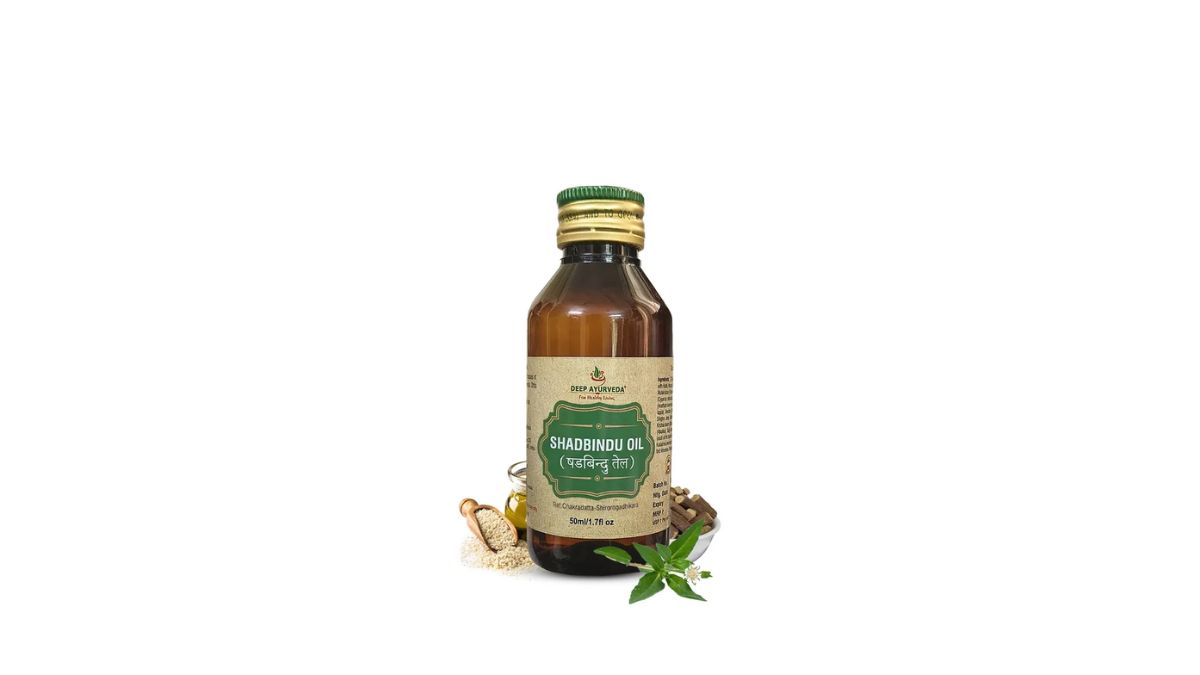

Deep Ayurveda Shadbindu oil
✅ 100% Ayurvedic & Safe ✅ Supports nasal health ✅ Supports head and sensory wellness ✅ Helps moisturize nasal passages ✅ Supports healthy breathing ✅ Promotes relaxation ✅ Supports hair and scalp wellness
Shadbindu Oil, also known as Shadbindu Taila or Shadbindu Thailam, is a traditional Ayurvedic medicated oil primarily used for Nasya. Ayurveda traditionally considers it useful for selected Vata-Kapha-related complaints affecting the nose, head, and upper respiratory region. However, the appropriate quantity and method of use depend on the individual, formulation, and purpose of treatment.
Have you heard of Shadbindu Oil for nasal congestion, sinus-related discomfort, headaches, or hair concerns? In Ayurveda, Shadbindu Oil is not simply an herbal oil. It is a traditional medicated Ayurvedic oil primarily associated with Nasya, an Ayurvedic nasal therapy used for conditions involving the head and neck region.
However, much of the information available online presents Shadbindu Oil as a remedy for almost every nasal or head-related problem. Some sources claim that it can cure sinusitis, migraine, nasal polyps, hair loss, and several other conditions. Such claims need to be interpreted carefully.
Shadbindu Taila is a classical Ayurvedic formulation traditionally used in Nasya for selected head, nasal, and upper-body complaints, particularly within a Vata-Kapha framework. Classical Ayurvedic references and published research describe its traditional applications in conditions involving the head and hair.
This guide explains what Shadbindu Oil is, its classical ingredients, traditional Ayurvedic benefits and uses, how it is used for Nasya, dosage considerations, possible side effects, safety precautions, and when professional medical advice is more appropriate.
What Is Shadbindu Oil?
Shadbindu Oil (Shadbindu Taila) is a multi-herb Ayurvedic medicated oil formulation. Its primary traditional application is Nasya Karma, an Ayurvedic procedure in which a suitable medicated preparation is administered through the nasal passages.
In Ayurveda, the nose is described as an important gateway to the head. This principle forms the basis of Nasya therapy, which has traditionally been used for various conditions involving the head, neck, nose, and sensory organs.
Shadbindu Taila is traditionally associated with classical Ayurvedic texts, including the Bhaishajya Ratnavali in the context of Shiroroga and Nasya. Published research has also examined its preparation and quality parameters according to Ayurvedic formulation standards.
It is important to understand that Shadbindu Oil is not simply an ordinary massage oil. When a product is specifically formulated for nasal administration, it should be used according to the manufacturer’s directions and, where therapeutic Nasya is intended, appropriate professional guidance.
Other Names for Shadbindu Oil
Depending on the manufacturer or source, you may find the formulation listed as:
- Shadbindu Oil
- Shadbindu Taila
- Shadbindu Tail
- Shadbindu Thailam
- Shadabindu Taila
- Shadbindu Ayurvedic Oil
- Shadbindu Nasya Oil
- षड्बिन्दु तैल
These variations generally refer to the same traditional Ayurvedic formulation or closely related preparations, although the exact ingredients can vary between manufacturers.
Why Is It Called Shadbindu Taila?
The name Shadbindu is commonly explained through two Sanskrit terms:
- Shad = six
- Bindu = drops
The name is therefore traditionally associated with the use of six drops in the context of Nasya.
However, this does not mean that every person should automatically put exactly six drops into each nostril.
This distinction is important because the appropriate Nasya dose can depend on the type of Nasya, the purpose of treatment, the formulation being used, and the individual’s condition.
Published clinical reports have used different quantities of Shadbindu Taila in different therapeutic contexts. One case report, for example, described the use of 8 bindu in each nostril during therapeutic Nasya and a smaller quantity during Pratimarsha Nasya.
Therefore:
The traditional association of Shadbindu with six drops should not be treated as a universal self-medication dosage.
Shadbindu Oil Ingredients: What Is It Made Of?
Shadbindu Taila is not a single-herb oil. It is a multi-ingredient Ayurvedic formulation prepared using several herbal ingredients along with a medicated oil base and other classical components.
A published standardization study examined Shadbindu Taila prepared according to Ayurvedic formulation standards. The study described processed black sesame oil as the primary oil base and evaluated the preparation through physicochemical and phytochemical testing.
The classical formulation studied included ingredients such as:
| Ayurvedic Ingredient | Common Name | Traditional Ayurvedic Context |
|---|---|---|
| Krishna Tila Taila | Black sesame oil | Main oil base and traditional Vata-oriented Sneha |
| Bhringaraja | Bhringraj | Traditionally associated with head and hair care |
| Erandamoola | Castor root | Traditionally used in Vata-related formulations |
| Tagara | Tagar | Traditionally used in head-related formulations |
| Shatahva | Dill | Traditionally associated with digestive and Kapha-related actions |
| Jivanti | Jivanti | Traditionally associated with nourishing properties |
| Rasna | Rasna | Traditionally used in Vata-related conditions |
| Vidanga | Vidanga | Traditionally associated with Kapha and Krimi management |
| Yashtimadhu | Licorice | Traditionally considered soothing and nourishing |
| Shunthi | Dry ginger | Traditionally associated with Deepana, Pachana and Kapha management |
| Saindhava | Rock salt | Traditionally used in Vata-Kapha-oriented formulations |
| Aja Payas | Goat milk | Classical liquid component |
The exact ingredient profile can differ between commercial products. Therefore, always check the ingredient list of the specific Shadbindu Oil you are purchasing rather than assuming that every product has an identical formulation.
The published standardization study also investigated physicochemical parameters and chromatographic characteristics as part of quality evaluation.
Shadbindu Oil Benefits: What Does Ayurveda Traditionally Say?
The word benefits needs to be understood carefully when discussing an Ayurvedic formulation.
There are three different levels of information:
1. Classical Ayurvedic use
This refers to the conditions and therapeutic purposes described in traditional Ayurvedic literature.
2. Clinical Ayurvedic practice
This refers to how an Ayurvedic practitioner may consider a formulation after assessing an individual’s symptoms, constitution, dosha involvement, and overall condition.
3. Modern scientific evidence
This asks whether controlled clinical research has established the effectiveness of the formulation for a particular modern disease.
For Shadbindu Taila, published research includes formulation standardization and safety-related evaluation, but this should not be interpreted as proof that the oil cures every modern condition for which it is promoted online.
With that distinction in mind, its traditional benefits can be understood as follows.
1. Supports Nasal Wellness Through Traditional Nasya
The primary traditional application of Shadbindu Taila is Nasya.
Ayurveda uses Nasya as part of its approach to various conditions involving the head and neck region. Shadbindu Taila is traditionally selected for certain nasal and head-related complaints based on the individual’s condition and Ayurvedic assessment.
This does not mean that Shadbindu Oil treats every type of nasal disorder. Rather, its traditional role is best understood as part of a broader Ayurvedic therapeutic approach.
2. Traditionally Used for Nasal Congestion and Kapha-Related Complaints
From an Ayurvedic perspective, excess Kapha in the head and nasal region may be associated with heaviness, excessive mucus, congestion, and a feeling of blockage.
Several ingredients traditionally used in Shadbindu Taila are described within Ayurveda in contexts related to Vata and Kapha management.
For this reason, Shadbindu Oil is traditionally used in the context of complaints such as:
- Nasal heaviness
- Nasal congestion
- Excessive mucus
- Head heaviness
- Certain Kapha-dominant nasal complaints
However, nasal congestion can have many causes, including allergies, viral infections, structural obstruction, chronic rhinosinusitis, and other medical conditions. The cause matters when deciding on treatment.
3. May Be Considered in Traditional Ayurvedic Management of Sinus-Related Complaints
Shadbindu Oil is frequently promoted online as a sinusitis treatment. This description requires some clarification.
Ayurveda does not necessarily approach every case of sinus-related symptoms in exactly the same way. An Ayurvedic assessment may consider the nature of the symptoms, dosha involvement, season, digestive status, and other individual factors before deciding whether Nasya is appropriate.
Therefore, it is more accurate to say:
Shadbindu Taila is traditionally used in Ayurvedic Nasya protocols for selected nasal and head-related complaints, including certain congestion-dominant presentations.
This is different from claiming that Shadbindu Oil cures every form of sinusitis.
If you experience persistent or severe:
- Facial pain or pressure
- Nasal blockage
- Thick or discolored nasal discharge
- Reduced sense of smell
- Recurrent sinus symptoms
- Fever
you should not rely solely on nasal oil without appropriate evaluation.
4. Traditionally Used for Certain Headache Patterns
Ayurveda does not treat every headache as the same condition. Different headache patterns may have different doshic associations and causes.
When headache is accompanied by features such as:
- Head heaviness
- Nasal congestion
- Excess mucus
- A feeling of stiffness
- Symptoms aggravated by cold exposure
an Ayurvedic practitioner may consider Nasya as part of an individualized management plan.
However, Shadbindu Oil should not be presented as a universal treatment for headache or migraine.
A headache that is sudden and severe, follows a head injury, occurs with neurological symptoms, vision changes, high fever, neck stiffness, or repeated unexplained episodes requires appropriate medical evaluation.
5. Traditional Use in Hair and Scalp Care
Hair-related benefits are another reason people search for Shadbindu Oil.
Published research discussing the classical formulation includes Keshashata (hair loss) among its traditional indications.
This provides a traditional Ayurvedic basis for its association with head and hair care.
However, traditional use should not be confused with modern proof of hair regrowth.
Hair loss can occur because of:
- Genetic or hereditary factors
- Nutritional deficiencies
- Hormonal changes
- Thyroid disorders
- Scalp conditions
- Significant stress
- Certain medications
- Other underlying medical conditions
Therefore, if hair loss is persistent, rapidly increasing, or associated with bald patches, identifying the underlying cause is more important than relying on any single oil.
Shadbindu Oil for Sinusitis: Can It Really Help?
This is one of the most common questions associated with Shadbindu Oil.
From an Ayurvedic perspective, nasal congestion and sinus-related symptoms may be assessed through a broader framework involving Kapha, Vata, mucus accumulation, digestion, season, and individual constitution.
Shadbindu Taila may traditionally be considered as part of an appropriate Nasya protocol for selected patients.
But can it cure sinusitis?
There is not enough high-quality modern clinical evidence to make that blanket claim.
The available scientific literature includes formulation standardization and safety research, but that is different from proving that Shadbindu Taila cures every form of modern sinusitis.
A responsible approach is therefore:
Traditional Ayurvedic use + correct diagnosis + appropriate individual assessment.
When Shadbindu Oil May Not Be Appropriate for Sinus Symptoms
Do not automatically use nasal oil when you have:
- High fever
- Severe facial swelling
- Severe facial pain
- Active or recurrent nosebleeds
- Significant breathing difficulty
- Recent nasal surgery
- Recent nasal or head trauma
- Persistent or worsening symptoms
- Recurrent severe sinus episodes
In such situations, identifying the underlying cause should come first.
Shadbindu Oil for Headache and Migraine
Migraine and ordinary headaches should not be treated as interchangeable conditions.
Shadbindu Taila has a traditional place in Ayurvedic management of certain head-related disorders, but this does not establish it as a universally proven modern migraine treatment.
Published clinical literature includes case reports involving Shadbindu Taila Nasya in headache and migraine-related contexts. However, case reports are not equivalent to large controlled clinical trials. One published case also reported an adverse event following therapeutic Nasya, reinforcing the importance of appropriate administration and patient selection.
For recurring migraine or severe headaches, the better approach is:
Diagnosis → Ayurvedic assessment → Appropriate therapy → Monitoring
rather than simply assuming that any headache can be treated with nasal oil.
Shadbindu Oil for Hair Fall: What You Should Know
Shadbindu Oil is often marketed for hair fall, but the claim needs to be placed in its proper context.
Classical Ayurvedic descriptions associate Shadbindu Taila with Keshashata, or hair loss, which provides a traditional basis for its use in Ayurvedic head and hair care.
However:
Traditional use for hair health does not mean that Shadbindu Oil has been clinically proven to regrow hair in every type of hair loss.
If hair fall is caused by nutritional deficiency, hormonal imbalance, hereditary hair loss, scalp disease, thyroid problems, or another underlying condition, nasal oil alone may not address the root cause.
For persistent or rapidly worsening hair loss, professional assessment is recommended.
How to Use Shadbindu Oil for Nasya
Shadbindu Oil should not be treated like an ordinary cosmetic oil when it is being used for Nasya.
Nasya is an Ayurvedic therapeutic procedure, and the preparation, dose, timing, and method can depend on the individual and the purpose of treatment.
A general Nasya process may involve:
Step 1: Determine Whether Nasya Is Appropriate
Not every person or every symptom is suitable for Nasya. Acute illness, certain nasal conditions, recent procedures, and individual health factors should be considered.
Step 2: Prepare the Oil
Depending on the Ayurvedic protocol and product instructions, the oil may be gently warmed before administration.
It should never be excessively hot.
Step 3: Adopt the Correct Position
Head positioning is an important part of Nasya administration. Therapeutic Nasya is best performed under the guidance of a qualified Ayurvedic practitioner when it is being used as a treatment rather than as routine nasal care.
Step 4: Use the Appropriate Quantity
This is where the common six drops for everyone advice can be misleading.
Different types of Nasya and different clinical situations may involve different quantities. Published clinical reports involving Shadbindu Taila have used different doses.
Step 5: Follow Post-Nasya Care
After administration, the individual should follow the post-procedure instructions recommended by the practitioner.
How Many Drops of Shadbindu Oil Should You Use?
This is one of the most commonly searched questions about Shadbindu Oil.
There is no single universal dose that is appropriate for every person.
Some commercial products provide six-drop instructions on their labels, while published clinical reports have used different quantities depending on the therapeutic protocol.
Therefore:
Follow the dosage instructions provided for your specific product, and seek professional Ayurvedic guidance when using Shadbindu Taila as therapeutic Nasya.
The traditional meaning of the name Shadbindu should not automatically be converted into a self-prescribed dosage.
Can Shadbindu Oil Be Used Every Day?
The answer depends on why and how it is being used.
Ayurveda distinguishes between different forms of Nasya, including therapeutic Nasya and Pratimarsha Nasya, which generally involves smaller quantities and a different purpose.
Therefore:
Daily nasal oiling is not automatically the same as therapeutic Shadbindu Nasya.
If you want to use Shadbindu Oil as part of a daily routine, first check whether the specific product is intended for that purpose and whether it is appropriate for your individual condition.
Shadbindu Oil Side Effects and Safety
Being Ayurvedic or herbal does not mean that a product can never cause an adverse reaction.
Nasal administration requires appropriate formulation, dosage, technique, and patient selection. Published clinical literature has reported adverse events associated with therapeutic Nasya, highlighting the importance of proper administration.
Possible unwanted effects may include:
- Nasal irritation
- Burning or discomfort
- Excessive sneezing
- Throat irritation
- Head discomfort or heaviness
- Sensitivity or allergic reactions
If significant burning, swelling, difficulty breathing, persistent bleeding, or other unusual symptoms develop after use, stop using the product and seek appropriate medical advice.
Who Should Be Careful With Shadbindu Oil?
Professional guidance is particularly advisable if:
- You are pregnant or breastfeeding
- You want to use it in a young child
- You have recurrent nosebleeds
- You recently underwent nasal surgery
- You recently experienced nasal or head trauma
- You have an acute illness or fever
- You are already using prescription nasal medication
- You have a known allergy to sesame or another ingredient
- Your symptoms are persistent or getting worse
And if you experience severe breathing difficulty, sudden severe headache, major facial swelling, neurological symptoms, or another medical emergency, do not use Nasya as a substitute for urgent medical care.
What Does Scientific Research Say About Shadbindu Taila?
Understanding the available evidence is important because traditional Ayurvedic claims and modern scientific evidence are often presented as though they mean exactly the same thing.
A peer-reviewed study evaluated the standardization and quality parameters of Shadbindu Taila prepared according to Ayurvedic formulation standards. Researchers assessed physicochemical characteristics, phytochemical properties, and chromatographic markers.
The study also reported safety-related findings, including the absence of the tested heavy metals and a non-irritant finding in its rabbit skin assessment.
However, this evidence should be interpreted correctly.
Evidence that a formulation can be standardized and meets selected safety parameters does not prove that it cures sinusitis, migraine, hair loss, or every other condition for which it may be promoted online.
This distinction is essential for responsible Ayurvedic health information.
Shadbindu Oil vs Anu Taila: What Is the Difference?
Shadbindu Taila and Anu Taila are both well-known Ayurvedic oils associated with Nasya, but they should not automatically be considered interchangeable.
The choice between them depends on the purpose of Nasya, the individual’s symptoms, the Ayurvedic assessment, and the specific formulation being used.
Shadbindu Taila
Shadbindu Taila is traditionally associated with more targeted management of certain head, nasal, and hair-related complaints. Its classical formulation contains multiple herbs selected within an Ayurvedic Vata-Kapha framework.
It may be considered in situations involving:
- Head heaviness
- Certain types of nasal congestion
- Selected Shiroroga presentations
- Certain Vata-Kapha-related head complaints
- Traditional hair-loss indications
Anu Taila
Anu Taila is another classical Ayurvedic Nasya oil traditionally used for the health and maintenance of the head, nose, and sensory organs.
It is commonly discussed in the context of:
- Regular Nasya
- Nasal and head-region wellness
- Vata-Kapha balance
- Supporting the normal function of the sense organs
Shadbindu Oil vs Anu Taila
| Feature | Shadbindu Taila | Anu Taila |
|---|---|---|
| Main Ayurvedic application | Therapeutic Nasya for selected conditions | Nasya and broader head/nasal care |
| Traditional focus | Head, nasal and certain hair-related complaints | Head, nose and sensory-organ support |
| Formulation | Multi-herbal medicated oil | Classical multi-herbal medicated oil |
| Appropriate for everyone? | No | No |
| Daily use | Depends on purpose and formulation | Depends on the type of Nasya |
| Best choice | Depends on individual assessment | Depends on individual assessment |
The important takeaway is simple:
There is no universally better oil. The appropriate Nasya oil depends on the therapeutic objective and the individual.
Shadbindu Oil vs Saline Nasal Drops: Are They the Same?
No.
Although both are administered through the nose, Shadbindu Oil and saline nasal drops have different purposes and should not be treated as interchangeable products.
Saline nasal drops
Saline preparations generally contain a salt-water solution and are commonly used in modern nasal care to help moisturize the nasal passages and loosen or clear mucus.
Shadbindu Oil
Shadbindu Taila is an Ayurvedic medicated oil traditionally used as part of Nasya therapy.
The underlying concepts are therefore different:
Saline nasal care → primarily a modern physical/hygienic approach to the nasal passages.
Shadbindu Nasya → an Ayurvedic therapeutic approach involving a medicated oil and a specific administration method.
This distinction is particularly important if someone has chronic nasal symptoms. A person should not automatically replace a medically recommended nasal treatment with an Ayurvedic oil simply because both are administered through the nose.
How Does Shadbindu Oil Work According to Ayurveda?
To understand Shadbindu Taila properly, it helps to separate the Ayurvedic explanation from a modern biomedical mechanism.
Ayurveda evaluates a condition through concepts such as:
- Dosha
- Agni
- Ama
- Srotas
- Prakriti
- Vikriti
- Kala or season
- Strength of the individual
Shadbindu Taila is traditionally associated particularly with Vata and Kapha-related disorders of the head and nasal region.
The Role of Vata
Vata is associated with movement, dryness, lightness, and neurological and sensory functions.
A Vata-dominant presentation may involve symptoms such as:
- Dryness
- Stiffness
- Sensitivity
- Certain types of headache
- Discomfort associated with dryness or irregularity
The oil-based nature of Shadbindu Taila is traditionally considered relevant to Vata management.
The Role of Kapha
Kapha is associated with stability, heaviness, lubrication, and mucus.
Excess Kapha in the head region may traditionally be associated with:
- Heaviness
- Congestion
- Excess mucus
- Sluggishness
- A feeling of blockage
Several ingredients in Shadbindu Taila are traditionally described as having properties relevant to Kapha management.
Why Nasya?
Ayurveda considers the nose an important route for delivering medicines intended to influence the head region.
This is why Nasya occupies an important position in Ayurvedic head-and-neck therapy.
However, these are Ayurvedic explanatory concepts. They should not automatically be interpreted as modern physiological mechanisms.
What Makes Shadbindu Oil Different From an Ordinary Hair Oil?
This is an important distinction because many people see oil in the name and assume that Shadbindu Taila is primarily a scalp massage oil.
It is not.
A traditional Shadbindu formulation is a medicated Ayurvedic oil designed for a specific therapeutic purpose, particularly Nasya.
Although classical descriptions associate Shadbindu Taila with certain hair-related indications, that does not mean that its primary application is simply massaging it onto the scalp.
If a product is specifically labeled for nasal administration, its route of use should follow the product’s instructions and appropriate Ayurvedic guidance.
In simple terms:
Regular hair oil → primarily external scalp and hair application.
Shadbindu Taila → traditionally associated with therapeutic Nasya and selected head-related Ayurvedic indications.
Always check the specific product label because commercial formulations and intended applications can differ.
Can Shadbindu Oil Be Used for Nasal Dryness?
This requires some caution.
Oil-based Nasya may traditionally be used in situations where dryness is considered part of a Vata-dominant presentation. However, not every case of nasal dryness should automatically be treated with Shadbindu Oil.
Nasal dryness can occur because of:
- Dry environmental conditions
- Excessive air conditioning
- Certain medications
- Frequent use of some nasal sprays
- Dehydration
- Nasal irritation
- Underlying nasal conditions
If the nasal passages are persistently dry, painful, crusted, or bleeding, the cause should be assessed rather than simply increasing the amount of oil.
Can Shadbindu Oil Be Used During Pregnancy?
Pregnancy is a situation where self-directed therapeutic procedures should be approached cautiously.
There is not enough evidence to recommend routine self-use of Shadbindu Oil during pregnancy as a universal practice.
If Nasya is being considered during pregnancy, the decision should be made with an appropriately qualified healthcare professional who understands the individual’s health status and the specific formulation.
The same principle applies to breastfeeding and the use of Ayurvedic medicines in young children.
Pregnancy is not the right time to experiment with a new therapeutic nasal oil without professional guidance.
Can Children Use Shadbindu Oil?
Children should not automatically receive the same Nasya dose used for adults.
Age, body strength, symptoms, formulation, route of administration, and the reason for treatment all matter.
For young children, especially infants and toddlers, nasal symptoms should be assessed carefully before any medicated oil is administered.
If a child has:
- Difficulty breathing
- Persistent fever
- Severe nasal obstruction
- Recurrent nosebleeds
- Facial swelling
- Unusual drowsiness
professional medical evaluation should take priority over home treatment.
How Long Does Shadbindu Oil Take to Work?
There is no scientifically established universal time within which Shadbindu Oil should work.
The answer depends on:
- The reason it is being used
- The underlying condition
- The type of Nasya
- The formulation
- The individual’s response
- Whether the symptoms are actually suitable for this therapy
Some people may experience a sensation of nasal lubrication or temporary comfort soon after application. That should not automatically be interpreted as proof that an underlying disease has been treated.
For chronic symptoms, improvement should be evaluated over time rather than judged from a single application.
Is Shadbindu Oil Safe for Daily Nasal Use?
Safety depends on the specific product, quantity, frequency, individual health status, and purpose of use.
This is why it is not appropriate to give a blanket statement such as:
Shadbindu Oil is completely safe for everyone to use every day.
Therapeutic Nasya and routine Pratimarsha Nasya are not identical practices.
If your intention is regular daily nasal care, ask whether the particular Shadbindu formulation you have is actually intended for that use.
When Should You Stop Using Shadbindu Oil?
Stop the application and seek appropriate advice if you experience:
- Significant burning
- Severe nasal irritation
- Facial swelling
- Difficulty breathing
- Persistent nosebleeding
- Severe headache after administration
- A suspected allergic reaction
- Symptoms that are clearly getting worse
Mild sneezing immediately after nasal administration can occur, but persistent or severe symptoms should not be ignored.
How to Choose a Good Shadbindu Oil
Not every product marketed as Shadbindu Oil necessarily has an identical formulation.
Before purchasing, look for:
1. Complete ingredient information
The label should clearly identify the ingredients rather than relying only on vague claims such as 100% Ayurvedic herbs.
2. Manufacturer information
The product should clearly identify the manufacturer and relevant regulatory information.
3. Batch and expiry details
Check the batch number, manufacturing information, expiry date, and storage instructions.
4. Intended route of use
Do not assume that an oil is suitable for nasal administration simply because the name says Shadbindu.
The product should clearly indicate how it is intended to be used.
5. Avoid exaggerated claims
Be cautious about products or pages claiming that Shadbindu Oil can:
- Permanently cure sinusitis
- Eliminate nasal polyps
- Guarantee hair regrowth
- Cure migraine in every person
- Replace all nasal medicines
- Treat every respiratory disease
Such absolute claims go beyond what the available evidence can support.
Why Product Quality Matters With Nasal Oils
The nasal route is different from applying an oil to intact skin.
Anything placed inside the nasal passage should be manufactured, packaged, stored, and labeled appropriately for its intended use.
This is particularly important because:
- Nasal tissue is sensitive
- Contamination can be problematic
- Incorrect storage can affect product quality
- Formulation quality matters
- Not every oil is intended for intranasal use
Therefore, never put an ordinary cosmetic or massage oil into the nose simply because it contains Ayurvedic herbs.
Use only a formulation specifically intended for the nasal route when Nasya is recommended.
Shadbindu Oil: Traditional Wisdom and Modern Responsibility
One of the biggest mistakes in online Ayurvedic content is presenting traditional knowledge and modern clinical evidence as though they are identical.
They are not.
Ayurveda provides its own sophisticated framework for understanding health, disease, doshas, therapeutic procedures, and individual variation.
Modern research, meanwhile, asks different questions:
- Is the formulation standardized?
- What compounds are present?
- Is the product safe under tested conditions?
- Does it improve a defined clinical outcome?
- How does it compare with another treatment?
- Are the findings reproducible in larger populations?
For Shadbindu Taila, published research has contributed useful information about formulation standardization and selected safety parameters. However, this evidence should not be exaggerated into a claim that the oil has been clinically proven to cure every condition associated with it in traditional or commercial descriptions.
This distinction actually makes the Ayurvedic discussion more credible, not less.
Final Takeaway
Shadbindu Oil is much more than an ordinary herbal oil. In Ayurveda, it is a traditional medicated Taila primarily associated with Nasya, with classical applications involving selected conditions of the head, nose, and hair.
Its traditional use provides an important foundation, while modern research offers additional information about formulation standardization and selected safety parameters.
At the same time, responsible use requires avoiding exaggerated claims. Shadbindu Oil should not automatically be considered a cure for sinusitis, migraine, nasal polyps, or hair loss.
The most appropriate approach is to consider the person’s symptoms, the underlying cause, the exact formulation, the intended type of Nasya, and the appropriate dosage and technique.
When used thoughtfully and appropriately, Shadbindu Taila can be understood within the broader Ayurvedic tradition of nasal and head care—without confusing traditional therapeutic use with proven treatment for every modern disease.
Frequently Asked Questions About Shadbindu Oil
What is Shadbindu Oil used for?
Shadbindu Oil is a traditional Ayurvedic medicated oil primarily associated with Nasya. It is traditionally used for selected head, nasal, and hair-related complaints, particularly within a Vata-Kapha Ayurvedic framework.
Is Shadbindu Oil good for sinusitis?
Shadbindu Taila is traditionally used in Ayurvedic Nasya for selected nasal and head-related complaints, including congestion-dominant presentations. However, there is not enough high-quality evidence to claim that it cures every form of sinusitis.
Can Shadbindu Oil be used for headache?
It may be considered as part of an Ayurvedic approach to selected headache patterns, particularly when an Ayurvedic assessment indicates Nasya. It should not be considered a universal treatment for all headaches or migraine.
Is Shadbindu Oil useful for hair fall?
Traditional Ayurvedic descriptions associate Shadbindu Taila with certain hair-loss indications. However, persistent hair loss can have many causes, so Shadbindu Oil should not be considered a guaranteed hair-regrowth treatment.
Can Shadbindu Oil be used every day?
Daily use depends on the formulation, purpose, dose, and individual condition. Therapeutic Nasya should not automatically be treated as the same thing as daily Pratimarsha Nasya.
Can children use Shadbindu Oil?
Children should not automatically receive adult Nasya doses. Use in children, particularly young children, should be discussed with an appropriately qualified healthcare professional.