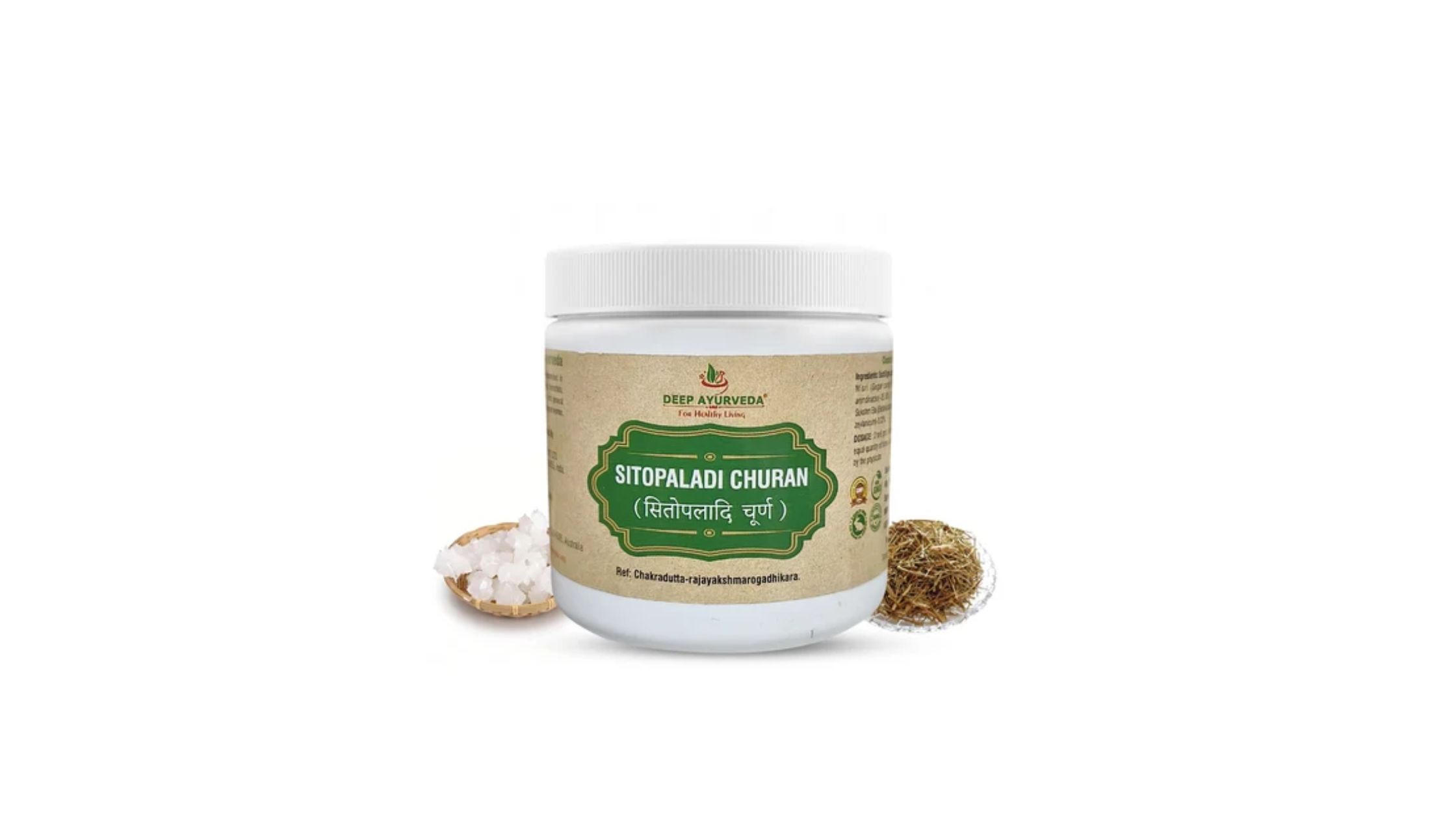
Sitopaladi Churna is a classical Ayurvedic powdered formulation traditionally used in the management of respiratory and throat-related discomfort and, in certain Ayurvedic contexts, digestive complaints. It is prepared from five principal ingredients—Sitopala (Mishri), Vanshlochan, Pippali, Ela and Twak (Cinnamon)—traditionally combined in a specific proportion.
Unlike the way many modern product pages describe it as simply a cough remedy, Ayurveda looks at a formulation such as Sitopaladi Churna in relation to the nature of the symptoms, dosha involvement, digestive status (Agni), and the anupana (vehicle) used with it.
This guide explains what Sitopaladi Churna is, its ingredients and traditional Ayurvedic properties, commonly discussed benefits and uses, how dosage is approached, the role of honey or other anupana, precautions, and what modern evidence currently tells us.
What Is Sitopaladi Churna?
Sitopaladi Churna is a polyherbal Ayurvedic powder (churna) traditionally prepared using five ingredients:
- Sitopala / Mishri (rock sugar)
- Vanshlochan
- Pippali (long pepper)
- Ela (cardamom)
- Twak (cinnamon)
The classical composition is commonly described in the proportion of 16:8:4:2:1, respectively. This means Sitopala forms the largest proportion of the formulation, followed by Vanshlochan, Pippali, Ela and Twak.
This composition is important because Sitopaladi Churna should not be understood simply as a mixture of five independent herbs. The formulation has a particular taste profile, potency and Ayurvedic therapeutic rationale resulting from the combination and proportions of its ingredients.
Traditionally, it is associated particularly with Kasa (cough), Shwasa-related respiratory complaints, throat discomfort and certain digestive or appetite-related complaints.
Modern sources, however, point out that high-quality human clinical research specifically establishing the effectiveness of Sitopaladi Churna remains limited. Therefore, traditional Ayurvedic indications and modern clinical evidence should be presented separately.
Sitopaladi Churna Ingredients
The five main ingredients of Sitopaladi Churna are:
| Ayurvedic Name | Common Name | Traditional Role in the Formulation |
|---|---|---|
| Sitopala | Mishri / Rock Sugar | Sweet base of the formulation |
| Vanshlochan | Bamboo manna | Traditionally used in respiratory formulations |
| Pippali | Long Pepper | Traditionally associated with Agni and respiratory support |
| Ela | Cardamom | Aromatic and digestive component |
| Twak | Cinnamon | Aromatic, warming spice |
The ingredients and their classical proportions are repeatedly described in Ayurvedic references and current Indian health resources.
1. Sitopala (Mishri)
Sitopala, commonly represented by rock sugar or Mishri, forms the largest proportion of the classical formulation.
Its sweet character contributes to the palatability of Sitopaladi Churna and forms an important part of the formulation’s traditional identity.
However, this ingredient also creates an important modern safety consideration: Sitopaladi Churna is not a sugar-free herbal powder.
People with diabetes, prediabetes or those following a sugar-restricted diet should therefore not assume that the formulation is automatically suitable simply because it is Ayurvedic.
2. Vanshlochan
Vanshlochan, traditionally described as bamboo manna, is another principal component of Sitopaladi Churna.
It is traditionally included in formulations associated with the respiratory tract and throat.
3. Pippali (Long Pepper)
Pippali is one of the most important herbs from an Ayurvedic formulation perspective.
It is traditionally valued for its Deepana and Pachana properties and is commonly incorporated into formulations where digestive function and respiratory symptoms are considered together.
Pippali also gives Sitopaladi Churna part of its characteristic pungent profile.
4. Ela (Cardamom)
Ela, or cardamom, contributes an aromatic quality to the formulation.
In Ayurveda, cardamom is traditionally used in digestive and respiratory formulations and is valued for its pleasant aroma and digestive properties.
5. Twak (Cinnamon)
Twak refers to cinnamon and is the smallest component by the commonly described classical proportion.
Its aromatic and warming qualities complement Pippali and Ela, contributing to the overall character of the formulation.
Sitopaladi Churna Ratio: Why 16:8:4:2:1 Matters
One of the most overlooked aspects of Sitopaladi Churna is its classical ingredient proportion.
The commonly described ratio is:
Sitopala : Vanshlochan : Pippali : Ela : Twak
16 : 8 : 4 : 2 : 1
In a traditional formulation, proportions matter because changing the relative amount of an ingredient can change the overall taste, potency and characteristics of the preparation.
This is also why consumers should not assume that every commercially available product has identical composition or dosage instructions. Always check the product label and manufacturer’s information.
How Does Sitopaladi Churna Work According to Ayurveda?
To understand Sitopaladi Churna properly, it helps to look beyond the word benefits.
Ayurveda traditionally evaluates a formulation through concepts such as:
- Rasa – taste
- Guna – qualities
- Virya – potency
- Vipaka – post-digestive effect
- Dosha – Vata, Pitta and Kapha
- Agni – digestive and metabolic capacity
- Anupana – the substance taken along with the formulation
This approach means that two people with the same symptom may not necessarily receive the same Ayurvedic recommendation.
For example, a cough associated with marked dryness may be approached differently from a cough accompanied by excessive mucus. Likewise, a person with poor digestion may be assessed differently from someone with strong digestion and predominant throat irritation.
Therefore, saying simply that Sitopaladi Churna is good for cough does not fully represent the Ayurvedic approach.
Sitopaladi Churna Benefits and Traditional Uses
Sitopaladi Churna is traditionally associated primarily with respiratory and throat-related complaints, although classical Ayurvedic descriptions also include digestive and appetite-related contexts.
1. Traditionally Used for Cough-Related Discomfort
Kasa, the Ayurvedic concept broadly associated with cough, is one of the best-known traditional contexts for Sitopaladi Churna.
Its combination of Pippali, Ela, Twak and Vanshlochan is traditionally considered suitable for respiratory formulations.
However, the type and cause of cough matter.
A short-lived seasonal cough is not the same as a cough caused by asthma, pneumonia, tuberculosis, chronic lung disease or another underlying condition.
For this reason, persistent or severe cough should be medically evaluated rather than managed indefinitely with a traditional formulation.
2. May Support Throat Comfort
Sitopaladi Churna is traditionally used when cough is accompanied by throat irritation or discomfort.
Its aromatic ingredients and sweet base make the formulation relatively palatable and explain why it is often traditionally administered with an appropriate anupana.
This should be understood as traditional symptomatic support, not proof that the formulation treats the underlying cause of throat inflammation.
3. Traditionally Used During Seasonal Respiratory Discomfort
Many Ayurvedic and Indian health resources describe Sitopaladi Churna in relation to seasonal cough and cold symptoms.
From a modern medical perspective, however, the cause of respiratory symptoms can vary considerably. A viral upper-respiratory infection, allergy, asthma or bacterial infection may require very different management.
Sitopaladi Churna should therefore not be presented as a substitute for diagnosis or appropriate medical treatment.
4. Traditionally Associated With Appetite and Digestion
The formulation also contains Pippali, Ela and Twak—ingredients traditionally valued in Ayurveda for their digestive properties.
Classical Ayurvedic descriptions include contexts such as Arochaka (reduced interest in food/taste) and Mandagni (reduced digestive capacity).
Some modern health pages also describe Sitopaladi Churna as traditionally used to support appetite and digestion.
However, persistent indigestion, abdominal pain, unexplained weight loss or recurrent digestive symptoms should not be self-treated indefinitely.
Sitopaladi Churna for Cough: What Ayurveda Says
This is one of the most searched questions about Sitopaladi Churna, but it deserves a more nuanced answer.
Ayurveda does not classify every cough in exactly the same way. The presentation may be assessed according to factors such as:
- dryness or mucus
- throat irritation
- heaviness
- appetite and digestion
- associated fever
- breathing difficulty
- dosha involvement
- duration of symptoms
Therefore, the word cough alone is not enough to determine whether Sitopaladi Churna is appropriate.
It is traditionally associated with Kasa, but modern medical evaluation becomes particularly important when coughing is persistent, recurrent, severe or accompanied by warning signs.
When should a cough not be self-managed?
Seek medical evaluation if cough is associated with:
- difficulty breathing
- chest pain
- coughing blood
- persistent or high fever
- significant wheezing
- unexplained weight loss
- severe weakness
- worsening symptoms
- prolonged or recurrent cough
A traditional Ayurvedic formulation can be considered complementary in appropriate circumstances, but it should not delay diagnosis of a potentially serious respiratory condition.
Sitopaladi Churna for Sore Throat and Seasonal Discomfort
Because of its sweet and aromatic ingredients, Sitopaladi Churna is traditionally taken in some settings when throat irritation accompanies cough or seasonal respiratory discomfort.
The important distinction is:
Traditional soothing use is not the same as treating an infection.
For example, severe sore throat with high fever, difficulty swallowing, breathing difficulty or significant swelling requires appropriate medical assessment.
How to Take Sitopaladi Churna
The appropriate method depends on the individual, formulation, symptoms and advice of the Ayurvedic practitioner.
Traditionally, Sitopaladi Churna may be administered with an anupana, such as honey or ghee, depending on the therapeutic context. Some modern product instructions also recommend water.
Sitopaladi Churna With Honey
Honey is a commonly mentioned anupana for Sitopaladi Churna, particularly in traditional cough-related use.
However:
- honey adds additional sugar
- people with diabetes need to consider the total sugar load
- honey should never be given to infants below 12 months of age because of the risk of infant botulism
The suitability of honey also depends on the individual situation.
Sitopaladi Churna With Ghee
Ghee is another traditionally used anupana in Ayurvedic practice.
Its use may be considered differently depending on the nature of the symptoms and the individual’s digestive capacity.
Do not assume that every person should automatically combine Sitopaladi Churna with ghee.
Sitopaladi Churna With Warm Water
Some products and modern guidance recommend taking the powder with lukewarm water.
This can be a practical option for people who do not wish to use honey, although the appropriate method should follow the product label or practitioner’s recommendation.
Sitopaladi Churna Dosage
There is no single universal dose that should be applied to every person.
Published Indian sources give different dosage recommendations—for example, some commonly describe around 1–2 g once or twice daily, while other commercial products provide different instructions.
This variation is precisely why dosage should not be copied from a random website or from another person’s prescription.
Factors that can affect dosage include:
- age
- body constitution
- digestive capacity
- nature and severity of symptoms
- other medicines
- existing health conditions
- product formulation
- duration of use
- anupana
For adults: Follow the dosage printed on the specific product label or the dose recommended by a qualified Ayurvedic practitioner.
For children: Do not self-prescribe Sitopaladi Churna. Children require age-appropriate professional guidance.
For long-term use: Discuss continued use with an Ayurvedic physician, particularly because of the formulation’s sugar content.
Can Sitopaladi Churna Be Taken Daily?
This is a common question, but daily does not automatically mean safe for everyone.
Some Ayurvedic practitioners may recommend a formulation for a specific period depending on the patient’s condition. However, taking Sitopaladi Churna continuously without assessing the reason for use is not a good approach.
The sugar content is particularly relevant for people with:
- diabetes
- prediabetes
- insulin resistance
- sugar-restricted diets
If symptoms continue for several days or repeatedly return, the more important question is often why the symptom is recurring, rather than simply increasing the duration of self-medication.
Sitopaladi Churna and Diabetes
This deserves special attention.
Because Sitopala/Mishri is the largest component of the traditional formulation, Sitopaladi Churna should not be considered a sugar-free herbal medicine. Current health sources specifically caution people with diabetes about its sugar content.
People with diabetes or prediabetes should discuss its use with their healthcare professional or qualified Ayurvedic physician before taking it regularly.
Adding honey can further increase the overall sugar intake.
This is one reason why the popular instruction take it with honey for cough should not be treated as a universal recommendation.
Sitopaladi Churna Side Effects
Ayurvedic products are not automatically risk-free simply because they are derived from traditional ingredients.
Possible problems may include:
- digestive discomfort
- acidity or heartburn in sensitive individuals
- mouth or throat irritation
- allergic reactions
- excessive sugar intake
- problems related to poor-quality or contaminated products
Current medical guidance also highlights the importance of product quality and potential interactions when herbal formulations are used alongside prescription medicines.
If you experience an unusual or significant reaction after taking Sitopaladi Churna, stop using it and seek appropriate medical advice.
Who Should Use Sitopaladi Churna With Caution?
Extra caution is appropriate for:
People with Diabetes or Prediabetes
Because of the sugar content, professional advice is recommended.
Pregnant or Breastfeeding Women
Safety information is not sufficient to recommend unsupervised use. Discuss any Ayurvedic formulation with your healthcare professional.
Children
Do not use adult dosage for children. Pediatric use should be guided by an appropriately qualified professional.
People Taking Prescription Medicines
If you regularly use medicines—particularly for diabetes, blood pressure, blood clotting or other chronic conditions—discuss herbal formulations with your doctor or pharmacist.
People With Liver or Kidney Disease
Chronic medical conditions can alter how medicines and supplements should be used. Professional guidance is advisable.
People With Persistent Respiratory Symptoms
If cough or breathing problems continue or worsen, investigate the underlying cause rather than relying only on symptomatic remedies.
Sitopaladi Churna and Modern Scientific Evidence
This is where responsible Ayurvedic content needs to be different from promotional content.
Traditional Ayurvedic use provides an important historical and clinical framework, but it should not automatically be described as modern clinical proof.
Current medical reviews note that high-quality clinical research specifically evaluating Sitopaladi Churna remains limited. Therefore, claims that it definitively cures cough, asthma, bronchitis, pneumonia or respiratory infections go beyond what current evidence can establish.
Research has examined aspects of the formulation and individual ingredients, including laboratory or pharmacological properties, but laboratory findings should not be interpreted as proof of effectiveness in humans.
In simple terms:
Traditional evidence:
Sitopaladi Churna has a long-standing place in Ayurvedic practice, particularly in respiratory and digestive contexts.
Modern clinical evidence:
More well-designed human studies are needed to establish its effectiveness, optimal dose, long-term safety and use for specific medical conditions.
This distinction allows readers to appreciate Ayurveda without making unsupported medical promises.
Is Sitopaladi Churna a Treatment for Asthma, Bronchitis or Pneumonia?
It should not be presented as a replacement treatment for these conditions.
Asthma, bronchitis, pneumonia and other respiratory diseases can have different causes and may require diagnosis, monitoring and specific treatment.
If someone has wheezing, breathlessness, chest pain, persistent fever, low oxygen levels or other serious symptoms, medical assessment should take priority.
Sitopaladi Churna may have a traditional supportive role in selected Ayurvedic contexts, but that is different from claiming that it cures a diagnosed respiratory disease.
How to Choose a Good Sitopaladi Churna
If you decide to purchase Sitopaladi Churna, look beyond the front-of-pack claims.
Check:
- complete ingredient information
- manufacturer details
- batch number
- manufacturing and expiry information
- storage instructions
- applicable licensing information
- quality/testing information where available
- intact packaging
- clear dosage instructions
Prefer products from established manufacturers that provide transparent information.
Avoid products making unrealistic claims such as 100% cure, permanent cure, or works for every type of cough.
Quality is particularly important for traditional herbal products because contamination or adulteration can create avoidable risks.
Sitopaladi Churna vs Talishadi Churna
Sitopaladi Churna and Talishadi Churna are both Ayurvedic powdered formulations associated with respiratory and digestive contexts, but they are not interchangeable formulations.
Their ingredients, proportions, traditional indications and therapeutic rationale differ.
Therefore, choosing between them simply because both are described online as cough powders oversimplifies Ayurvedic practice.
The appropriate formulation depends on the symptom pattern and individual assessment.
What Makes Sitopaladi Churna Different From a Generic Herbal Cough Powder?
The main difference is its classical formulation structure.
Sitopaladi Churna is not simply five herbs mixed together. The formulation has:
- a defined ingredient sequence
- traditionally described proportions
- a particular rasa profile
- specific Ayurvedic properties
- a traditional relationship with Kasa and respiratory complaints
- a role for anupana
- an important relationship with Agni and dosha assessment
This formulation-based perspective is often missing from consumer-focused articles.
When Should You See a Doctor?
Do not rely on Sitopaladi Churna alone if you experience:
- difficulty breathing
- chest pain
- coughing blood
- severe or persistent fever
- blue lips or significant oxygen-related symptoms
- severe wheezing
- rapidly worsening symptoms
- persistent cough without an obvious cause
- unexplained weight loss
- recurrent respiratory symptoms
These symptoms may indicate a condition requiring medical diagnosis and treatment.
Final Ayurvedic Perspective
Sitopaladi Churna is a classical Ayurvedic formulation traditionally used for Kasa (cough), throat discomfort and certain respiratory complaints, with its ingredients also supporting traditional approaches to digestion and appetite. Its suitability depends on the nature of symptoms, dosha involvement, Agni and appropriate anupana.
Because it contains Mishri, people with diabetes or those limiting sugar should use it cautiously. Traditional use should also be distinguished from modern clinical evidence, which remains limited. For persistent or severe symptoms, consult a qualified Ayurvedic practitioner or healthcare professional.
Frequently Asked Questions About Sitopaladi Churna
Can Sitopaladi Churna be taken with honey?
Honey is a traditionally used anupana for Sitopaladi Churna, particularly in cough-related contexts. However, honey adds sugar and should not be given to children below one year of age.
Can people with diabetes take Sitopaladi Churna?
Caution is advised because Sitopala/Mishri is a major component of the formulation and contributes significant sugar. People with diabetes or prediabetes should consult a healthcare professional before use.
Can children take Sitopaladi Churna?
Children should not be given an adult dose without professional guidance. Consult a qualified Ayurvedic practitioner or pediatric healthcare professional for age-appropriate advice.
Can Sitopaladi Churna be taken every day?
It may be recommended for a particular duration depending on the individual and reason for use, but long-term unsupervised use is not advisable. People with diabetes or chronic health conditions should be particularly cautious.
Does Sitopaladi Churna cure asthma?
There is not sufficient high-quality clinical evidence to describe Sitopaladi Churna as a cure for asthma. Asthma requires appropriate diagnosis and management.