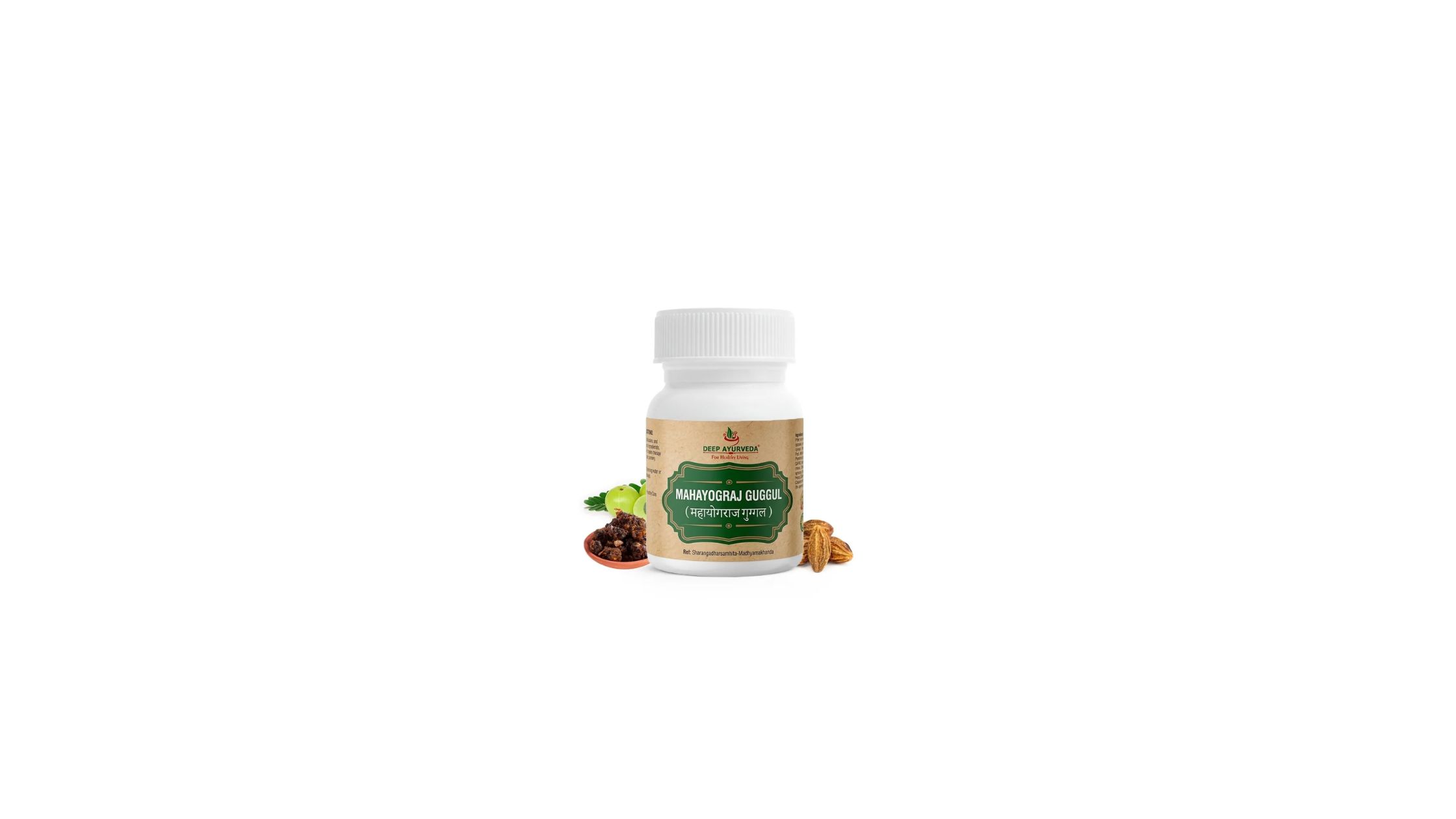
Mahayograj Guggul, also written as Mahayograj Guggulu or Mahayogaraja Guggulu, is a classical Ayurvedic formulation traditionally used in conditions associated with Vata imbalance, particularly those involving the joints, muscles, bones and nerves. Unlike a single-herb supplement, Mahayograj Guggul is a complex formulation containing numerous herbal ingredients along with Guggulu and, depending on the classical formulation or commercial preparation, mineral and bhasma ingredients.
In Ayurveda, its use is not determined simply by asking, Where does it hurt? An Ayurvedic assessment may also consider Vata, Agni, Ama, Prakriti, age, strength, digestion and the nature of the symptoms before selecting a formulation.
This guide explains what Mahayograj Guggul is, its traditional Ayurvedic uses and benefits, ingredients, dosage considerations, how it is taken, precautions, formulation differences and what modern research tells us.
Important: Mahayograj Guggul is not a one-size-fits-all medicine. Different products can vary in composition and strength. Follow the directions of the specific product and seek qualified professional advice, particularly when using a formulation containing mineral or bhasma ingredients.
What Is Mahayograj Guggul?
Mahayograj Guggul is a classical Ayurvedic herbo-mineral formulation described in Ayurvedic literature, including the Sharangadhara Samhita, Madhyama Khanda 7/56–69. A formulation described under this name contains a combination of digestive and aromatic herbs, Triphala, Guggulu and several bhasma/mineral ingredients.
The name itself provides an interesting clue:
- Maha – great or extensive
- Yog(a) – formulation or therapeutic combination
- Raja – traditionally conveying a prominent or principal formulation
- Guggulu – referring to Guggulu, the resin-based component
Rather than relying on one herb for one symptom, Ayurveda traditionally uses such multi-ingredient formulations to address a broader pattern of imbalance.
Mahayograj Guggul is particularly associated with Vata-oriented Ayurvedic management, including traditional applications involving stiffness, discomfort and impaired movement.
However, it is important to understand that Mahayograj Guggul is a formulation, not a single standardized chemical substance. The exact composition should always be checked on the label of the particular product being purchased.
Mahayograj Guggul Benefits
The traditional benefits of Mahayograj Guggul are best understood through Ayurvedic principles rather than by presenting it as a universal treatment for a modern disease.
1. Traditionally supports joint comfort and mobility
Mahayograj Guggul is traditionally used in Ayurvedic practice for Vata-associated musculoskeletal complaints, particularly where discomfort, stiffness and restricted movement are prominent.
From an Ayurvedic perspective, aggravated Vata can be associated with qualities such as dryness, lightness, roughness and mobility. When these qualities become excessive, discomfort and stiffness may be experienced in the musculoskeletal system.
Therefore, the traditional use of Mahayograj Guggul is often discussed in relation to maintaining joint comfort, flexibility and normal movement.
This should not be interpreted as evidence that the formulation cures arthritis or every cause of joint pain.
2. Traditionally used for Vata-related musculoskeletal concerns
Vata plays an important role in Ayurveda in relation to movement and the nervous and musculoskeletal systems.
Mahayograj Guggul is traditionally associated with Vata-dominant conditions, especially when symptoms include:
- stiffness
- discomfort
- reduced mobility
- dryness
- a feeling of weakness
- chronic musculoskeletal complaints
The Ayurvedic approach, however, is individualized. Two people with the same modern diagnosis may not necessarily receive the same Ayurvedic formulation.
3. Supports comfortable movement and flexibility
Healthy movement depends on more than the absence of pain. Joint mobility, muscle function, flexibility and overall physical strength all contribute to comfortable movement.
The traditional Ayurvedic use of Mahayograj Guggul includes conditions in which stiffness and restricted movement are part of the symptom pattern.
For people seeking Ayurvedic support for mobility, the formulation is therefore traditionally considered in the broader context of Vata management.
4. Traditionally supports muscles, bones and joints
Classical and contemporary Ayurvedic literature discusses Mahayograj Guggulu in relation to musculoskeletal conditions. A recent review discussing its classical formulation describes its traditional relevance to Asthi, Sandhi and Majja, corresponding broadly to the Ayurvedic concepts of bone, joints and marrow/nervous tissue.
It is important not to convert these traditional concepts directly into modern medical claims.
For example, saying that a formulation is traditionally associated with Asthi and Sandhi does not mean that modern clinical research has established that it repairs cartilage or reverses arthritis.
5. Traditionally supports Agni and digestion
One of the less discussed features of Mahayograj Guggul is its combination of pungent and digestive herbs.
The formulation includes ingredients such as Shunthi, Pippali, Chavya, Chitraka, Hingu, Ajamoda and Jeeraka, which are traditionally used in Ayurveda in digestive formulations.
This is relevant because Ayurveda does not always separate digestion from musculoskeletal health.
An Ayurvedic practitioner may consider Agni, or digestive/metabolic capacity, when assessing a person with chronic musculoskeletal complaints.
How Does Mahayograj Guggul Work According to Ayurveda?
This is where Mahayograj Guggul becomes more interesting than a simple joint supplement.
Ayurveda looks at health through a network of Dosha, Agni, Ama, Srotas and Dhatu rather than examining an isolated symptom alone.
Vata and movement
Vata is traditionally associated with movement, communication and neurological functions.
When Vata becomes aggravated, Ayurveda describes symptoms that may include dryness, stiffness, variable discomfort and impaired movement.
Mahayograj Guggul is traditionally used in Vata-oriented formulations because of the collective properties of its ingredients.
Agni and digestion
Agni refers broadly to the digestive and metabolic processes described in Ayurveda.
When Agni is considered weak or impaired, Ayurveda may describe incomplete digestion and the formation of Ama.
Ama and stiffness
Ama is an Ayurvedic concept describing incompletely processed metabolic material associated with impaired digestion and metabolism.
In Ayurvedic assessment, symptoms such as heaviness, stiffness, coating on the tongue, poor appetite and digestive discomfort may be considered when evaluating an Ama-associated condition.
This is an Ayurvedic framework, not a modern biochemical definition of a toxin.
Srotas and tissue nourishment
Ayurveda also considers Srotas, the body’s channels or pathways, and Dhatu, the tissues.
This is why an Ayurvedic practitioner may consider digestion, circulation, tissue nourishment and Dosha balance rather than focusing only on the painful joint.
Mahayograj Guggul Uses in Ayurveda
Traditionally, Mahayograj Guggul is discussed in connection with a range of Vata-related and musculoskeletal presentations.
Depending on the formulation and individual assessment, traditional Ayurvedic applications may include:
- joint stiffness and discomfort
- restricted movement
- Vata-associated musculoskeletal complaints
- muscle and neuromuscular complaints
- conditions involving the joints, bones and supporting tissues
- selected chronic Vata-dominant presentations
Classical references and Ayurvedic literature also describe Mahayogaraja Guggulu in contexts beyond modern joint health terminology. For this reason, reducing the formulation to an arthritis tablet does not accurately represent its traditional Ayurvedic scope.
A useful Ayurvedic distinction
A modern diagnosis such as arthritis does not automatically tell an Ayurvedic practitioner which formulation is appropriate.
The practitioner may additionally assess:
Vata or other Dosha involvement + Agni + Ama + Prakriti + age + strength + duration + symptom pattern
That is one reason traditional Ayurvedic medicine is often individualized.
Mahayograj Guggul Ingredients
Mahayograj Guggul contains a complex combination of herbs and, in classical herbo-mineral formulations, mineral/bhasma ingredients.
A classical ingredient listing includes herbs such as:
- Shunthi
- Pippali
- Chavya
- Pippali Moola
- Chitraka
- Hingu
- Ajamoda
- Sarshapa
- Shweta Jeeraka
- Krishna Jeeraka
- Renuka
- Indrayava
- Patha
- Vidanga
- Gajapippali
- Katuki
- Ativisha
- Bharangi
- Vacha
- Murva
- Haritaki
- Bibhitaki
- Amalaki
- Guggulu
The formulation described in Ayurvedic literature also includes mineral/bhasma components such as Vanga Bhasma, Roupya Bhasma, Naga Bhasma, Loha Bhasma, Abhraka Bhasma, Mandura Bhasma and Rasa Sindura.
Why are so many ingredients used?
The purpose of a classical Ayurvedic formulation is not necessarily to make every ingredient perform the same job.
Different ingredients can contribute different traditional properties and roles.
For example:
- Shunthi and Pippali are traditionally associated with Deepana and Pachana.
- Chitraka is traditionally considered an Agni-supporting herb.
- Triphala provides a combination of Haritaki, Bibhitaki and Amalaki.
- Guggulu is the central resin component of the formulation.
- Other ingredients contribute their own traditional Ayurvedic properties.
This multi-ingredient approach is one of the defining features of classical Ayurvedic formulations.
Does Every Mahayograj Guggul Have the Same Ingredients?
No. This is an important point for consumers.
The term Mahayograj Guggul refers to a classical formulation, but commercial products can differ in their exact composition, dosage strength, processing and presentation.
Published research has examined a particular Mahayograj Guggulu preparation, while contemporary Ayurvedic products may have their own declared composition and manufacturing specifications.
Therefore, never assume that:
one brand’s ingredient list = every Mahayograj Guggul product.
Before purchasing, check:
- Complete ingredient list
- Quantity per tablet
- Recommended dosage
- Manufacturer information
- Batch number
- Manufacturing and expiry dates
- Product-specific precautions
- Quality/testing information where available
This becomes especially important when a formulation contains bhasma or mineral ingredients.
Mahayograj Guggul Dosage
There is no single dosage that should automatically be applied to every Mahayograj Guggul product.
Classical references and commercial products can specify different doses depending on the formulation and preparation. One Ayurvedic reference lists Mahayogaraj Guggulu at ½–1 g, while product-specific directions can differ.
The appropriate dosage may depend on factors such as:
- formulation and tablet strength
- age
- digestive capacity
- individual constitution
- symptom pattern
- duration of the complaint
- other medicines being used
- overall health and strength
For this reason, consumers should follow the specific product label or advice from a qualified Ayurvedic practitioner rather than copying a dosage from another brand’s website.
How to Take Mahayograj Guggul
The method of administration can also differ between formulations.
Depending on the product and individual recommendation, an Ayurvedic practitioner may specify an appropriate Anupana, meaning the substance taken along with a medicine to support its administration and traditional therapeutic context.
Commonly discussed vehicles in Ayurvedic practice may include water, milk or other suitable Anupana, but this does not mean every person should take Mahayograj Guggul with the same vehicle.
Therefore:
Follow the directions supplied with your specific product or the recommendation of your Ayurvedic practitioner.
Avoid changing the dose or Anupana simply because another website recommends it.
Mahayograj Guggul for Joint Health
Mahayograj Guggul is frequently searched for in relation to joint discomfort and stiffness.
From a traditional Ayurvedic perspective, joint symptoms are considered in relation to Sandhi, Vata, tissue condition, digestion and the presence or absence of Ama.
For example, a person with chronic stiffness and dryness may present a different Ayurvedic picture from someone experiencing an acute swollen joint with signs of inflammation.
Therefore, the same formulation should not automatically be considered appropriate for every type of joint complaint.
What this means practically
If joint discomfort is persistent, severe, associated with significant swelling, fever, injury, deformity or loss of function, the underlying cause should be assessed by an appropriate healthcare professional rather than relying only on a supplement.
Mahayograj Guggul for Arthritis
Mahayograj Guggul is traditionally associated with several Vata-related musculoskeletal conditions, which is why it is often marketed in relation to arthritis and joint health.
However, arthritis is not one single condition.
Osteoarthritis, rheumatoid arthritis, gout and other inflammatory or autoimmune joint conditions have different causes and management approaches.
From an Ayurvedic perspective, the formulation would traditionally be selected according to the individual’s Dosha, Agni, Ama status and clinical presentation rather than simply because the person has been given the label arthritis.
Therefore, it is more accurate to describe Mahayograj Guggul as traditionally used in selected Vata-oriented musculoskeletal conditions rather than claiming that it cures arthritis.
Mahayograj Guggul Side Effects and Precautions
Mahayograj Guggul deserves more careful discussion than an ordinary herbal supplement because classical preparations can contain herbal as well as mineral/bhasma ingredients.
A published safety study investigated a specific Mahayograj Guggulu batch manufactured by Shree Baidyanath Ayurved Bhawan. The researchers measured heavy metals and conducted a 120-day toxicity study in rats. At the tested therapeutic-equivalent dose, they did not observe major organ toxicity, although the study also reported measurable lead, mercury and arsenic in the tested preparation.
Importantly, this was:
- one particular preparation/batch,
- an animal study,
- not a clinical trial proving safety for every Mahayograj Guggul product.
Another published investigation of traditional Indian medicines reported substantial variation in heavy-metal content among products and specifically identified a Mahayograj Guggulu sample with high measured metal content.
These findings are a strong reason to pay attention to product quality, manufacturing standards and professional guidance rather than assuming that every product sold under the same name is identical.
Who Should Consult a Healthcare Professional Before Taking Mahayograj Guggul?
Professional guidance is particularly appropriate for:
- pregnant or breastfeeding women
- children
- older adults taking multiple medicines
- people with chronic medical conditions
- people taking prescription medicines
- people with liver or kidney concerns
- people considering long-term use
- anyone unsure about the formulation or dosage
If the product contains mineral or bhasma ingredients, do not substitute a generic internet dosage for product-specific or practitioner guidance.
Mahayograj Guggul and Heavy Metals: What Should You Know?
This is one area where transparency is more useful than simply saying that an Ayurvedic product is 100% safe.
Some classical Mahayograj Guggulu formulations include mineral/bhasma ingredients. CCRAS has specifically included Mahayograj Guggul among the metal- and mineral-based Ayurvedic formulations for quality and safety work.
A 2010 study measured lead, mercury and arsenic in one Mahayograj Guggulu preparation and also evaluated its toxicity in rats. The authors concluded that the tested preparation was generally well tolerated under the study conditions, while also discussing the complexity of interpreting heavy-metal measurements in processed herbo-mineral preparations.
At the same time, other research has reported concerns about the bioaccessibility of lead and arsenic in certain traditional medicines, including a Mahayograj Guggulu sample.
What should a consumer take from this?
Not that all Mahayograj Guggul is dangerous.
And not that all Mahayograj Guggul is automatically safe.
The practical lesson is:
The exact formulation, manufacturing process, quality control and product source matter.
Mahayograj Guggul vs Yograj Guggul
Although their names are similar, Mahayograj Guggul and Yograj Guggul are different Ayurvedic formulations.
They should not be treated as interchangeable products simply because both contain Guggulu and are traditionally associated with Vata-related conditions.
| Feature | Mahayograj Guggul | Yograj Guggul |
|---|---|---|
| Formulation | Distinct classical formulation | Distinct classical formulation |
| Guggulu | Present | Present |
| Herbal composition | Complex and formulation-specific | Different formulation |
| Mineral/bhasma ingredients | Present in classical formulations | Depends on the specific preparation |
| Traditional context | Vata-oriented and musculoskeletal applications | Vata-oriented applications |
| Selection | Depends on individual presentation | Depends on individual presentation |
Always compare the actual ingredient labels, rather than choosing based only on the name.
Mahayograj Guggul vs Swarna Mahayograj Guggul
Swarna Mahayograj Guggul should also not simply be described as a stronger version of ordinary Mahayograj Guggul.
The important difference is the presence of Swarna/gold-containing material in formulations marketed as Swarna Mahayograj Guggul.
Because mineral and bhasma ingredients require formulation-specific quality control, consumers should look at the complete ingredient list and manufacturer information before choosing between products.
The decision should be based on the individual’s needs and professional advice—not on the assumption that a formulation containing more ingredients is automatically better.
How Long Does Mahayograj Guggul Take to Work?
There is no scientifically established universal timeframe in which Mahayograj Guggul should produce a particular result.
The experience can vary according to:
- the underlying condition
- duration of symptoms
- individual constitution
- formulation and dose
- diet and lifestyle
- digestive capacity
- concurrent treatment
Avoid products or articles promising that Mahayograj Guggul will produce guaranteed results within a fixed number of days.
If symptoms persist or worsen, the underlying condition should be reassessed rather than simply increasing the dosage.
How to Choose a Quality Mahayograj Guggul
When purchasing Mahayograj Guggul in India, don’t choose only on the basis of price or the number of claimed benefits.
Look for:
1. A complete ingredient declaration
You should be able to identify what is actually present in the product.
2. Clear dosage instructions
The label should clearly state the quantity per tablet/capsule and recommended use.
3. Manufacturer information
Choose products from a manufacturer that provides clear product and manufacturing information.
4. Batch and expiry information
The package should provide traceable batch and expiry details.
5. Appropriate quality information
Where available, review information regarding testing and quality control.
6. Realistic claims
Be cautious of advertisements promising to permanently cure arthritis, sciatica, nerve disorders or multiple unrelated diseases.
A trustworthy Ayurvedic product page should explain what the formulation traditionally does and where professional guidance is appropriate, rather than promising a cure for every condition.
What Does Modern Research Say About Mahayograj Guggul?
Modern research on Mahayograj Guggulu includes formulation analysis and safety investigations, but this evidence should be interpreted carefully.
A 2010 study published in the International Journal of Ayurveda Research evaluated a specific Mahayograj Guggulu preparation for heavy-metal content and chronic toxicity in rats. The researchers found no major toxicity at the tested therapeutic-equivalent dose over the study period, while also reporting measurable heavy metals in the tested sample.
This is useful safety information, but it does not establish that every Mahayograj Guggul product has the same composition or safety profile.
Similarly, evidence describing traditional Ayurvedic use should not automatically be interpreted as modern clinical proof that the formulation treats or cures a particular disease.
The evidence in simple terms
Traditional Ayurvedic evidence:
Mahayograj Guggulu has a documented place in classical Ayurvedic formulation literature.
Formulation evidence:
Published literature describes a complex herbo-mineral composition.
Safety research:
Specific preparations have been investigated in laboratory and animal studies.
Clinical evidence:
The available evidence should not be overstated as proof that every commercial formulation treats specific diseases.
This distinction helps readers make more informed decisions.
Frequently Asked Questions About Mahayograj Guggul
What is Mahayograj Guggul used for?
Mahayograj Guggul is traditionally used in Ayurveda for selected Vata-related conditions, particularly those involving the musculoskeletal system. Traditional applications can include stiffness, discomfort and restricted movement. Its suitability depends on the individual’s Ayurvedic assessment and the specific formulation.
What are the main benefits of Mahayograj Guggul?
Its traditional benefits are mainly discussed in relation to Vata-oriented musculoskeletal health, joint comfort, mobility and support for digestion and Agni. These are traditional Ayurvedic uses and should not be presented as proof that the formulation cures a specific disease.
What are the ingredients of Mahayograj Guggul?
Classical formulations contain Guggulu along with numerous herbs such as Shunthi, Pippali, Chavya, Chitraka, Triphala and other Ayurvedic ingredients. Some classical formulations also contain bhasma/mineral ingredients. Exact composition can vary by product.
What is the dosage of Mahayograj Guggul?
Dosage depends on the specific formulation, tablet strength and individual requirements. Classical references and commercial products can provide different directions. Follow the label of the product you are using or the recommendation of a qualified Ayurvedic practitioner.
Can Mahayograj Guggul be taken every day?
Daily use should not automatically be assumed to be appropriate for everyone. The suitability of continued use depends on the formulation, dosage, individual health status and reason for use. Professional guidance is particularly important for long-term use of herbo-mineral formulations.
Is Mahayograj Guggul safe?
Safety depends on the specific formulation, manufacturing quality, dosage and individual circumstances. Because some classical preparations contain mineral/bhasma ingredients, consumers should use a reputable product according to its directions and seek professional advice where appropriate.
Does Mahayograj Guggul contain metals?
Some classical Mahayograj Guggulu formulations contain mineral/bhasma ingredients, including preparations containing metals or mineral-derived substances. The exact composition depends on the formulation and product, so the ingredient label should always be checked.
Can Mahayograj Guggul be used for arthritis?
Mahayograj Guggul is traditionally associated with Vata-related musculoskeletal complaints, which is why it is often discussed in relation to arthritis. However, arthritis has different forms and causes, so it should not be presented as a universal treatment or cure.
What is the difference between Mahayograj Guggul and Yograj Guggul?
They are different Ayurvedic formulations with different ingredient profiles. Although both contain Guggulu and are traditionally associated with Vata-related conditions, they should not be considered interchangeable.
What is the difference between Mahayograj Guggul and Swarna Mahayograj Guggul?
Swarna Mahayograj Guggul refers to a formulation containing Swarna/gold-containing material in addition to the formulation’s other ingredients. Exact composition varies by manufacturer, so the product label should be checked rather than assuming that one is simply a stronger form of the other.
Final Words
Mahayograj Guggul is a classical Ayurvedic formulation traditionally used for Vata-related and musculoskeletal concerns, including joint stiffness, discomfort and restricted movement. Its complex formulation combines Guggulu with several herbs and, in some preparations, mineral or bhasma ingredients.
Because formulations and strengths can vary between manufacturers, always check the specific product label and follow appropriate dosage and usage guidance. For long-term use, pregnancy, breastfeeding, existing health conditions or concurrent medicines, professional advice is recommended.
In short, Mahayograj Guggul should be understood as a formulation selected according to individual Ayurvedic needs—not simply as a universal remedy for joint or muscle problems.